

Molecular diagnostics analyzes DNA, RNA, proteins, and biomarkers in tissues or body fluids to identify disease, assess prognosis, and guide treatment selection, as defined by the NCI Dictionary of Cancer Terms. For clinicians and trial teams, that definition has a direct practical consequence: the right assay, ordered correctly with the right specimen, can change a treatment decision within days.
Three clinical takeaways to keep in mind before reading further:
- Test families map to specific decisions. PCR-based assays answer targeted, time-sensitive questions (pathogen ID, known variant confirmation). Next-generation sequencing (NGS) answers broad profiling questions (unknown variants, tumor clonality, pharmacogenomic landscape). Choosing the wrong family delays results and can generate uninterpretable data.
- Lab accreditation and FDA status matter for clinical claims. CLIA certification is the legal floor for any U.S. clinical lab. CAP accreditation and FDA-cleared in vitro diagnostic (IVD) status add layers of validated performance data that support clinical and regulatory claims. When ordering for a trial, always confirm which standard the lab meets.
- Integrated diagnostics accelerates trial readiness. Combining molecular lab data with radiology and AI-driven quality checks in a single workflow, as Kohealth Labs does for CROs and pharma sponsors, reduces send-out delays and delivers analysis-ready data bundles that compress time from enrollment to first dosing decision.
What does molecular diagnostics actually cover?
The scope of molecular diagnostics extends well beyond a single gene test. At its core, the field studies four analyte classes: DNA (germline and somatic), RNA (messenger, non-coding, and viral), proteins (expressed biomarkers and receptor status), and circulating biomarkers such as cell-free DNA (cfDNA) and cell-free RNA (cfRNA). Each analyte class supports different clinical intents.
Clinical intents by analyte:
- Diagnostic: Confirming a suspected pathogen, germline mutation, or cancer subtype
- Prognostic: Estimating disease course or recurrence risk from tumor genomic signatures
- Predictive: Identifying variants that predict response or resistance to a specific therapy
- Monitoring: Tracking minimal residual disease (MRD) or treatment response over time
A short vocabulary reference that comes up repeatedly in clinical reports and lab conversations:
- IVD (in vitro diagnostic): An FDA-regulated test kit with cleared or approved performance claims
- LDT (laboratory-developed test): A test designed and validated internally by a single lab; subject to CLIA oversight but historically not FDA pre-market review (though FDA oversight is expanding)
- Analytic sensitivity vs. clinical sensitivity: Analytic sensitivity is the lowest concentration the assay can detect (limit of detection, or LOD). Clinical sensitivity is the proportion of true disease cases the test correctly identifies.
- VUS (variant of uncertain significance): A detected variant whose clinical impact is not yet established; a common source of clinical uncertainty in NGS reports
- cfDNA/cfRNA: Nucleic acids shed into blood from normal and diseased cells; the substrate for liquid biopsy assays
"Molecular diagnostics includes tests that study DNA, RNA, and proteins to diagnose disease, determine prognosis, and guide treatment — including biomarker tests, tumor sequencing, and liquid biopsies." — NCI Dictionary of Cancer Terms
The test families that follow from these analytes map cleanly to clinical goals. Infectious disease detection relies primarily on PCR and isothermal amplification. Tumor profiling uses targeted oncogene panels, comprehensive genomic profiling (CGP) by NGS, and liquid biopsy cfDNA assays. Inherited disease testing uses single-gene sequencing, multigene panels, and chromosomal microarray. Pharmacogenomics uses targeted SNP panels and, increasingly, broader NGS panels that cover drug-metabolizing enzyme genes simultaneously.
Which molecular techniques should you use and when?
PCR is the most common tool for rapid, targeted detection, while NGS is preferred for comprehensive genomic profiling when specific variants are unknown. The table below maps the major modalities to their practical parameters.
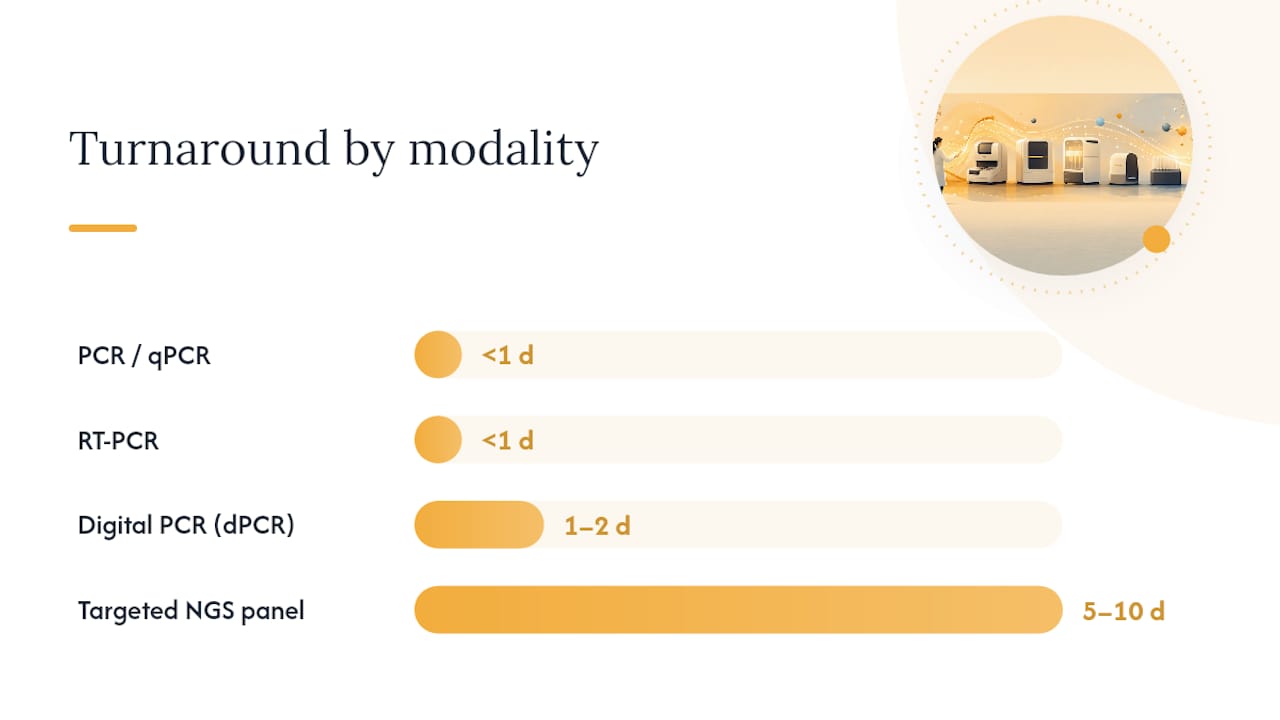
| Modality | Target | Breadth | Analytic Sensitivity | Typical Turnaround | Specimen | Common Indications |
|---|---|---|---|---|---|---|
| PCR / qPCR | Known sequence | Targeted (1–few targets) | High (LOD: copies/mL range) | Hours to 1 day | Swab, blood, tissue, urine | Pathogen ID, known mutation confirmation, viral load |
| RT-PCR | RNA targets | Targeted | High | Hours to 1 day | Swab, plasma, tissue | RNA virus detection, gene expression, fusion transcripts |
| Digital PCR (dPCR) | Known sequence | Targeted | Very high (rare variant detection) | 1–2 days | Plasma cfDNA, tissue | MRD monitoring, low-frequency somatic variants |
| Targeted NGS panel | Selected gene set | Moderate (5–100 genes) | High for covered regions | 5–10 days | FFPE, blood, biopsy | Tumor profiling, hereditary cancer panels, pharmacogenomics |
| WES (whole exome sequencing) | All coding exons | Broad | Moderate | 2–4 weeks | Blood, saliva, tissue | Rare disease, unclear inherited etiology |
| WGS (whole genome sequencing) | Entire genome | Broadest | Moderate | 3–6 weeks | Blood, tissue | Structural variants, research, complex cases |
| FISH | Chromosomal loci | Targeted (1–few loci) | Moderate | 2–5 days | FFPE, cytology | Gene amplification, translocations (e.g., ALK, HER2) |
| Microarray / CMA | Copy number, SNPs | Genome-wide | Moderate | 5 days | Blood, saliva, FFPE | Copy number variants, LOH, constitutional abnormalities |
| Sanger sequencing | Single gene/region | Very targeted | Moderate | 2–5 days | Blood, tissue | Confirmatory sequencing, known variant verification |
| MLPA | Copy number at specific loci | Targeted | High | 3 days | Blood, FFPE | Deletion/duplication syndromes, BRCA dosage |
Real-time PCR and RT-PCR are rapid, sensitive methods; qPCR adds quantitation through the quantification cycle (Cq) metric but requires careful attention to amplification efficiency when comparing samples across runs or platforms.
When to prefer targeted PCR over NGS:
- The variant or pathogen is known and a validated assay exists
- Turnaround time is critical (same-day or next-day result needed)
- Cost constraints are significant and broad profiling is not clinically indicated
- Confirmatory testing after an NGS finding
When NGS is the better choice:
- The causative variant is unknown and broad profiling is needed
- Tumor clonality, mutational burden, or microsatellite instability (MSI) status is required
- Multiple genes need simultaneous assessment (e.g., hereditary cancer risk, pharmacogenomic landscape)
- Liquid biopsy for MRD or treatment monitoring across multiple loci
Two emerging modalities are worth tracking. CRISPR-based diagnostic assays (such as SHERLOCK and DETECTR platforms) use guide-RNA-directed nuclease activity to detect specific sequences with high sensitivity, and early data suggest point-of-care applications for infectious disease. Nanopore sequencing offers real-time, long-read sequencing that can resolve structural variants and complex repeat regions that short-read NGS misses, with turnaround times that are compressing toward hours in research settings. Neither has broad FDA-cleared clinical use yet, but both are entering clinical validation studies.
For optimized PCR workflows, assay setup decisions, including primer design, polymerase selection, and thermal cycling parameters, directly affect sensitivity and specificity before a single patient sample is run.
How do you choose the right test for a clinical question?
Test selection starts with the clinical question, not the technology. Targeted panels often have greater clinical actionability than broad sequencing when a diagnosis is suspected, because they are designed around variants with established clinical significance and validated performance at those loci.
Decision-flow checklist:
- Define the clinical question precisely. Is this diagnostic (confirm/exclude), prognostic (risk stratification), predictive (therapy selection), or monitoring (response/recurrence)?
- Estimate pre-test probability. A high pre-test probability for a specific variant favors a targeted assay. Low pre-test probability or unclear etiology favors broader sequencing.
- Determine required analytic scope. One gene? A curated panel? Exome? Genome? Each step up in breadth increases VUS burden and cost.
- Set turnaround and cost constraints. Acute infectious disease requires hours; germline cancer risk assessment can tolerate weeks.
- Plan confirmatory testing. NGS findings in oncology are often confirmed by orthogonal methods (FISH for amplification, IHC for protein expression, Sanger for single variants).
When writing a test order, include the clinical indication, suspected diagnosis, relevant prior test results, and the intended use (diagnostic, screening, or trial eligibility). A vague order produces a vague report. Labs interpret ambiguous orders conservatively, which can mean a narrower panel than the clinical question requires.
Multigene panels, WES, and WGS each carry specific indications and trade-offs, including VUS risk and the possibility of incidental findings. When ordering WES or WGS for a patient, involve a genetic counselor before the test, not after. Pre-test counseling sets expectations for VUS results and incidental findings, which are common at the exome and genome level.
What to ask your lab before ordering:
- What is the validated LOD for this assay, and at what allele fraction?
- What bioinformatics pipeline is used, and has it been validated against a reference standard?
- How are variants classified (ACMG criteria or equivalent)?
- What external proficiency testing or QA program does the lab participate in?
- What is the report format, and does it include clinical interpretation commentary?
Pro Tip: When ordering a tumor NGS panel for treatment selection, specify whether you need tumor mutational burden (TMB) and MSI status on the order. Many labs do not include these by default on standard panels, and adding them retroactively requires a new specimen submission.
Specimen types and preanalytic best practices
The most technically sophisticated assay fails if the specimen is compromised before it reaches the lab. Preanalytic variables account for a significant proportion of molecular testing errors, and most are preventable.
Common specimen types and assay compatibility:
- Fresh tissue/core biopsy: Highest nucleic acid quality; compatible with all NGS, PCR, and RNA-based assays; requires immediate processing or snap-freezing
- FFPE (formalin-fixed, paraffin-embedded) tissue: The most common clinical specimen; compatible with DNA-based NGS and PCR, but fixation introduces cytosine deamination artifacts that can mimic somatic mutations; RNA quality is variable
- Blood (EDTA whole blood): Standard for germline DNA testing and CBC-based assays; use EDTA tubes, not serum separator tubes, for DNA extraction
- Plasma cfDNA: Requires specialized collection tubes (e.g., Streck Cell-Free DNA BCT or similar) to prevent leukocyte lysis; process within 6–8 hours of collection or per manufacturer guidelines; low input quantity demands high-sensitivity assays
- Saliva: Convenient for germline DNA; lower DNA concentration than blood; acceptable for SNP arrays and some panel tests
- Buccal swabs: Germline DNA source; susceptible to bacterial contamination; not ideal for high-sensitivity applications
- Nasopharyngeal/respiratory swabs: Standard for respiratory pathogen PCR; transport medium type and temperature affect RNA stability
Collection and transport checklist:
- Confirm fixation type: neutral buffered formalin (a solution commonly used for surface cleaning) is standard for FFPE. Avoid Bouin's or heavy metal fixatives for molecular testing
- Control fixation time: under-fixation and over-fixation both degrade nucleic acid quality; 6–24 hours is the generally accepted window for most tissue types
- Record sample volume and confirm it meets the lab's minimum input requirement before shipping
- Use the correct anticoagulant: EDTA for germline DNA, specialized cfDNA tubes for liquid biopsy
- Maintain cold chain: most molecular specimens ship on wet ice or at 2–8°C; RNA specimens may require dry ice
- Document courier timeline and temperature excursions on the requisition
Contamination control and strict physical separation of pre-PCR and post-PCR areas are critical to avoiding false positives. This applies both in the clinical lab and in the collection environment: a swab collected in a room where amplified PCR products are handled is a contamination risk.
Pro Tip: For FFPE specimens, request the pathology block or freshly cut unstained slides rather than pre-cut slides that have been sitting at room temperature. Oxidative DNA damage accumulates on exposed sections over weeks, and fresh cuts from the block consistently yield higher-quality nucleic acid for NGS.
How molecular diagnostics is used across clinical specialties
Biopsies sent for molecular testing guide precision medicine by identifying genomic markers that inform prognosis and predict response to targeted therapies. The clinical applications span four major domains.
Infectious disease
Molecular testing has replaced culture as the primary method for many pathogens where speed or culture difficulty is a barrier. Targeted PCR panels identify respiratory viruses, SARS-CoV-2, influenza, and atypical bacteria within hours. Resistance gene detection (e.g., mecA for MRSA, blaKPC for carbapenem-resistant Enterobacteriaceae) guides antibiotic selection before susceptibility testing is complete. Syndromic panels covering 20+ pathogens simultaneously from a single specimen have changed the workflow for sepsis workup and meningitis/encephalitis evaluation.
Oncology and liquid biopsy
Tumor sequencing is now standard of care for multiple cancer types. A targeted oncogene panel on a solid tumor biopsy identifies actionable variants (EGFR, KRAS, BRAF, ALK fusions, HER2 amplification) that determine eligibility for approved targeted therapies. Comprehensive genomic profiling by NGS adds TMB, MSI, and copy number landscape for immunotherapy and clinical trial eligibility decisions. Liquid biopsy cfDNA assays detect circulating tumor DNA (ctDNA) for MRD monitoring after surgery or during treatment, with the advantage of serial sampling without repeat biopsy.
| Clinical Domain | Assay Type | Clinical Decision Supported |
|---|---|---|
| Respiratory infection | Multiplex PCR panel | Pathogen ID, antiviral/antibiotic selection |
| Sepsis / bacteremia | Blood culture + resistance gene PCR | Antibiotic de-escalation or escalation |
| Solid tumor (treatment selection) | Targeted oncogene panel / CGP | Targeted therapy eligibility, trial enrollment |
| Solid tumor (monitoring) | cfDNA MRD assay | Response assessment, recurrence detection |
| Hereditary cancer risk | Germline multigene panel | Surveillance, prophylactic intervention, family testing |
| Pharmacogenomics | Drug metabolism panel | Drug selection, dose adjustment |
| Rare/inherited disease | WES or WGS | Diagnosis, recurrence risk counseling |
| Hematologic malignancy | NGS panel + FISH | Subtype classification, prognosis, therapy selection |
Inherited disorders and pharmacogenomics
Germline testing for hereditary cancer syndromes (BRCA1/2, Lynch syndrome genes, PALB2) uses multigene panels that cover 20–100 genes in a single run. The result guides surveillance schedules, prophylactic surgery decisions, and cascade testing in family members. Pharmacogenomic panels covering CYP2D6, CYP2C19, TPMT, and DPYD identify patients at risk for drug toxicity or therapeutic failure before the first dose is given, a particularly high-value application in oncology and psychiatry.
Integrating molecular results with imaging and histopathology
A molecular result interpreted in isolation is often incomplete. An EGFR mutation detected on a plasma cfDNA assay carries different clinical weight depending on whether imaging shows progressive disease or stable response. Histopathology confirms tumor cellularity and guides whether the molecular result reflects the dominant clone. Combining molecular data with radiology findings and pathology in a unified report, as integrated diagnostic platforms support, gives clinicians and trial teams a more complete picture for stratification and treatment decisions. For a deeper look at how biomarker analytics fit into clinical workflows, the interplay between molecular and imaging endpoints is becoming a defining feature of modern trial design.

How to read and act on a molecular diagnostic report
A well-structured molecular report contains specific elements that clinicians need to locate quickly. Knowing what to look for prevents misinterpretation and avoids acting on a result that requires confirmatory testing.
Standard report elements:
- Test scope and method: Which genes or regions were analyzed, what sequencing depth (mean read depth), and what the validated LOD is for the assay
- Detected variants and classification: Each variant listed with gene, nucleotide change, amino acid change, allele fraction (for somatic tests), and ACMG/AMP classification (pathogenic, likely pathogenic, VUS, likely benign, benign)
- Copy number calls and structural variants: Amplifications, deletions, and gene fusions with supporting evidence (read depth ratio, split reads, fusion transcript evidence)
- TMB and MSI status: Reported as mutations per megabase (TMB) and stable/low/high (MSI); relevant for immunotherapy eligibility
- Clinical interpretation commentary: A board-certified molecular pathologist's or medical geneticist's interpretation of the findings in the context of the stated clinical indication
- Recommended follow-up: Confirmatory testing, genetic counseling referral, or additional studies suggested
Key report callouts to check first:
- Mean read depth and percent bases at adequate coverage: low coverage at a clinically relevant locus means the variant may have been missed, not that it is absent
- Allele fraction for somatic variants: a 2% allele fraction finding has different clinical implications than a 45% finding, and may reflect a subclonal event or ctDNA in a liquid biopsy
- Fusion evidence: confirm that a reported fusion has both supporting read types (split reads and spanning pairs) before acting on it
- VUS count: a report with many VUS findings is a signal to involve a genetic counselor before communicating results to the patient
When a VUS is reported:
- Do not change clinical management based on a VUS alone
- Order confirmatory testing if an orthogonal method can clarify pathogenicity (e.g., protein expression by IHC, functional assay data)
- Initiate family studies if the variant is in a gene with established dominant inheritance; co-segregation data can reclassify a VUS over time
- Check ClinVar, LOVD, and disease-specific databases for updated classifications before the next clinical encounter
- Refer to a board-certified molecular pathologist or genetic counselor for complex cases
For standardized data reporting in molecular biology, consistent output formats across platforms reduce the interpretive burden on clinicians and improve data quality for downstream regulatory submissions.
What are the limitations and regulatory requirements you need to know?
Molecular testing is powerful, but it has real limitations that affect clinical decisions. Understanding where errors enter the workflow, and what the U.S. regulatory framework requires, helps you evaluate labs and interpret results with appropriate confidence.
Major limitations and error sources:
- Contamination: Amplicon carryover from post-PCR products is the most common source of false positives in PCR-based assays; requires strict physical lab separation
- Sample quality: Degraded nucleic acid from poor fixation, delayed processing, or temperature excursion reduces assay sensitivity and can produce artifactual variants
- Primer and probe specificity: Off-target amplification or hybridization can produce false positives; particularly relevant for highly homologous gene families
- VUS burden: Broad sequencing (WES/WGS) generates more VUS findings than targeted panels; each VUS requires clinical judgment and often genetic counseling
- Bioinformatics pipeline variability: Different variant callers and filtering thresholds produce different results from identical raw data; pipeline validation and version control are quality requirements
- Turnaround time vs. breadth trade-off: Broad NGS takes days to weeks; time-sensitive decisions may require a parallel targeted assay
- Cost: Comprehensive genomic profiling can cost several thousand dollars per sample; insurance coverage varies by indication and payer
The U.S. regulatory framework:
CLIA (Clinical Laboratory Improvement Amendments) certification is required for any U.S. lab performing clinical testing. It sets minimum standards for personnel, quality control, and proficiency testing. CAP (College of American Pathologists) accreditation goes further, with on-site inspections, peer-reviewed checklists, and external proficiency testing programs that are widely recognized as the quality standard for molecular labs.
FDA-cleared or FDA-approved IVDs have undergone pre-market review with defined analytical and clinical performance claims. LDTs are designed and validated by the lab itself; they are subject to CLIA oversight but have historically not required FDA pre-market review. FDA has been moving toward greater oversight of LDTs, and the regulatory landscape is evolving. For clinical trial use, sponsors typically require FDA-cleared IVDs or LDTs with documented analytical validation packages that meet the sponsor's data acceptance criteria.
Quality checklist for evaluating a molecular lab:
- CLIA certificate and CAP accreditation (or equivalent): confirm current status
- Analytical validation report: accuracy, precision, LOD, interfering substances
- External proficiency testing participation: CAP PT, EMQN, or equivalent
- Bioinformatics pipeline documentation: version-controlled, validated against reference standards
- Control strategy: positive, negative, and no-template controls run with every batch
- Turnaround time guarantee and escalation protocol for critical results
A brief note on ethics and consent: genetic testing for inherited conditions requires pre-test informed consent that covers the scope of testing, the possibility of VUS and incidental findings, implications for family members, and data storage and privacy. The Genetic Information Nondiscrimination Act (GINA) provides federal protections against genetic discrimination in health insurance and employment, but does not cover life, disability, or long-term care insurance. Patients should be informed of these limits before germline testing.
Key Takeaways
Molecular diagnostics delivers its highest clinical value when the right assay is matched to a precise clinical question, the specimen is collected and transported correctly, and results are interpreted by qualified professionals within an accredited quality framework.
| Point | Details |
|---|---|
| Match assay to clinical question | Use targeted PCR for known variants and speed; use NGS panels for unknown variants, broad profiling, or trial eligibility. |
| Specimen quality is non-negotiable | FFPE fixation time, cfDNA tube type, and cold-chain compliance directly determine whether the assay produces a reliable result. |
| Understand your report before acting | Check read depth, allele fraction, and VUS classification before making treatment decisions; involve a molecular pathologist for complex findings. |
| Know the regulatory floor | CLIA is the legal minimum; CAP accreditation and FDA-cleared IVD status provide the validation evidence needed for clinical and trial claims. |
| Kohealth Labs for integrated trial diagnostics | Kohealth Labs combines lab, radiology, and AI-driven data quality in a single contract, delivering analysis-ready data bundles that reduce trial timelines for CROs and sponsors. |
Why integrated diagnostics changes what's possible in clinical research
The conventional model of molecular diagnostics treats lab data as a separate stream from imaging and clinical data, and that separation creates friction at every handoff. Variant reports arrive in one system, radiology reads in another, and the trial team spends days reconciling formats before any analysis can begin. From our perspective at Kohealth Labs, this is the most underappreciated inefficiency in clinical research today, and it is entirely solvable.
The evidence supports a different approach. When molecular data, imaging findings, and clinical biomarkers are captured in a harmonized pipeline from the start, patient stratification is faster, protocol deviations are caught earlier, and the data package that reaches the sponsor is already formatted for regulatory review. That is not a theoretical benefit. It is the practical difference between a trial that hits its enrollment timeline and one that does not. The PCR testing workflows that work best in trial settings are the ones designed with data integration in mind from specimen collection forward, not retrofitted after the fact.
Kohealth Labs supports your clinical research diagnostics
Clinical research teams managing molecular endpoints across multiple sites face a real coordination problem: lab data, imaging data, and quality documentation rarely arrive in the same format, on the same timeline, or through the same contract.
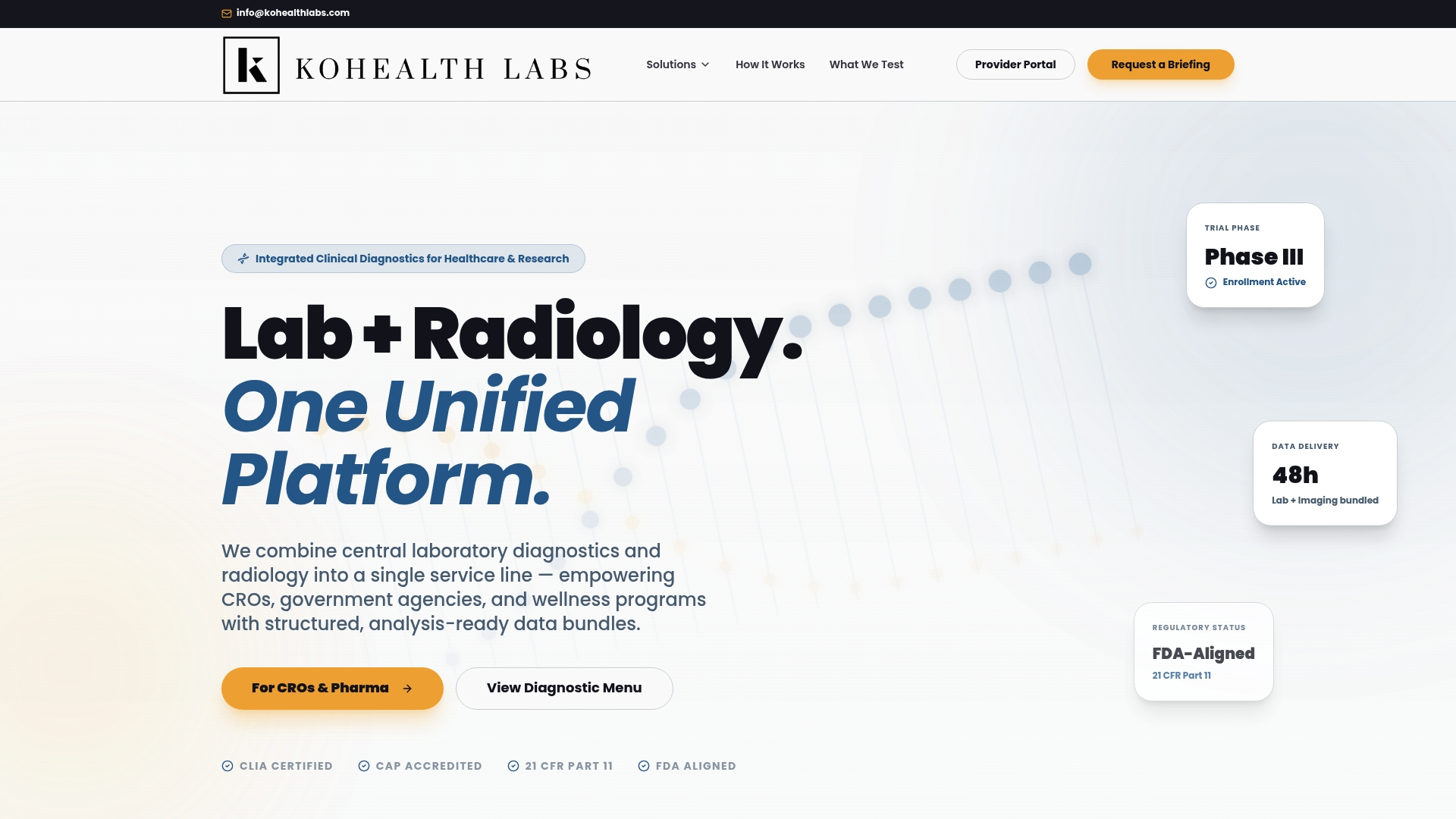
Kohealth Labs resolves that directly. The offering covers integrated laboratory diagnostics and radiology under a single contract, with AI-driven data quality checks that flag deviations before they reach the sponsor's database. Coverage spans over 100 biomarkers and genomic panels, with courier specimen pickup, EMR integration, and dedicated onboarding support for CROs, pharma sponsors, government agencies, and clinical practices. The result is analysis-ready data bundles that compress the time between enrollment and first dosing decision.
For CROs and sponsors ready to reduce vendor complexity and accelerate data lock, explore Kohealth Labs' integrated diagnostic solutions or review the specialty testing panels and validation documentation to confirm fit with your protocol requirements. Contact the team at kohealthlabs.com to discuss your trial's specific diagnostic endpoints.
Authoritative sources and further reading
The following sources provide the clinical, methodological, and regulatory depth that supports the guidance in this article.
- Polymerase Chain Reaction (PCR) - StatPearls - NCBI Bookshelf
- Dos and Don’ts for molecular testing - WHO
- Molecular Genetics Testing - StatPearls - NCBI Bookshelf
- Genetic Testing - An Evidence Framework for Genetic Testing - NCBI Bookshelf
- Annual Reviews (analytical review on molecular methods)
- Yale Medicine — Molecular diagnostics overview
- Definition of molecular diagnostics - NCI Dictionary of Cancer Terms
- The Journal of Molecular Diagnostics
This article provides general educational information for healthcare professionals and researchers. It does not constitute clinical, legal, or regulatory advice. Confirm current CLIA, CAP, and FDA requirements with the relevant regulatory bodies or a qualified compliance professional before making laboratory or trial design decisions.