

PCR testing is the gold-standard nucleic acid amplification method CROs and pharma teams use to detect and quantify target DNA or RNA for screening, endpoints, and biomarker work in clinical trials. Its combination of high sensitivity, precise quantification, and molecular specificity makes it the preferred diagnostic method when the science demands more than an antigen test can deliver.
Why trial teams rely on it:
- Screening accuracy: PCR detects sequence-specific genetic material rather than antibody responses, reducing misclassification at enrollment.
- Endpoint quantification: qPCR and digital PCR (dPCR) produce Cq/Ct values and absolute copy counts that support viral load kinetics and biomarker endpoints.
- Data integration: Trial-grade PCR data must arrive in HL7/FHIR, CDISC-ready (SDTM/ADaM), or API-accessible formats to feed EDC systems without manual transcription.
Trust signals to confirm before contracting any lab: CLIA and CAP certification, documented assay validation (limit of detection, sensitivity, specificity), and written turnaround time SLAs.
What PCR methods does your trial actually need?
PCR amplifies specific DNA sequences through repeated thermal cycles of denaturation, annealing, and extension. For RNA targets such as SARS-CoV-2, a reverse transcription step converts RNA to cDNA before cycling begins, adding pre-analytic handling time and RNase contamination risk.
The four methods trial teams encounter:
- Conventional PCR: Qualitative, end-point detection. Confirms presence or absence of a target. Appropriate for genotyping or pathogen identification where quantification is not required.
- RT-PCR: Adds a reverse transcription step for RNA targets. Standard for viral respiratory endpoints and gene-expression work.
- qPCR (quantitative PCR): Measures fluorescence in real time to produce Cq/Ct values. Requires standard-curve validation and efficiency correction for accurate cross-run comparisons.
- dPCR (digital PCR): Partitions the reaction into thousands of individual droplets for absolute quantification without a standard curve. Best for low-copy targets, rare mutation detection, and reference-standard work.
Amplification efficiency declines after multiple cycles due to reagent depletion and inhibitory byproducts. Assay design and cycle-threshold cutoffs must account for this to avoid false-positive calls at high cycle numbers.
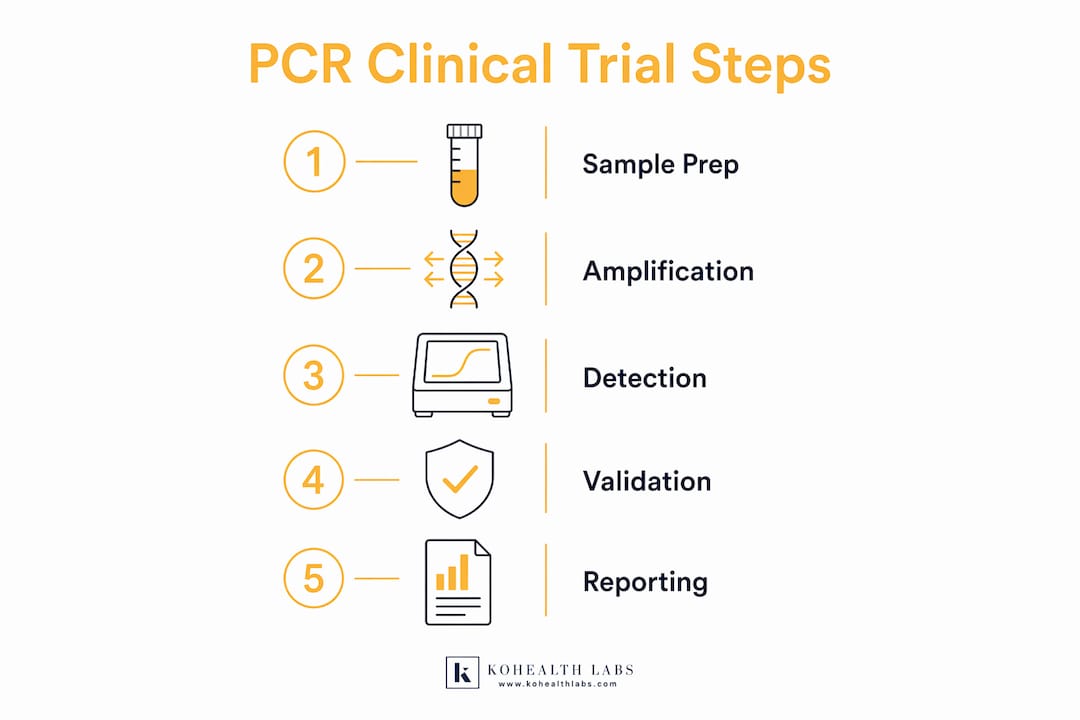
Primary uses of PCR in clinical trials
PCR's role in trials extends well beyond infectious disease diagnosis. It enables biomarker quantification and mutation identification that immunoassays simply cannot provide, which is critical for mechanism-of-action endpoints.
- Screening and inclusion/exclusion: Confirm active infection or target-gene presence before randomization. Qualitative readout is usually sufficient here.
- Primary and secondary endpoints: Viral load kinetics, time-to-clearance, and pharmacodynamic biomarker levels require quantitative qPCR or dPCR outputs with Cq/Ct or copies/mL reported per sample.
- Safety monitoring and viral shedding: Longitudinal PCR sampling tracks shedding duration and informs dose-modification decisions.
- Companion diagnostics and PD biomarkers: Mutation-specific PCR confirms patient eligibility for targeted therapies and measures target engagement over time.
Pro Tip: Specify in the protocol whether each PCR endpoint requires a qualitative or quantitative readout. Mixing them in a single assay order without clear field-level instructions is a common source of protocol deviations.

Timing, persistence of positivity, and how to avoid screening confounders
The most underestimated PCR challenge in trial design is not sensitivity. It is persistence. Viral RNA can remain detectable for up to 90 days after infection, long after a participant is no longer infectious. A positive PCR result at screening does not necessarily indicate active infection due to persistence of genetic material after infection.
| Window | Duration | Trial implication |
|---|---|---|
| Infectivity window | Roughly days 2–9 post-symptom onset | Relevant for safety and site exposure decisions |
| RNA detection window | Up to ~90 days post-infection | Drives false-positive risk at screening |
| Recommended screening exclusion | Prior positive within 90 days | Exclude from NAAT-based enrollment per CDC guidance |
Testing too early after exposure also produces false negatives when viral load is below the assay's LOD. Protocol language should specify a minimum interval from known exposure before a screening PCR is collected.
Pro Tip: For participants with a recent positive history, require symptom resolution plus a 90-day interval before re-screening with PCR. Document the prior positive date in the source record to support audit queries.
Laboratory, validation, and regulatory requirements for trial-grade PCR data
A PCR result is only as credible as the lab that produced it. For U.S. trials, the minimum bar is CLIA certification. CAP accreditation adds a second layer of external proficiency oversight and is increasingly expected by FDA reviewers for data used as primary endpoints.
Required validation documentation before a lab can support trial endpoints:
- Assay validation report covering LOD, analytical sensitivity, specificity, precision (intra- and inter-run), and linearity.
- Proficiency testing records from an approved external program.
- Run acceptance criteria defining when a plate or batch is rejected based on control performance.
- Audit trail documentation showing who accessed, modified, or released each result.
QC components every run must include: positive controls, negative controls, inhibition controls (to catch matrix interference), and standard curves for quantitative assays.
On the regulatory side, FDA guidance for clinical trial diagnostics expects assay validation data to be available for inspection. HIPAA governs how PCR results linked to participant identifiers are stored and transmitted. Secure, encrypted data transfer and role-based access controls are not optional. For contamination control, post-amplification handling practices must prevent amplified DNA from re-entering the pre-amplification workspace. A useful reference for lab-side contamination prevention is this peptide contamination prevention guide, which covers physical separation and decontamination protocols applicable to nucleic acid labs.
Pro Tip: Request the lab's most recent CAP inspection report and proficiency testing summary before signing a master services agreement. A lab that hesitates to share these documents is a red flag.
- Confirm the lab holds both CLIA and CAP credentials.
- Verify the assay was validated on the same platform and specimen type your trial will use.
- Require written run-acceptance criteria and a sample rejection policy in the contract.
Specimen types, chain-of-custody, transport, and turnaround time
Specimen selection affects both assay performance and site feasibility. Common types used in trials:
- Nasopharyngeal (NP) swab: Highest sensitivity for upper respiratory targets; requires trained collection staff.
- Mid-turbinate or anterior nares swab: Lower sensitivity than NP but more feasible for decentralized or participant-collected protocols.
- Saliva: Acceptable for some viral targets; simpler collection but higher matrix variability.
- Blood (plasma or serum): Required for viral load quantification in systemic infections and for circulating tumor DNA (ctDNA) endpoints.
Chain-of-custody documentation must capture collector ID, collection timestamp, specimen condition at receipt, and any temperature excursions during transit. Cold-chain requirements vary by specimen type and assay, but most PCR specimens require refrigeration at 2–8°C for short-term storage or freezing at –70°C for longer holds.
Turnaround time shapes enrollment velocity. Rapid PCR platforms at point-of-care return results in minutes, but most centralized lab workflows deliver results in 24–72 hours. For timely diagnostic data delivery to matter at enrollment visits, build the lab's SLA into the visit window and allow a buffer for shipping delays from remote sites.
Statistic callout: Centralized lab-based PCR tests typically return results in a few days; on-site rapid PCR platforms can return results in less than an hour, making specimen routing decisions a direct driver of enrollment cycle time.
What data fields and delivery formats does your trial system need?
Every PCR result delivered to a trial database should carry these fields at minimum: patient pseudonym/ID, sample ID, collection timestamp, specimen type, assay ID, instrument platform, Cq/Ct value or copies/mL, assay LOD, qualitative result flag, and QC pass/fail status.
| Field | Format / unit | Why it matters |
|---|---|---|
| Cq/Ct value | Numeric, 2 decimal places | Required for quantitative endpoint analysis |
| Copies/mL | Numeric with LOD stated | Absolute quantification for viral load endpoints |
| QC flag | Pass / Fail / Inhibited | Triggers re-test workflow without manual review |
| Assay lot and instrument ID | Alphanumeric | Supports deviation investigation and audit |
| Collection timestamp | ISO standard date format (UTC) | Aligns with EDC visit windows |
Preferred delivery mechanisms: HL7/FHIR for real-time EHR integration, secure SFTP for batch transfers, REST APIs for EDC connectivity, and CDISC SDTM/ADaM-formatted datasets for regulatory submissions. Machine-readable exports prevent manual transcription errors that inflate protocol deviation rates. AI-enabled QC layers that flag anomalous Cq/Ct patterns or inhibition signals before results are released add another audit-ready checkpoint.
- Require the lab to deliver a sample dataset in your target format before study start.
- Confirm HL7/FHIR version compatibility with your EDC vendor.
- Specify SDTM domain mapping (LB domain for lab results) in the data transfer agreement.
How to choose a PCR laboratory partner for a clinical trial
Vendor selection for PCR work is a technical and operational decision, not just a procurement exercise. Use this framework:
- Accreditation: Confirm CLIA certification and CAP accreditation. For international sites, confirm equivalent national accreditation.
- Assay validation evidence: Request the full validation report for the specific assay and specimen type. LOD, sensitivity, and specificity must be documented on the platform you will use.
- Throughput and capacity: Confirm the lab can handle your projected sample volume at peak enrollment without extending SLAs.
- Turnaround SLAs: Get written commitments with defined escalation paths for delays.
- Data integration capabilities: Confirm HL7/FHIR, CDISC-ready exports, and API availability before signing.
- Cold-chain and logistics: Verify the lab has established courier relationships and documented temperature-monitoring procedures.
- Cost transparency: Require per-sample pricing, re-test fees, and rush-result surcharges in writing.
Questions to ask every candidate lab: What is your documented LOD for this assay? What are your run-acceptance criteria and sample rejection rates? How do you handle inhibited samples? What security certifications cover your data environment?
Red flags: no published validation data, vague or verbal SLA commitments, no API or CDISC deliverables, and missing chain-of-custody SOPs. The role of central lab oversight in sponsor accountability means these gaps become protocol deviations, not just vendor inconveniences.
How Kohealth Labs supports PCR in clinical trials
Kohealth Labs provides a unified diagnostic contract that combines laboratory services, radiology, and data pipelines under a single agreement for CROs and pharma sponsors. The integrated model eliminates the handoff delays that occur when lab results, imaging reads, and data formatting are managed by separate vendors.
Key capabilities:
- CLIA/CAP-credentialed laboratory network with documented assay validation bundles (LOD, sensitivity, specificity) available on request.
- HL7/FHIR connectivity and CDISC-ready (SDTM/ADaM) dataset exports for direct EDC integration.
- AI-enabled QC that flags Cq/Ct anomalies, inhibition signals, and run-level deviations before results are released, with full audit trails.
- SLA commitments and throughput capacity documented in the master services agreement.
- Coverage of over 100 biomarkers, including specialty assay panels for companion diagnostic and pharmacodynamic endpoints.
Integrated diagnostics reduce handoffs and accelerate analysis-ready data delivery, which directly cuts time-to-readout for primary endpoints and reduces protocol deviations. For trials with both imaging and lab endpoints, the single-contract model means one point of contact, one data schema, and one audit trail.
Pro Tip: Ask Kohealth Labs for a sample CDISC-formatted dataset and a connectivity test with your EDC before protocol finalization. Confirming data format compatibility early prevents costly amendments later.
Implementation checklist and sample protocol language for PCR endpoints
Use this checklist during protocol development:
- Select assay type (qualitative vs. quantitative) and confirm LOD meets the study's clinical threshold.
- Obtain lab's validation report for the specific specimen type and platform.
- Define screening window: exclude participants with a prior positive PCR within 90 days.
- Specify collection method, handling temperature, and maximum time-to-processing in the lab manual.
- Define required data fields and delivery format in the data transfer agreement.
- Include informed consent language describing specimen collection, storage duration, and data use.
- Set reporting timelines and escalation procedures for indeterminate or inhibited results.
Sample protocol language (inclusion/exclusion): "Participants must have no documented positive NAAT result within 90 days prior to screening. Participants with a prior positive result may re-screen after 90 days from the date of the positive test, provided they are asymptomatic at the time of re-screening."
Sample language for indeterminate results: "Specimens with an inhibited or indeterminate PCR result will be repeated once using a fresh aliquot. If the repeat result remains indeterminate, the participant will be considered unevaluable for that visit and the event will be recorded as a protocol deviation."
Pro Tip: Build a 48-hour buffer into enrollment visit windows to accommodate shipping delays from remote sites. Batching shipments twice weekly from low-volume sites reduces per-sample courier costs without meaningfully extending turnaround.
When is PCR preferred over antigen or serology in trials?
The choice depends on what the endpoint requires, not on which test is faster or cheaper.
- Use PCR when: low-copy detection is required, the endpoint is quantitative (viral load, copies/mL), the specimen type is blood or tissue, or regulatory guidance specifies a NAAT. PCR is mandatory for most primary virologic endpoints.
- Use antigen testing when: rapid prescreen at enrollment is needed and sensitivity requirements are lower. Antigen tests return results in 15–30 minutes but are generally less sensitive than PCR, especially in low-viral-load scenarios.
- Use serology when: the endpoint is immune response (antibody titer, seroconversion) rather than active infection or viral presence.
A pragmatic hybrid: use a rapid antigen test to prescreen participants at the site visit, then confirm enrollment eligibility with a central-lab PCR. This reduces the number of full PCR runs without compromising endpoint data quality.
Key Takeaways
PCR testing is the required method for quantitative virologic endpoints in clinical trials, and its reliability depends entirely on validated assays, documented chain-of-custody, and CDISC-ready data delivery.
| Point | Details |
|---|---|
| Screening window matters | Exclude participants with a prior positive NAAT within 90 days to avoid RNA-persistence confounders. |
| Lab trust signals are non-negotiable | Require CLIA/CAP credentials, a full assay validation report (LOD, sensitivity, specificity), and written SLAs before contracting. |
| Data fields drive endpoint quality | Every result must include Cq/Ct or copies/mL, QC flag, assay LOD, and collection timestamp in machine-readable format. |
| Vendor red flags to act on | No published validation data, verbal SLAs, missing CDISC deliverables, or absent chain-of-custody SOPs signal operational risk. |
| Kohealth Labs | Provides a single-contract model combining lab, radiology, and CDISC-ready data with AI-enabled QC for CROs and pharma sponsors. |
The case for integrated diagnostics in trial PCR programs
Most protocol deviations tied to PCR endpoints trace back to the same three failure points: a lab that cannot deliver data in the right format, a specimen that arrived outside temperature range with no documentation, and a result that sat in a portal instead of flowing into the EDC. These are not assay failures. They are integration failures.
The conventional approach of contracting a separate lab, a separate imaging vendor, and a separate data team creates exactly the handoff gaps where deviations accumulate. When PCR results, radiology reads, and biomarker panels arrive through different portals on different timelines, the trial operations team spends its time chasing data instead of monitoring safety.
Integrated diagnostics change that equation. A single contract, a unified data schema, and AI-enabled QC that flags anomalies before results are released means the endpoint data is ready when the biostatistician needs it, not three weeks later after a manual reconciliation. For CROs managing multi-site trials with tight enrollment windows, that difference is measured in weeks off the timeline.
Kohealth Labs: your next step for trial-grade PCR diagnostics
Faster enrollment and cleaner endpoint data start with one conversation. Kohealth Labs delivers integrated lab, radiology, and data services under a single contract, so your trial team gets CDISC-ready PCR results without managing three vendors and three data formats.
Request a validation data package, a sample CDISC-formatted dataset, and a written SLA proposal from Kohealth Labs before your next protocol finalization meeting. The AI-enabled QC layer and HL7/FHIR connectivity are already built in. Fewer protocol deviations and faster enrollment are the direct result of getting the diagnostic infrastructure right from day one. Contact Kohealth Labs at kohealthlabs.com to schedule a capabilities review.
Useful sources and standards
- CDC: Overview of Testing for SARS-CoV-2 — Primary reference for NAAT screening windows, RNA persistence guidance, and re-testing recommendations. Consult for protocol inclusion/exclusion language.
- NCBI StatPearls: Polymerase Chain Reaction — Technical reference for amplification efficiency, cycle thresholds, qPCR quantification, and contamination controls. Use for assay design and validation conversations.
- National Human Genome Research Institute: Understanding COVID-19 PCR Testing — Accessible overview of how PCR targets genetic sequences; useful for protocol team onboarding and IRB submissions.
- MedlinePlus: PCR Tests — Plain-language explanation of PCR applications including cancer cell detection and infectious disease; useful for patient-facing consent language.
- MedlinePlus Medical Encyclopedia: COVID-19 Virus Test — Turnaround time benchmarks and specimen type guidance for point-of-care versus centralized lab decisions.
- NCBI Bookshelf: Biochemistry, Polymerase Chain Reaction — Deep technical reference on PCR components, thermal cycling, qPCR fluorophores, and RT-PCR methodology; consult for assay validation design.
- Peptide sequence verification guide — Practical reference on sequence verification and QC methods applicable to nucleic acid confirmation and assay specificity checks.