

Biomarker analytics in polyclinic patient care means analyzing multiple biological indicators simultaneously to guide personalized treatment decisions, stratify patient risk, and improve clinical trial outcomes. The role of biomarker analytics in polyclinic patient care goes well beyond running a single lab test. When you integrate multidimensional biomarker data with radiology findings and clinical workflows, you get a far clearer picture of each patient's disease trajectory than any single marker can provide. Studies through 2026 show that combining Continuous Quality Improvement methodologies like Lean and Six Sigma with advanced biomarker analytics measurably improves patient outcomes.
Key functions biomarker analytics serve in polyclinic and clinical trial settings:
- Risk stratification: Multi-marker panels classify patients by disease severity before symptoms escalate.
- Early detection: Pre-clinical biomarker signals identify disease onset earlier than imaging alone.
- Personalized therapy: Biomarker profiles guide drug selection and dosing at the individual level.
- Trial efficiency: Unified diagnostic data reduces vendor complexity and accelerates enrollment decisions.
Kohealth Labs covers over 100 biomarker analyses within a single integrated platform, connecting lab results and radiology data to give clinical teams analysis-ready bundles rather than fragmented reports.
How biomarker analytics directly improve clinical trial diagnostics and patient outcomes
Integrated biomarker analytics deliver concrete, measurable advantages across the full diagnostic workflow. The clearest gain is accuracy. Quantitative protein biomarker panels outperform single biomarkers in diagnosis, prognosis, and therapy response prediction, particularly in patients with complex comorbidities where a single marker routinely misleads.
Speed matters too, but not in isolation. An international survey of 508 physicians found that a large majority of physicians believed faster biomarker results would benefit patient care, with troponin, C-reactive protein, and D-dimer among the prioritized biomarkers mentioned by physicians. Yet the same research cautions that excessive focus on turnaround time can undermine evidence-based diagnostic strategies. The real payoff comes when speed and clinical utility align within a standardized framework.
Benefits that integrated biomarker analytics deliver in practice:
- Unified diagnostics: Combining lab and radiology data under one contract removes the coordination burden that slows most polyclinic workflows.
- Dynamic health monitoring: Multi-biomarker predictive models enable real-time risk reassessment rather than static snapshots.
- Proactive intervention: Early risk signals allow clinical teams to act before a patient deteriorates, reducing costly late-stage interventions.
- Trial data quality: AI-flagged deviations catch mislabeled samples and protocol gaps before they compromise a dataset.
Pro Tip: When designing a clinical trial diagnostic protocol, specify which biomarker panels map to each endpoint before site activation. Retrofitting panel selection mid-trial is one of the most common causes of data gaps.
Which computational platforms are transforming biomarker data into clinical decisions?
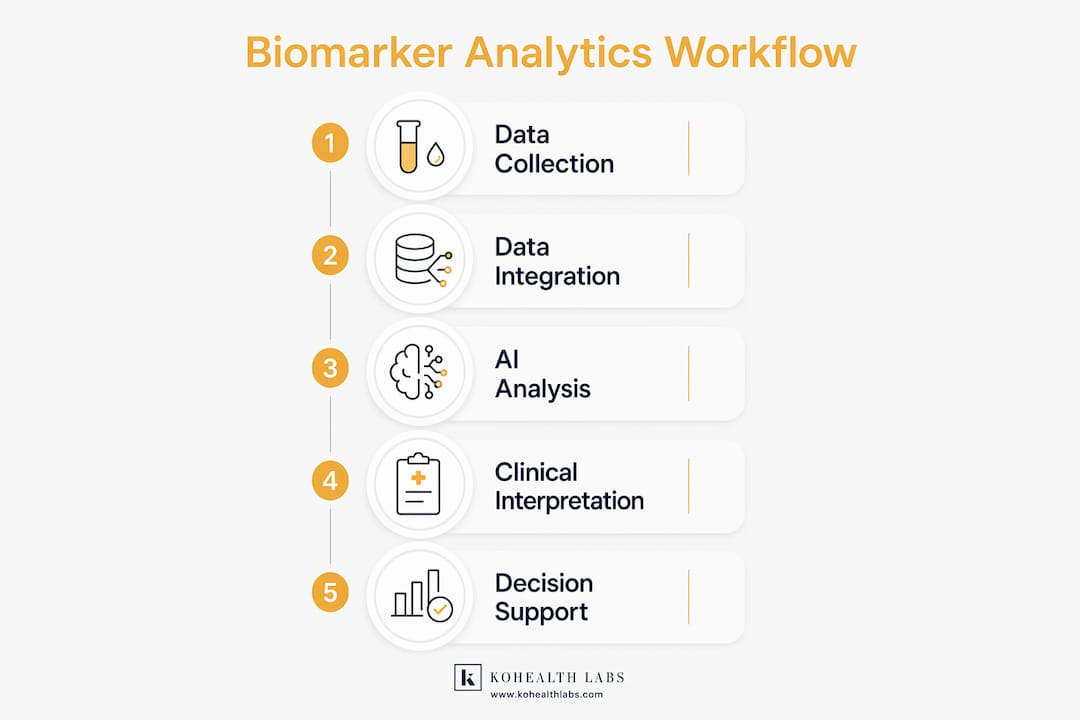
Raw biomarker data is only as useful as the tools that interpret it. Advanced AI-driven platforms automate dimensionality reduction and classification across complex omics datasets, surfacing hidden patient subgroups and generating prediction metrics like F1-scores that directly inform clinical decision support.

Omics BioAnalytics, an R Shiny platform, exemplifies this approach. It performs late integration using ensembles of elastic net models trained independently on transcriptomic, proteomic, and metabolomic datasets, then averages predictions across modalities for improved accuracy. The platform supports interactive dashboards, differential expression analysis, and downloadable reports, making reproducible workflows accessible to researchers without deep bioinformatics backgrounds.
Clinlabomics takes a different angle, applying machine learning to routine blood and body fluid tests to reveal diagnostic information that standard lab reads miss entirely. Models built on this approach outperform human experts at detecting mislabeled samples and clot specimens, directly improving data reliability for clinical trials. The insight here is that significant diagnostic value already exists in data your lab collects every day. It just requires the right analytics layer to extract it.
For AI-supported diagnostics across specialties, the practical requirement is role-adapted results delivery. Clinicians need risk scores and recommended interventions. Trial sponsors need population-level summaries. A platform that delivers the same raw output to both groups creates friction rather than clarity.
What barriers are slowing biomarker analytics adoption in routine polyclinic care?
The primary barrier is regulatory, not technical. Experts highlight that even biologically validated biomarkers stall in clinical translation because harmonized qualification pathways from regulators like the FDA and EMA remain inconsistent. Reimbursement models compound the problem: payers have not kept pace with the clinical evidence, leaving many multi-marker panels uncompensated despite their diagnostic superiority.
Structural challenges run alongside the regulatory ones:
- Data standardization: Biomarker data generated across different labs and instruments rarely arrives in compatible formats, making cross-site comparisons unreliable.
- Interoperability: Most polyclinic electronic health record systems were not built to ingest omics-scale data alongside imaging results.
- Physician workflow friction: Clinicians receive biomarker outputs that require specialist interpretation, creating bottlenecks in busy clinical settings.
- Data privacy and ethics: Biomarker data carries re-identification risk beyond standard patient records. Governance frameworks must address consent, data minimization, and secondary use explicitly, particularly for trial populations.
- Cost barriers: High-throughput detection enhances sensitivity but restricts widespread use due to cost and operational complexity.
Understanding adoption challenges in clinical practice helps trial teams anticipate where integration will stall and build contingency into their protocols from the start.
Best practices for embedding biomarker analytics into clinical decision support
Multidisciplinary collaboration is the single most reliable predictor of successful biomarker integration. Professional guides recommend patient-partnered multidisciplinary approaches that bring clinicians, pharmacists, data scientists, and patients into a shared decision framework rather than treating biomarker results as a one-way data feed from the lab.
Practical steps that consistently improve integration outcomes:
- Standardize before you scale: Define data formats, reference ranges, and reporting templates across all sites before trial activation.
- Train by role: Clinicians need interpretation training; data scientists need clinical context. Generic training programs serve neither group well.
- Use role-adapted results delivery: Intelligent results systems should display risk assessments and intervention recommendations for clinicians, accessible summaries for patients, and population-level reports for sponsors.
- Embed biomarker checkpoints in trial protocols: Treat biomarker review as a protocol milestone, not an optional add-on.
- Audit data quality continuously: AI tools that flag deviations in real time prevent small errors from compounding into protocol violations.
Kohealth Labs applies this framework directly. Its unified diagnostics model connects lab results and radiology findings under a single contract, with AI monitoring data quality throughout the trial lifecycle. That architecture removes the coordination overhead that typically delays clinical decision support in multi-site polyclinic environments.
Real-world examples of biomarker analytics improving polyclinic patient care
The clearest real-world evidence comes from oncology. Independent validation of the Apo10 and TKTL1 biomarkers confirmed their clinical utility in early cancer detection, with multi-marker panels detecting fundamental hallmarks like defective apoptosis and altered metabolism that single biomarkers miss. These panels have shown particular value in reflex testing for cytologically indeterminate cases, where a binary positive or negative result from a single marker leaves clinicians without a clear path forward.
In cardiovascular care, the physician survey cited earlier found that combining troponin, BNP, and D-dimer results within a structured diagnostic framework improves triage accuracy and reduces unnecessary treatment delays. The benefit is not just speed. It is the clinical context that a panel provides when individual markers fall in ambiguous ranges.
At the population level, biomarker-driven prediction systems have demonstrated the ability to identify high-risk community distributions and allocate resources before disease burden peaks. For polyclinics running chronic disease management programs alongside clinical trials, that population-level signal is directly applicable to patient scheduling, staffing, and intervention timing.
What does the future of biomarker analytics look like for polyclinic care?
Digital twin technology is the development most likely to change polyclinic workflows in the near term. By simulating patient physiological data in real time, digital twins allow clinical teams to model intervention outcomes before committing to a treatment path. Predictive models incorporating multiple dynamic biomarkers already enable accurate patient risk stratification, and digital twin integration will extend that capability to prospective scenario planning.
Multi-omics integration is the other major direction. Combining transcriptomics, proteomics, and metabolomics within a single analytical pipeline gives a more complete picture of disease biology than any single omics layer provides. The interdisciplinary biotech research supporting this approach is accelerating, with academic institutions, medical centers, and industry partners increasingly sharing validation datasets to speed translation.
Point-of-care biomarker devices will also reduce the gap between sample collection and clinical decision. Simplified testing technologies lower the cost and complexity of high-value biomarker detection, making panel-based diagnostics viable in lower-resource polyclinic settings. For large biological dataset analysis, edge computing solutions are emerging as a practical path to real-time analytics without requiring centralized infrastructure.
Kohealth Labs gives your clinical trials analysis-ready biomarker data from day one
Clinical researchers running multi-site trials know the cost of fragmented diagnostics. Chasing lab results from one vendor and imaging reports from another adds weeks to data lock and introduces reconciliation errors that slow regulatory submissions.
Kohealth Labs solves that directly. Its single-contract model unifies lab and radiology diagnostics with AI-powered analytics covering over 100 biomarkers, delivering analysis-ready data bundles to CROs, government agencies, and wellness programs. AI monitors data quality throughout the trial, flagging deviations before they become protocol violations. The result is faster trial completion, cleaner datasets, and stronger safety monitoring without the overhead of managing multiple vendors. Explore Kohealth Labs' clinical trial diagnostic solutions or review the full AI-powered analytics platform to see how integrated diagnostics fit your next trial design.
Key Takeaways
Biomarker analytics in polyclinic patient care delivers its greatest value when lab data, radiology, and AI-driven analysis operate as a single integrated system rather than separate diagnostic silos.
| Point | Details |
|---|---|
| Multi-marker panels outperform single biomarkers | Protein panels improve diagnosis, prognosis, and therapy response prediction across complex patient populations. |
| Speed requires clinical context | A large majority of surveyed physicians valued faster biomarker results, but clinical utility within a standardized framework drives better outcomes than speed alone. |
| Regulatory barriers lead adoption challenges | Inconsistent FDA and EMA qualification pathways, not technical gaps, are the primary reason validated biomarkers stall before reaching routine clinical use. |
| Multidisciplinary teams are required for integration | Patient-partnered teams of clinicians, pharmacists, and data scientists achieve higher success in embedding biomarker analytics into decision support workflows. |
| Kohealth Labs | Integrates lab, radiology, and AI analytics covering over 100 biomarkers under a single contract, delivering analysis-ready data for clinical trials. |