

A pharmaceutical testing lab analyzes drug substances, finished products, and raw materials for identity, purity, potency, and safety through analytical chemistry, microbiology, stability, and bioanalysis testing. Before contacting one, gather your sample specifications, batch records, and testing timeline. An audit-ready lab should offer:
- ISO/IEC 17025 accreditation
- GLP/GMP compliance with FDA registration
- 21 CFR Part 11 electronic records controls
Pro Tip: Request a lab's capability statement before sending samples. It reveals accreditation scope, instrument list, and whether your specific test method is already validated there.
Key Takeaways
Integrated diagnostics that combine lab testing, radiology, and AI-driven data delivery under one contract reduce vendor handoffs and shorten time to data lock in clinical programs.
| Point | Details |
|---|---|
| Prepare before you contact a lab | Gather sample specs, batch records, and timelines, and confirm ISO/IEC 17025 and GLP/GMP status upfront. |
| Match test category to method | Use HPLC/UPLC for assay, USP <71> for sterility, and ICH conditions for stability programs. |
| Fix pre-analytical steps first | Standardized labeling and chain of custody prevent the majority of laboratory errors before testing even starts. |
| Ask hard questions during RFP | Confirm subcontracting practices, instrument downtime plans, and true rush turnaround times. |
| Consider integrated diagnostics | Kohealth Labs bundles lab, imaging, and AI-driven data under one contract to cut vendor handoffs and speed data lock. |
What Pharmaceutical Laboratory Services Cover
Pharmaceutical laboratory services span raw material testing, in-process controls, finished product release, stability programs, microbiology, and bioanalysis. Sponsors and contract research organizations lean on these labs at nearly every stage: screening candidate compounds in early R&D, generating data for IND-enabling studies, releasing commercial lots, running ongoing stability programs, and troubleshooting deviations that trigger regulatory scrutiny.
Common use cases include:
- Raw material and excipient qualification before formulation work begins
- Finished product release testing tied to batch disposition
- Stability studies supporting shelf-life claims and beyond-use dating
- Bioanalytical support for pharmacokinetic and biomarker data in trials
Where these services get complicated is coordination. A trial that needs lab results synced with imaging data and clinical records often juggles three or four separate vendors, each with its own turnaround clock. Integrated diagnostics, combining lab testing, radiology, and data delivery under one workflow, removes that friction and gets analysis-ready datasets to sponsors faster. Kohealth Labs built its drug testing services around exactly that consolidation.
Core Test Categories and the Methods Behind Them
Every pharmaceutical testing lab organizes its work around a handful of test categories, each with its own compendial method and decision points for when it applies.
Analytical chemistry covers assay testing (usually HPLC or UPLC), impurity profiling, residual solvent analysis by gas chromatography, content uniformity, and dissolution testing. These methods confirm a drug is what the label claims, at the right strength, without unsafe byproducts.
Microbiology testing verifies a product is free of harmful organisms or within safe bioburden limits. Sterility testing follows USP <71>, bioburden testing follows USP <61>, bacterial endotoxin testing uses the LAL method under USP <85>, and antimicrobial effectiveness testing follows USP <51>. Labs source characterized microbial strains for these assays from repositories like ATCC and BEI Resources.
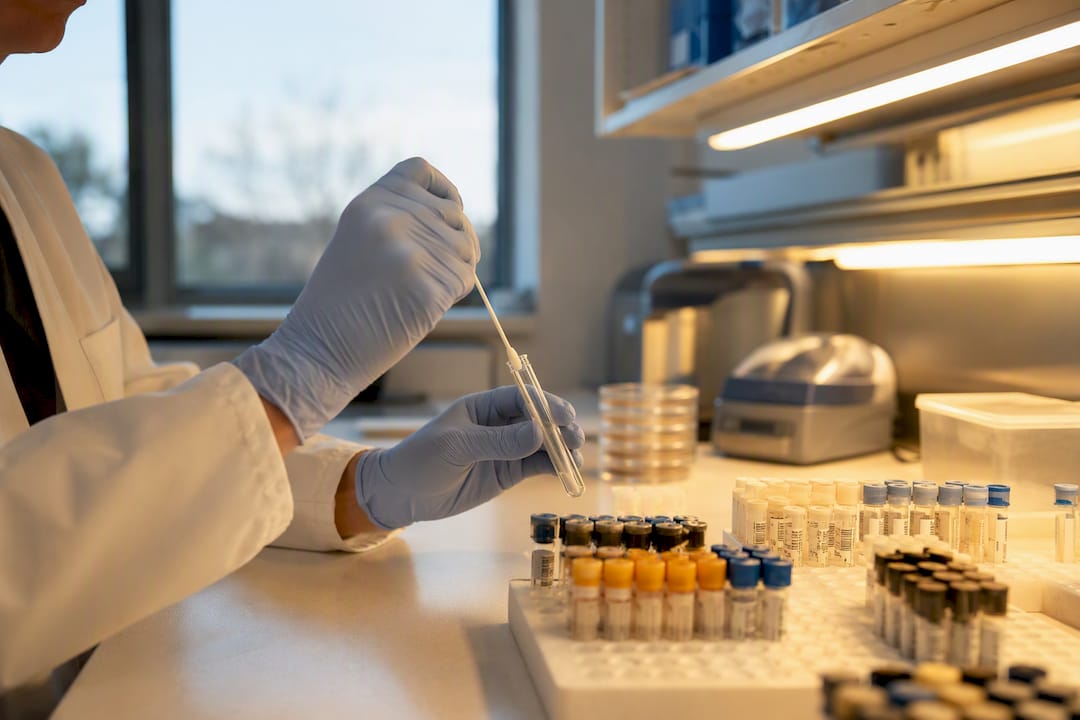
Stability testing places samples under ICH-defined conditions, long-term, accelerated, and photostability, to generate the data that supports shelf-life and beyond-use-date claims. Bioanalysis and in vitro toxicology round out the picture with pharmacokinetic assays and biomarker panels, where method sensitivity and matrix effects matter as much as the raw result.
| Test category | What it measures | Typical method |
|---|---|---|
| Assay/potency | Drug strength vs. label claim | HPLC/UPLC |
| Residual solvents | Leftover processing solvents | Gas chromatography |
| Sterility | Absence of viable microorganisms | USP <71> |
| Bacterial endotoxin | Pyrogenic contamination | LAL, USP <85> |
| Stability | Degradation over time/conditions | ICH long-term/accelerated |
Pro Tip: Rapid microbial methods can cut sterility turnaround from 14 days to under 48 hours, but confirm the alternative method is validated against your product matrix before you build a release schedule around it.
Regulatory and Quality Credentials That Actually Matter
Credentials separate a lab you can cite in a regulatory submission from one you can't. The baseline expectations are ISO/IEC 17025 accreditation for technical competence, GLP or GMP compliance depending on the study phase, and FDA registration where the work touches commercial product release.
Behind those certifications, look for the operational proof:
- Documented method validation packages and current SOPs for every test offered
- QA review built into the reporting chain, not bolted on afterward
- 21 CFR Part 11 controls governing electronic records and audit-ready certificates of analysis
- Recent third-party audit history and a capability statement that names specific accreditation scope
A regulatory-compliant lab will hand over this documentation without hesitation. If a vendor hedges on any of it, that hesitation is itself useful information.
Sample Submission, Chain of Custody, and What Drives Cost
Getting reliable results on schedule depends on what you do before the sample ever reaches the bench. A solid submission checklist includes accurate labeling, complete chain-of-custody documentation, defined stability time points, matrix identification, and correct storage conditions during transit.
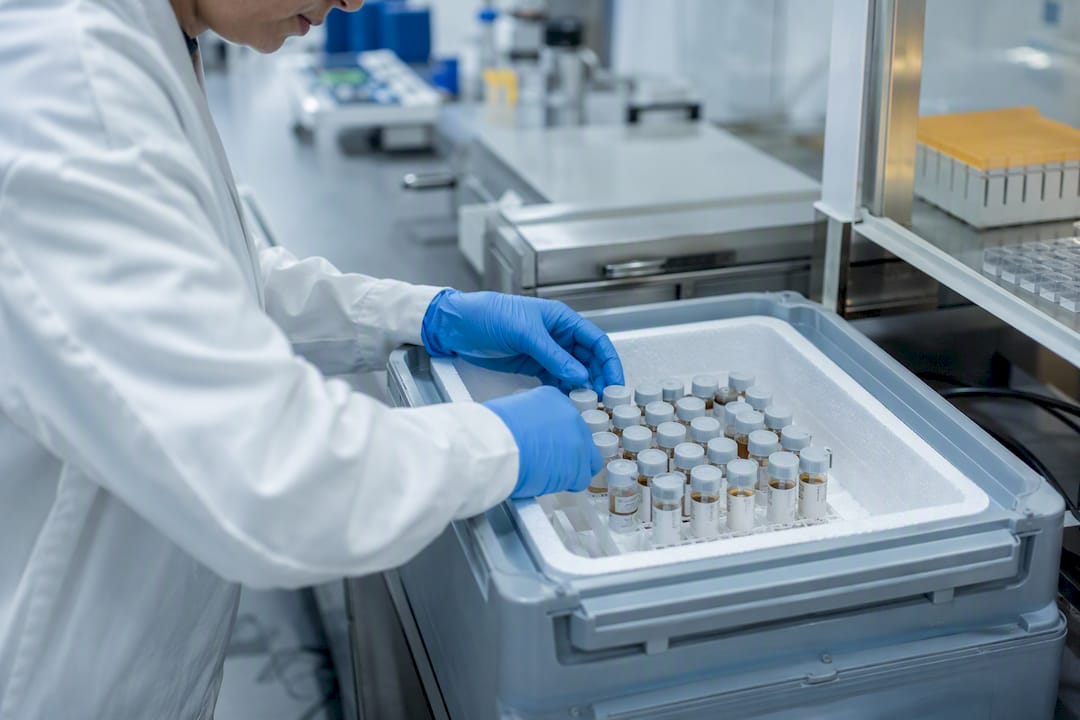
The pre-analytical phase, everything before testing actually starts, accounts for over 60 to 70 percent of laboratory errors. That statistic alone justifies the fuss over courier logistics and temperature-controlled shipping.
Turnaround times vary widely by category: routine assay testing often runs a few days, sterility testing takes up to 14 days unless rapid methods apply, and full stability pulls follow a fixed schedule set months in advance. Cost drivers include analytical complexity, whether a new method needs validation, and whether you're paying for expedited turnaround. Data delivery format matters too. Results that arrive as raw PDFs create reconciliation work; results integrated through an ELN with Part 11 controls drop straight into your systems.
How to Choose a Pharmaceutical Testing Lab
Evaluating a lab comes down to a short list of hard questions, asked before you sign anything.
Checklist to work through:
- Confirm current ISO/IEC 17025 and GMP/GLP status, not just a logo on the website
- Ask for validation data on the exact method you need, not a general capability claim
- Check stability chamber capacity against your program's timeline, not just current availability
- Get turnaround SLAs in writing, including penalties or credits for missed dates
- Verify 21 CFR Part 11 controls and chain-of-custody documentation practices
During RFP or onboarding, ask directly:
- What happens to my samples if your primary instrument goes down mid-run?
- Do you subcontract any testing, and if so, to whom and under what oversight?
- What's your actual turnaround for a priority or rush sample, not the standard quote?
- How do you handle out-of-specification results before they reach my desk?
Red flags worth walking away from: missing or outdated SOPs, vague certificates of analysis that don't show method reference numbers, no documented Part 11 controls, and thin onboarding support that leaves your team guessing about submission formats.
How Integrated Diagnostics Speed Up Clinical Programs
Every vendor handoff in a clinical trial is a place where data can stall, get mismatched, or need re-verification. Combining lab testing and radiology under a single workflow removes several of those handoffs entirely, which shortens the path to data lock.
AI-driven data pipelines add a second layer of speed. Automated systems that flag deviations in real time let QA review exceptions immediately rather than discovering them during a batch audit weeks later. Automation and integrated lab systems are already recognized for improving throughput and reducing outlier rates industry-wide.
What this looks like operationally:
- Single-contract onboarding instead of separate agreements with a lab, an imaging provider, and a data vendor
- Dedicated courier and phlebotomy logistics that reduce the pre-analytical errors mentioned earlier
- Analysis-ready datasets covering over 100 biomarkers, delivered through systems aligned to 21 CFR Part 11
Consolidating lab, imaging, and data delivery under one contract doesn't just save paperwork. It closes the specific gap where most trial delays actually originate: the handoff between vendors, not the testing itself.
What Clients Get Wrong About Lab Selection
The most common mistake we see is treating sample submission as an afterthought, then wondering why turnaround slips. Standardizing your submission package before you need it fixes more delays than any lab's internal speed ever will.
Integrated diagnostics solve the rest. For complex, multi-site programs, reach out before you're up against a deadline.
Why KoHealthLabs Simplifies Pharmaceutical Testing
Most sponsors juggling separate contracts for labs, imaging, and data analytics know the real cost isn't the testing, it's the coordination. Kohealth Labs replaces that patchwork with one contract covering laboratory diagnostics, radiology, and AI-driven analysis-ready data bundles.
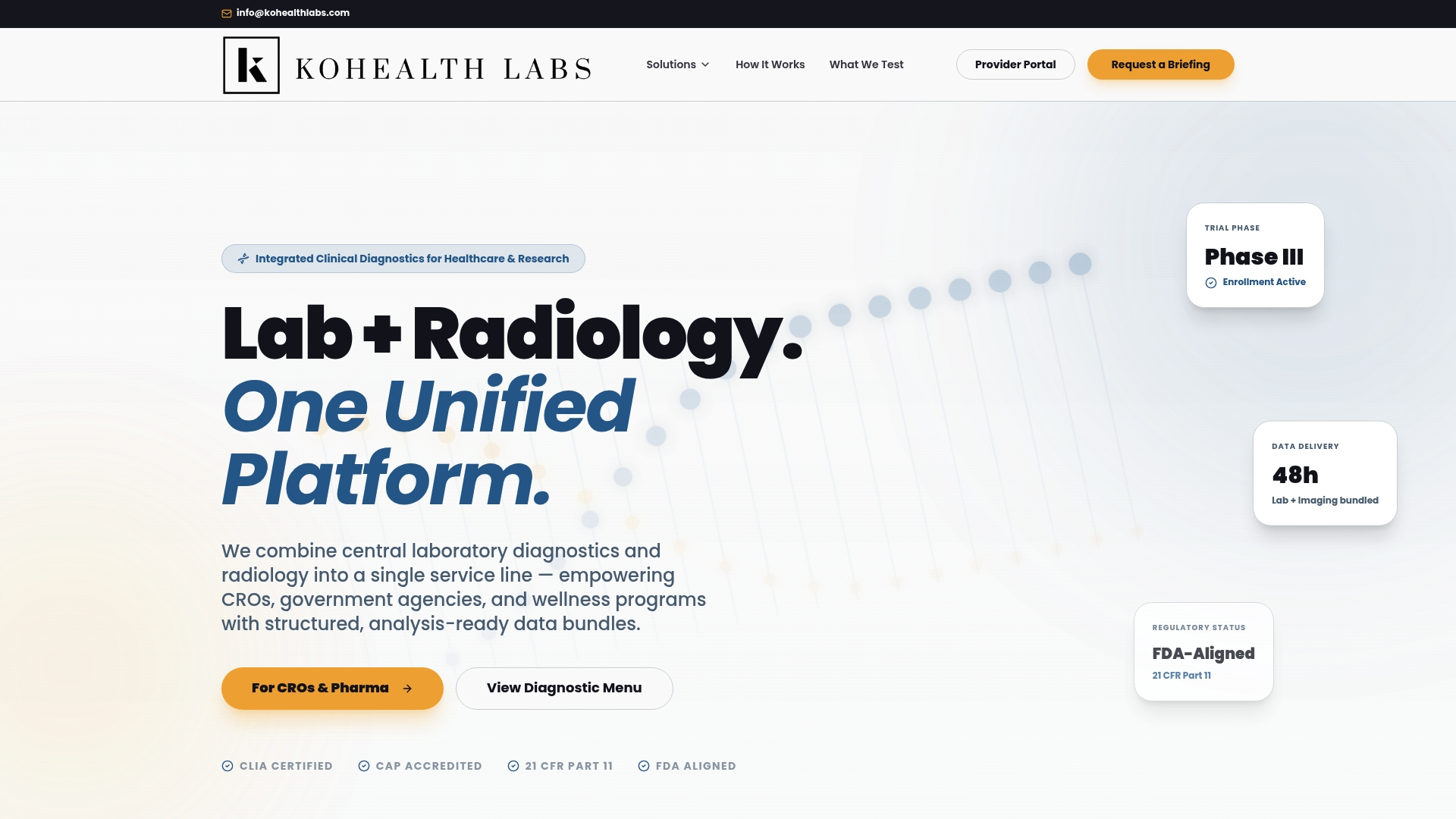
That single-contract model means one onboarding process, one point of contact for chain-of-custody questions, and one data pipeline instead of three formats to reconcile. Kohealth Labs pairs dedicated courier and phlebotomy logistics with GLP/GMP-aligned reporting and audit-ready certificates of analysis, backed by AI and data analytics covering over 100 biomarkers.
If you're running a clinical program with lab and imaging needs that currently sit with different vendors, request a capability statement and pricing walkthrough from Kohealth Labs before your next protocol amendment locks in a testing plan.
Standards and Resources Worth Consulting
For deeper reference, consult ISO/IEC 17025 accreditation criteria, ICH stability guidelines, and USP chapters on sterility and endotoxin testing. For reagents, BEI Resources and the International Reagent Resource supply standardized QC materials.
Frequently Asked Questions
What's the difference between a GLP lab and a GMP lab?
GLP governs non-clinical safety studies that support regulatory submissions, while GMP governs manufacturing and quality control for commercial products. A pharmaceutical testing lab may hold both, depending on whether it supports early development or commercial release testing.
How long does stability testing typically take?
Long-term stability studies run on fixed ICH schedules, often spanning 12 to 36 months, while accelerated conditions can generate supporting data within three to six months. Photostability testing usually completes faster, within a matter of weeks.
Do I need a separate bioanalytical lab for pharmacokinetic studies?
Not necessarily. Many contract testing labs run pharmacokinetic assays and biomarker panels alongside standard analytical and microbiology services, particularly when the lab supports integrated diagnostics for clinical trials.
What documentation should a lab provide with test results?
At minimum, expect a certificate of analysis referencing the exact validated method used, along with QA sign-off. Labs with 21 CFR Part 11 controls also provide traceable electronic records tied to each result.
Can a single vendor handle both lab testing and imaging data for a clinical trial?
Yes. Integrated diagnostics providers like Kohealth Labs combine laboratory testing, radiology, and AI-driven data delivery under one contract, which reduces the handoffs that typically slow multi-vendor clinical programs.
This article is general information, not a substitute for advice from a qualified doctor. Consult a qualified healthcare professional about your own circumstances before acting on anything here.