

Integrated drug testing services for clinical research must deliver analysis-ready lab and imaging bundles, blinded independent reads, secure chain-of-custody, and regulatory-aligned data delivery. CLIA and CAP accreditations, HIPAA-compliant data handling, and 21 CFR Part 11 electronic records readiness are non-negotiable. Kohealth Labs provides a single-contract platform that meets every one of those requirements, reducing vendor handoffs and accelerating enrollment.
Every qualified supplier must cover:
- Phlebotomy and specimen logistics with cold-chain courier pickup
- PK/toxicology panels with defined timepoint sampling
- Biomarker and genomics panels across 100+ analytes
- Imaging in DICOM format with blinded, independent radiology reads
- API, HL7/FHIR, and DICOM data delivery endpoints
- Full audit trail and documented chain-of-custody
- CLIA/CAP accreditation and 21 CFR Part 11 readiness
- HIPAA-compliant data transfer and storage
Why do integrated lab and imaging drug testing services change trial outcomes?
Integration directly shortens the path from sample collection to a statistically valid endpoint. Centralized lab and imaging providers improve trial outcomes through faster automated reporting, global logistics, and de-identified blinded imaging assessments that reduce site-level investigator bias. When lab and radiology data arrive in the same analysis-ready bundle, biostatisticians can run endpoint adjudication without waiting on a second vendor's export.
Integrative diagnostics unifies lab, pathology, and radiology data through advanced IT, reducing fragmented diagnostic data and enabling real-time clinical information. More than 7 billion diagnostic exams influence 70% of healthcare decisions globally, which illustrates how heavily clinical conclusions depend on the quality and completeness of diagnostic data.
Operational benefits compound quickly:
- Fewer protocol amendments because sample collection and imaging protocols are aligned from day one
- Centralized QC and AI-driven validation catch deviations before they reach the database
- Simplified logistics with a single point of contact for specimen pickup, imaging scheduling, and data delivery
- Blinded reads prevent site investigators from overestimating drug efficacy
For sponsors running oncology diagnostics or other complex therapeutic-area studies, the difference between siloed and integrated diagnostics often determines whether a database lock happens on schedule.
What core drug-testing services should you require from an integrated partner?
| Capability Category | Specific Services | Key Requirements |
|---|---|---|
| Clinical lab | PK/toxicology, biomarker panels, genomics/PGx assays | Validated assay methods, serum/plasma/whole blood matrices, aliquot protocols |
| Imaging | MRI, CT, PET, X-ray, ultrasound | DICOM delivery, blinded independent reads, central adjudication |
| Logistics | Phlebotomy, courier pickup, cold-chain transport | Chain-of-custody documentation, temperature monitoring, site training |
| Data delivery | API, HL7/FHIR, DICOM, CSV bulk export | Analysis-ready bundles, de-identified, timestamped, audit-logged |
| QC and AI | Automated delta checks, anomaly detection, deviation flagging | Validated AI models, documented V&V, biostatistics-ready labeling |
| Accreditations | CLIA, CAP, HIPAA, 21 CFR Part 11 | Current certificates, SOPs, audit support |
Specialty test and sample requirements to confirm in your SOW:
- PK timepoint sampling with defined pre-dose and post-dose windows
- Toxicology matrices covering serum, plasma, urine, and whole blood as needed
- Biomarker panels validated against published reference ranges
- Genomic and pharmacogenomics (PGx) assays with clinically defensible reporting
- Aliquot volumes and preservation conditions documented per assay
- Sample retention periods and destruction schedules specified in the contract
Kohealth Labs covers 100+ biomarkers and specialty testing panels with AI-driven QC that flags deviations before data reaches your CDMS.
How do you evaluate and select a drug-testing services partner?
Start with the dimensions that most directly affect trial quality: services offered, biomarker and genomics breadth, turnaround time, data formats and APIs, regulatory accreditations, AI/QC validation, logistics footprint, pricing model, and onboarding depth.
Numbered RFP checklist for vendor responses:
- Provide current CLIA certificate and most recent CAP inspection summary.
- State routine and stat turnaround times (TATs) for each assay category.
- Describe report formats: FHIR endpoints, DICOM delivery, CSV exports, and API documentation.
- Submit assay validation reports for all panels included in the SOW.
- Provide AI/QC validation documentation, including model performance metrics.
- Describe chain-of-custody procedures from specimen pickup through data delivery.
- Confirm sample retention periods and conditions.
- Provide audit log examples and 21 CFR Part 11 SOP references.
- List geographic coverage for phlebotomy and courier networks.
- Describe onboarding milestones, training deliverables, and go-live criteria.
Pro Tip: Weight regulatory accreditation and AI/QC validation artifacts above price in early scoring rounds. A vendor who cannot produce assay validation reports or a current CAP checklist during RFP review will not produce them under audit pressure either. Request a sample analysis-ready data package before contract signature to test your CDMS mapping.
For companion diagnostics, engage diagnostic teams by Phase 2 and confirm whether the assay is classified as a CDx or non-CDx device. Sponsors carry ultimate responsibility for scientific validity and regulatory compliance in IVD performance studies, so contract clauses covering data ownership, audit rights, and delegation of activities must be explicit.

What do timelines and pricing look like for integrated diagnostics?
Vendor selection through validated go-live typically runs 10–16 weeks for a well-prepared sponsor. Pricing follows three common models: fee-for-service per assay, bundled analysis-ready data packages for defined panels, and onboarding or setup fees for IT integration and validation work.
Main cost drivers:
- Custom assay validation and method development
- Rush or stat TAT surcharges
- Specialty biomarker or genomics panels beyond standard menus
- Geographic logistics for multi-site or international specimen pickup
- Blinded imaging reads and central adjudication fees
- API and HL7/FHIR integration development
- Validation rework if sample collection SOPs change mid-study
Administrative misalignment between drug-protocol timelines and diagnostic-validation requirements is the most frequent cause of delay in diagnostic-integrated studies. Budget a contingency of at least 20% of the diagnostic workstream timeline for validation rework and regulatory classification reviews. Misclassification of diagnostic risk can trigger mandatory dossier redesign and a minimum six-month setback, so regulatory classification should be confirmed before the SOW is signed.
For practical delay mitigation strategies, the common delays in academic trial diagnostics guide breaks down the most frequent bottlenecks and how to avoid them.
What does "analysis-ready" data actually mean?
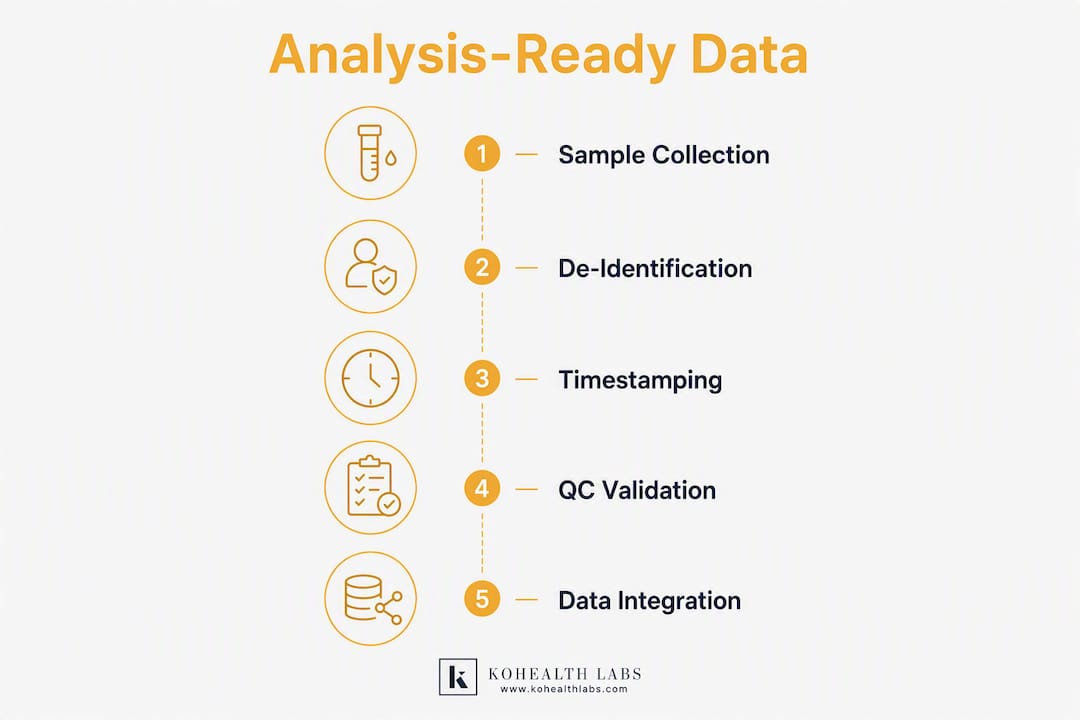
Analysis-ready bundles include de-identified, timestamped lab and imaging data, validated reference ranges, complete metadata (sample chain-of-custody, assay lot numbers, instrument IDs), and machine-readable formats ready for direct CDMS import.
| Format | Best Used For | Integration Method |
|---|---|---|
| HL7/FHIR | Lab results, patient demographics, longitudinal data | REST API endpoint |
| DICOM | Imaging studies, blinded reads, central adjudication | PACS or imaging platform |
| CSV bulk export | Biostatistics datasets, ad hoc analysis | Secure file transfer |
| API (JSON/XML) | Real-time data pull, automated CDMS mapping | Direct integration |
QC steps that must be documented in the vendor's SOPs:
- Automated range and delta checks on every result
- AI anomaly detection with deviation flagging and resolution workflow
- Biostatistics-ready variable labeling and unit standardization
- Audit logs capturing every data access, modification, and transfer event
- Chain-of-custody records linked to each specimen and result
Pro Tip: Before go-live, request a complete example analysis-ready package and run a mock import into your CDMS. Map every field, confirm units match your statistical analysis plan, and document any transformation rules. Fixing mapping errors before enrollment begins costs hours; fixing them after costs weeks.
Unified diagnostics and PGx reporting automation are two areas where integrated platforms consistently outperform siloed vendors on data completeness and turnaround.
What regulatory and compliance requirements must your vendor meet?
Verify CLIA and CAP accreditations, 21 CFR Part 11 electronic records readiness, applicable IDE or PMA pathways for companion diagnostics, and HIPAA-compliant data handling before contract signature.
Required documentation from every vendor:
- Current CLIA certificate of compliance or accreditation
- Most recent CAP inspection checklist and corrective action summary
- 21 CFR Part 11 SOPs covering electronic signatures, audit trails, and system validation
- Assay validation reports for all panels in the SOW
- Chain-of-custody SOPs from specimen collection through data delivery
- HIPAA Business Associate Agreement (BAA)
- Audit log examples demonstrating tamper-evident record keeping
When diagnostics become the critical regulatory path:
- Confirm CDx versus non-CDx classification with regulatory affairs before the SOW is finalized.
- Identify whether an IDE or PMA submission applies to the assay.
- Engage your regulatory lead and the vendor's regulatory team simultaneously, not sequentially.
- Require the vendor to provide a regulatory timeline that aligns with your IND or NDA milestones.
- For multi-country trials, confirm international specimen transport compliance and any IVDR timing considerations.
What should you expect during onboarding after contract signature?
Onboarding moves through five phases: project kickoff, SOP alignment and documentation exchange, IT integration, validation sample runs, and acceptance testing before go-live.
Numbered milestone timeline:
- Kickoff (Week 1–2): Project team introductions, study protocol review, and communication plan established.
- Documentation exchange (Week 2–4): SOPs, assay menus, chain-of-custody forms, and IT architecture documents shared and reviewed.
- IT integration (Week 3–8): API connections, HL7/FHIR endpoints, and DICOM routing configured and tested.
- Validation sample runs (Week 6–12): Blinded validation samples processed; results reviewed against acceptance criteria.
- Acceptance testing (Week 10–14): Mock CDMS import, audit log review, and go/no-go decision.
- Go-live (Week 12–16): First enrollment samples collected under full chain-of-custody.
Sponsor responsibilities during onboarding:
- Provide finalized sample collection SOPs and informed consent language covering biospecimen use
- Coordinate site training schedules with the vendor's training team
- Confirm CDMS field mapping and variable naming conventions before IT integration begins
- Review and approve validation sample results against the statistical analysis plan
Vendor deliverables to track:
- Completed SOPs, V&V documentation, and test menus delivered before validation runs begin
- Training sessions for site coordinators with attendance records
- Acceptance testing report with pass/fail criteria documented
How integrated diagnostics support specialty care teams provides workflow examples that translate directly to onboarding planning for multi-specialty studies.
What outcomes can sponsors realistically expect from integrated diagnostic programs?
Integrated diagnostic programs consistently deliver shorter lab and imaging turnaround times, fewer protocol amendments, and faster database lock readiness compared to multi-vendor approaches. Centralized analysis-ready data pools with standardized reference ranges and de-identified imaging prevent site-level bias from inflating efficacy estimates, which protects the integrity of primary endpoints.
Representative outcomes from integrated programs:
- Reduced median specimen-to-report TAT when phlebotomy, lab, and data delivery are managed under one contract
- Fewer data queries per subject when AI-driven QC catches range errors before database entry
- Faster endpoint adjudication when blinded imaging reads arrive in the same bundle as lab results
- Lower protocol amendment rates when diagnostic sample collection requirements are aligned with the drug protocol from study start
To convert these outcomes into enforceable contract terms, define SLA TATs for each assay category, specify maximum data query rates per 100 subjects, and require a monthly performance dashboard. Consolidated diagnostics and therapeutic-area diagnostic support resources provide benchmarks you can adapt for your SLA negotiations.
Key Takeaways
Integrated drug testing services for clinical trials succeed when analysis-ready data, blinded imaging reads, CLIA/CAP accreditation, and validated AI/QC are contracted together under a single vendor with documented onboarding milestones.
| Point | Details |
|---|---|
| Analysis-ready data is the baseline | Require de-identified, timestamped bundles with chain-of-custody metadata in FHIR, DICOM, and CSV formats. |
| Blinded imaging reads protect endpoints | Central, independent radiology reads prevent site investigators from overestimating drug efficacy. |
| Regulatory classification drives timelines | Confirm CDx versus non-CDx status before signing the SOW to avoid minimum six-month redesign delays. |
| Misalignment is the top delay cause | Administrative gaps between drug-protocol and diagnostic-validation timelines are the most frequent source of study delays. |
| Kohealth Labs | Provides a single-contract integrated lab and imaging platform with AI-driven QC, 100+ biomarkers, and CLIA-ready operations for CROs and sponsors. |
The case for treating diagnostics as a co-equal trial workstream
The conventional wisdom in clinical trial planning treats diagnostics as a support function, something you configure after the drug protocol is locked. That framing is the single most expensive mistake sponsors make.
Diagnostic validation timelines, particularly for companion diagnostics and novel biomarker assays, run parallel to, not after, drug development milestones. When a sponsor engages a diagnostic partner in Phase 3 for an assay that needed Phase 2 validation, the diagnostic workstream becomes the critical path. The study waits on the lab, not the other way around.
The fix is straightforward: treat your diagnostic lead the same way you treat your clinical operations lead. Bring them into protocol design meetings. Confirm assay classification before the IND is filed. Require the vendor to produce a diagnostic timeline that maps to your regulatory milestones, not just your enrollment targets. Sponsors who do this consistently report fewer amendments, cleaner databases, and faster lock readiness. Those who do not often discover the gap at the worst possible moment, during a pre-NDA inspection.
Kohealth Labs: integrated diagnostics built for clinical research
Sponsors and CROs evaluating integrated diagnostic platforms need a partner who can deliver on every dimension the RFP checklist above demands. Kohealth Labs provides exactly that through a single-contract model that unifies lab, imaging, phlebotomy, and analysis-ready data delivery for clinical trials and healthcare programs.
Key capabilities aligned to your evaluation criteria:
- Services offered: Lab, radiology, phlebotomy, and courier specimen pickup under one contract
- Biomarker and genomics coverage: 100+ biomarkers and specialty panels including PGx assays
- Turnaround time: Routine and stat TATs defined per assay category with SLA documentation
- Data formats and integration: API, HL7/FHIR, DICOM, and CSV with EMR and CDMS mapping support
- Accreditations: CLIA-ready operations, CAP-aligned QC, HIPAA BAA, and 21 CFR Part 11 readiness
- AI and QC: Validated AI-driven anomaly detection, delta checks, and audit-logged deviation resolution
- Logistics: Nationwide phlebotomy network with cold-chain courier pickup and chain-of-custody documentation
- Pricing model: Fee-for-service and bundled analysis-ready data packages with transparent onboarding fees
- Onboarding support: Dedicated project team, SOP alignment, IT integration, validation runs, and site training
Request a sample analysis-ready data package and onboarding checklist by visiting the Kohealth Labs clinical trials page and connecting with the team directly.
Authoritative resources for procurement and regulatory review
- 21 CFR Part 11 and IVD regulatory frameworks (RQM+) — use for electronic records readiness and FDA IVD regulatory strategy
- Integrative diagnostics and clinical decision support — use for IT integration rationale and data unification standards
- Kohealth Labs specialty testing panels — use for biomarker menu review and AI/QC capability assessment
- Kohealth Labs AI and data delivery — use for data format specifications, API documentation, and QC validation details
- Kohealth Labs blog: common diagnostic delays — use for delay mitigation planning and onboarding timeline benchmarks