

A regulatory-aligned sample stability program rests on five pillars: validated stability-indicating analytical methods, clearly defined storage conditions with documented tolerances, a study design covering long-term, intermediate, and accelerated conditions with minimum timepoints across at least three primary batches, forced-degradation (stress) testing to challenge method specificity, and an unbroken chain-of-custody backed by SOP-level documentation. Every section below breaks one of these pillars into protocol language, statistical methods, and audit-ready checklists you can lift directly into a study plan.
TL;DR:
- Batch selection and testing frequency must follow ICH and FDA guidelines, with at least three batches for drug products and five timepoints for clinical specimens.
- Storage conditions need strict adherence to specified temperature and humidity tolerances, with documented excursions and corrective actions to prevent data invalidation.
- Forced-degradation studies must confirm that analytical methods separate parent compounds from degradation products before stability evaluation begins.
- A stability-indicating method requires verified separation of components and should be validated for accuracy and precision within the actual study matrices.
- An integrated diagnostics approach consolidates laboratory, radiology, and logistics data, reducing gaps and streamlining regulatory compliance during stability studies.
Which Regulations Govern Sample Stability Guidelines?
Three sources of authority shape almost every stability protocol you'll write: ICH, the FDA, and a growing body of consensus recommendations for clinical specimens that fill gaps the drug-substance guidelines never addressed.
The ICH Q1A(R2) guideline sets the baseline stability data package for drug substances and drug products. It calls for at least 12 months of long-term data on a minimum of three primary batches, alongside defined intermediate and accelerated conditions and a testing schedule (commonly 0, 3, and 6 months under accelerated conditions). This is the document regulators expect to see referenced by name in your protocol's rationale section, not paraphrased from memory.
The FDA's stability guidance builds on ICH Q1A with sharper operational detail. It recommends stress testing at temperature increments of 10°C above your accelerated condition, humidity stress around 75% relative humidity, and forced oxidation, photolysis, and hydrolysis across a range of pH values. The agency also expects batch selection and testing frequency to be justified in writing, not simply copied from a template.
For clinical specimens, the guidance gap gets filled by two consensus bodies. The Global Bioanalysis Consortium's harmonization recommendations cover practical bioanalytical scenarios ICH never anticipated: bench-top stability, freeze-thaw cycling, long-term frozen storage, and stock solution stability, with acceptable bias thresholds baked in. Separately, EFLM's WG-PRE recommendations prescribe a statistically rigorous design for clinical specimen stability studies, built around regression modeling and hypothesis testing rather than simple pass/fail comparisons.
Industry guidelines round out the picture. The CHPA's stability testing guideline for nonprescription drug products shows how a mature industry group translates ICH principles into reduced-sampling programs for OTC products, an approach worth studying even if you work exclusively with prescription drugs or biospecimens.
None of these frameworks demand rigid uniformity. Where your matrix, analyte, or clinical context doesn't fit the default template, document the deviation and the scientific rationale behind it. Regulators generally accept a justified alternative approach far more readily than an unexplained shortcut.
How Many Batches and Timepoints Does a Stability Study Need?
Batch count and timepoint spacing are the two decisions that determine whether your stability data will actually support a shelf-life or retest-period claim, or collapse under statistical scrutiny.
For drug substances and drug products, ICH Q1A(R2) sets the floor at three primary batches for long-term and accelerated testing. Add a fourth batch, or extra samples at the final timepoint, when your accelerated data already shows a "significant change," since a thin dataset at that stage tends to produce shelf-life estimates that don't survive statistical review during submission.
Timepoint spacing typically follows certain templates:
- Long-term studies sample at multiple timepoints over a year or more, tapering to less frequent intervals thereafter.
- Intermediate studies, used when accelerated data shows change, sample at several points within a year.
- Accelerated studies use a shorter sampling schedule, with more frequent early timepoints, and may add points if early degradation appears.
- Clinical specimen stability studies require a minimum of five uniformly distributed storage timepoints to produce a statistically valid instability equation, a requirement EFLM's WG-PRE treats as non-negotiable for regression-based modeling.
- Isochronous designs, where samples from multiple collection days are all tested on a single analytical run, reduce run-to-run variability but delay the availability of intermediate results compared to a longitudinal design tested as each timepoint is reached.
Replicate strategy matters as much as timepoint count. The GBC's harmonization team recommends triplicate measurements as standard practice for bioanalytical stability assessments, which gives you enough data to distinguish genuine degradation from assay noise without inflating sample consumption unnecessarily.
Pro Tip: Before finalizing your timepoint schedule, map it against your instability equation's degrees of freedom. Five timepoints is a statistical minimum, not a comfortable margin. If your matrix is prone to variable degradation kinetics, six or seven uniformly spaced points give your regression far more room to detect nonlinearity before you commit to a shelf-life claim.
What Preanalytical Controls Prevent Sample Instability?
Most stability failures never happen in the storage freezer. They happen in the thirty minutes between collection and processing, when a mislabeled tube, a delayed centrifugation step, or an undocumented temperature excursion quietly compromises data you won't examine for months.
Every specimen needs a defined metadata set captured at collection: matrix type, anticoagulant or preservative used, collection volume, light sensitivity requirements, container material, and a unique identifier tied to the chain-of-custody record. The GBC's sample management recommendations push labs toward standardized storage terminology, replacing vague labels like "cold" with defined ranges for room temperature, refrigerator, freezer, and ultra-freezer storage. That precision matters enormously once you're coordinating stability data across multiple collection sites, where "refrigerated" can mean three different temperature bands depending on who wrote the SOP.
Processing steps deserve equally tight documentation:
- Centrifugation parameters (speed, duration, temperature) recorded for every batch, not just validated once and assumed stable.
- Stabilizer or preservative addition timing, since a delayed additive can shift degradation kinetics measurably.
- Aliquoting procedures that minimize freeze-thaw cycling for samples slated for long-term storage.
- LIMS-based chain-of-custody tracking that timestamps every handoff from collection through final disposal.
- Transport mode selection (dry ice, wet ice, or ambient) matched to the analyte's known stability profile, with temperature logs retained as part of the study record.
The principle here isn't unique to pharmaceuticals. Environmental testing labs working under EPA SW-846 methods apply the same logic: holding times and preservation methods must be analyte- and matrix-specific, never generalized across sample types. A serum sample and a whole-blood sample simply don't share a preservation window, and treating them as interchangeable is a documented source of avoidable data loss.
Pro Tip: Run a mock chain-of-custody audit before your first stability batch ships. Pull one sample record end to end and check whether every handoff, temperature reading, and processing step has a timestamp. Gaps you find in a mock audit are far cheaper than gaps a regulator finds in a submission. Tools like AI-driven preanalytical QA can flag these deviations automatically before they propagate into your stability dataset.

What Storage Conditions and Tolerances Does ICH Require?
ICH Q1A(R2) defines three standard storage conditions, and getting the tolerances wrong is one of the more common (and avoidable) reasons stability data gets questioned during review.
- Long-term conditions typically run at 25°C ± 2°C / 60% RH ± 5% RH, or 30°C ± 2°C / 65% RH ± 5% RH for climatic zones where higher ambient humidity is the norm.
- Intermediate conditions sit at 30°C ± 2°C / 65% RH ± 5% RH, used when accelerated data shows significant change and long-term data alone won't support the proposed shelf life.
- Accelerated conditions run at 40°C ± 2°C / 75% RH ± 5% RH, designed to surface degradation pathways faster than real-time storage would reveal them.
- Container/closure systems need testing in the actual proposed packaging configuration, not a generic reference container, since permeability and light exposure vary meaningfully between blister packs, amber glass, and HDPE bottles.
- Alternative conditions (a different humidity band, a refrigerated storage claim, a specialized packaging format) require documented scientific justification tied to the drug substance's known degradation chemistry.
Excursion handling deserves its own SOP, separate from the primary storage protocol. When a stability chamber drifts outside its tolerance band, even briefly, the response needs to be immediate and documented: log the excursion's duration and magnitude, assess whether the affected timepoint samples remain scientifically valid, and record the corrective action taken on the chamber itself. A single undocumented excursion can force you to discard an entire timepoint's data, which is a far more expensive outcome than the monitoring investment that would have caught it early. Continuous cold-chain monitoring during both storage and transport closes this gap before it becomes a data integrity problem.
How Should Forced-Degradation Studies Be Designed?
Stress testing exists to answer one question before your stability program even begins: does your analytical method actually separate the parent compound from everything it degrades into?
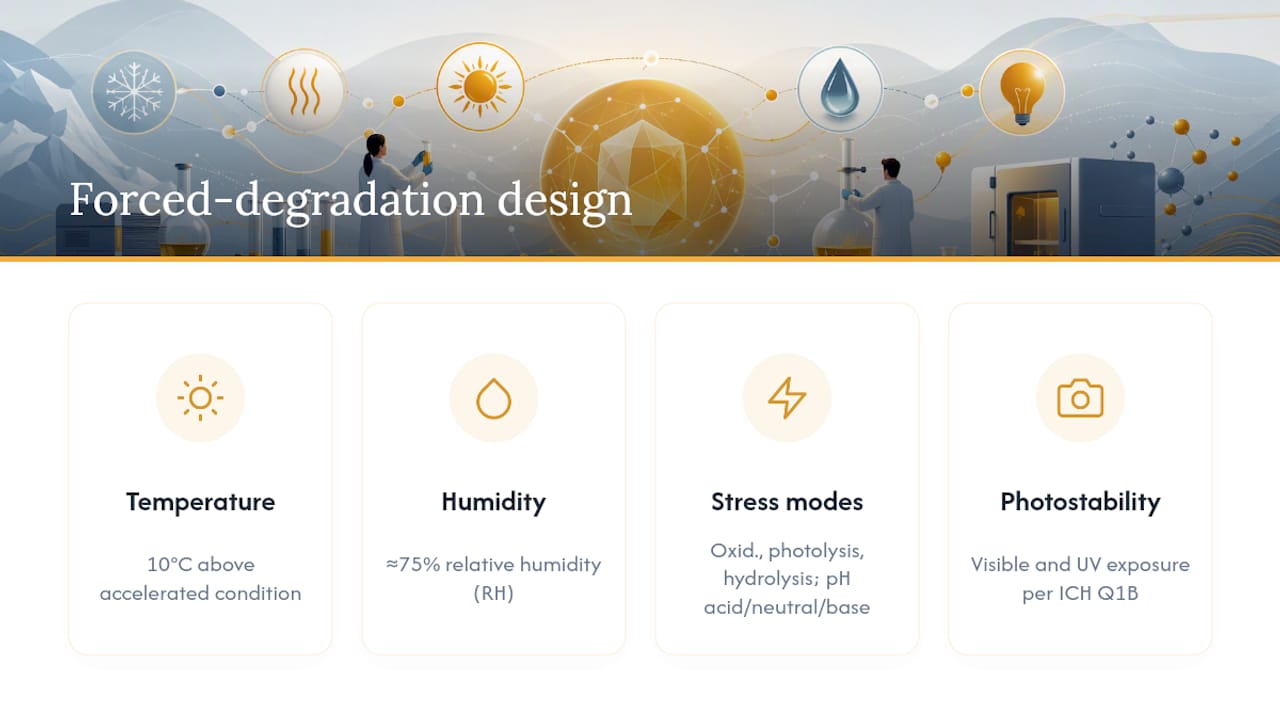
FDA guidance recommends running forced-degradation studies at temperatures 10°C above your accelerated condition, humidity stress around 75% RH, and forced oxidation, photolysis, and hydrolysis across acidic, neutral, and basic pH conditions. Photostability testing specifically follows ICH Q1B's light exposure protocols, which specify defined illumination levels for both visible and UV light exposure.
The goal isn't to destroy the sample; it's to generate a representative spread of degradation products under controlled, exaggerated conditions so you can confirm your analytical method resolves each one from the parent peak. A method that looks clean on a fresh sample but can't distinguish a degradation product from the active compound isn't stability-indicating. It's just a method that hasn't been challenged yet.
Interpreting the results means comparing degradation product profiles against your proposed specification limits and confirming peak purity through techniques like diode-array UV scanning or mass spectrometry. When a degradation product coelutes with the parent peak, that's a method specificity failure that needs resolving before you commit to a shelf-life study, not after.
Stress testing can be scoped down with justification, particularly for well-characterized molecules with an established degradation literature or for line extensions of an already-validated formulation. The justification itself needs to be explicit in your protocol. Regulators accept scientific reasoning readily; they rarely accept an assumption stated without one.
What Makes an Analytical Method "Stability-Indicating"?
A stability-indicating method must demonstrate clean separation between the parent compound and its degradation products, along with acceptable accuracy and precision across the matrices your study actually uses. That's the baseline definition, and it's worth repeating because "validated" and "stability-indicating" get conflated more often than they should. A method can be validated for potency assay and still fail as a stability-indicating method if it can't resolve a known degradant.
Practical bias thresholds vary by assay type. The GBC's harmonization recommendations cite acceptable bias limits around 15% for chromatographic methods and 20% for ligand-binding assays, reflecting the greater inherent variability of immunoassay platforms compared to HPLC or LC-MS/MS. Apply the tighter threshold whenever your method allows it; reserve the looser binding-assay threshold for situations where the assay chemistry genuinely demands it.
Every stability study needs a defensible t=0 measurement, established before any storage condition begins, since it's the baseline every later timepoint gets compared against. Where possible, use incurred samples (real matrix containing the analyte from actual biological or manufacturing processes) rather than spiked samples, since spiking can behave differently than naturally incorporated analyte, particularly for protein-bound or matrix-associated compounds.
Duplicate or triplicate measurements at each timepoint, paired with QC samples run alongside study samples, let you separate genuine degradation trends from assay-to-assay variability, a distinction that matters enormously once you move into regression modeling.
How Do You Statistically Evaluate Stability Data?
Turning a stability dataset into a defensible shelf-life or retest-period claim follows a specific statistical sequence, and skipping steps is where most protocols run into trouble during review.
- Choose your regression model based on the degradation kinetics you observe. Linear regression is preferred whenever the data supports it; only move to a transformed or nonlinear model when a linear fit shows systematic lack of fit against your goodness-of-fit checks.
- Confirm you have enough timepoints. EFLM's WG-PRE recommendations require a minimum of five uniformly distributed timepoints to produce a valid instability equation for clinical specimens. Fewer points and your regression estimate carries too much uncertainty to support a defensible limit.
- Test slope significance with a t-test. A slope that isn't statistically different from zero suggests the analyte is stable across your tested storage window; report the R² and p-value alongside the slope estimate so a reviewer can independently judge fit quality.
- Calculate the 95% one-sided confidence limit and find where it intersects your predefined maximum permissible error (MPE) to derive your stability limit, the point at which percent degradation crosses the acceptance threshold you set in the protocol before testing began.
- Test for pooling across batches by comparing slopes and intercepts statistically. ICH Q1A(R2) treats a p-value above 0.25 as a practical threshold for considering batches similar enough to pool; document the test result and retain each batch's raw slope data for audit purposes even after pooling.
Regression through the origin, uniformly spaced timepoints, and hypothesis-tested slope significance form the statistical backbone EFLM's WG-PRE recommends for every clinical specimen stability study, regardless of matrix.
Extrapolation beyond your longest tested timepoint should stay limited and always tied to a documented scientific rationale, generally no more than double the duration of long-term data already collected, and only when the degradation trend is well-established and linear. Where accelerated data shows early signs of significant change, resist the temptation to extrapolate further; add a fourth timepoint or extra final-timepoint replicates instead, since that additional resolution tends to produce a more defensible retest period than a longer extrapolation from thinner data.
What SOPs and Reports Do Stability Programs Need?
A stability program lives or dies on its documentation trail, and the SOP list is longer than most protocols initially budget for. At minimum, you need a stability protocol SOP defining batch selection and storage conditions, a sample processing SOP, a container/closure testing SOP, a stress-testing SOP, an analytical method SOP specific to the stability-indicating assay, a chain-of-custody SOP, and an excursion response SOP.
Study reports submitted for regulatory review need raw data (not just summary tables), full batch descriptions including manufacture date and container/closure configuration, analytical method validation data, degradation product profiles from stress testing, and the complete statistical analysis behind any shelf-life or retest-period claim.

Retention requirements extend well past the study's active phase. Metadata, raw chromatograms, and chain-of-custody records typically need retention periods matching your organization's broader regulatory record-keeping policy, and disposal records need the same documentation rigor as collection records. A missing disposal log is a surprisingly common audit finding.
How Do Integrated Diagnostics Support Guideline-Driven Stability Programs?
Every requirement above depends on one thing: consistent execution across every site, shipment, and handoff a sample passes through. That's where fragmented vendor relationships tend to break down, since each additional lab, courier, or imaging partner introduces its own documentation gaps and terminology drift.
An integrated diagnostics model, combining lab services, radiology, and data delivery under a single contract, removes several of those handoff points entirely. Kohealth Labs's AI preanalytical QA flags deviations like delayed processing or temperature excursions before they invalidate a stability timepoint, while LIMS-based chain-of-custody tracking and monitored cold-chain logistics feed directly into regulatory reporting instead of living in a separate spreadsheet. Sponsors evaluating a diagnostics vendor should ask specifically what SOPs and audit trails come standard, not bundled as an add-on.
Practical Trade-Offs and Defensible Scientific Decisions
Every stability program eventually faces a resource allocation question: add more timepoints, add more replicates, or switch to an isochronous design? There's no universal answer, but there is a defensible way to reason through it.
Isochronous designs earn their keep when a reliable long-term reference method already exists and run-to-run variability is your dominant source of noise. You trade away early visibility into intermediate results, which matters less when your degradation kinetics are already well-characterized from prior studies on related compounds.
Additional replicates improve confidence fastest when your assay has known precision limitations, particularly ligand-binding assays sitting near that 20% bias threshold. Additional timepoints matter more when the degradation kinetics themselves are uncertain, since no amount of replication fixes an underpowered regression model.
Where I'd push back on common practice: too many programs default to the ICH minimum of three batches and five timepoints as though it were a target rather than a floor. That's diminishing returns thinking applied backward. The marginal cost of a fourth batch or a sixth timepoint is small relative to the cost of a retest-period claim that doesn't survive statistical challenge during submission.
— Kohealth Labs
Get Regulatory-Ready Stability Data Without Managing Five Vendors
Most stability programs lose time and data quality in the gaps between vendors, one lab for chemistry, another for imaging, a separate courier for cold-chain transport, each with its own documentation format. An integrated diagnostics provider consolidates laboratory diagnostics, radiology, and specimen logistics under a single contract, which means chain-of-custody records, temperature logs, and analytical data arrive as one regulatory-ready bundle instead of multiple reconciled spreadsheets.

That integration matters most at the exact points this guide covers: preanalytical handling, storage monitoring, and stability-indicating method validation. AI-driven QA can flag preanalytical deviations before they reach your stability dataset, and analytics spanning more than 100 biomarkers can feed directly into the reporting format sponsors need for submissions. For CROs and pharmaceutical sponsors evaluating a lab partner, the practical question is what documentation ships standard versus what gets billed separately. Review Kohealth Labs's pathology and diagnostics services to see how a single-contract model maps against your current vendor list, or explore the integrated diagnostics solutions page to request a walkthrough of how labs, radiology, and data delivery come together for your next trial.
Sources
- ICH Q1A(R2) guideline on stability testing of drug substances and drug products
- FDA guidance: Stability Testing of New Drug Substances and Products (Q1A-related guidance)
- Stability: Recommendation for Best Practices and Harmonization from the Global Bioanalysis Consortium Harmonization Team
- Recommendation for the design of stability studies on clinical specimens (EFLM WG-PRE)
- Recommendation for the design of stability studies on clinical specimens
FAQ
What are the ICH guidelines for stability testing?
ICH Q1A(R2) defines the stability data package for drug substances and products, specifying long-term, intermediate, and accelerated storage conditions, minimum batch counts, and testing frequency requirements.
What are the GMP requirements for stability testing?
GMP-aligned stability testing requires validated stability-indicating methods, documented SOPs for sample processing and storage, chain-of-custody records, and statistical justification for any shelf-life or retest-period claim submitted to regulators.
Who sets the guidelines on stability testing?
ICH and the FDA set the primary regulatory framework for drug substance and product stability, while consensus bodies like the Global Bioanalysis Consortium and EFLM's WG-PRE fill guidance gaps specific to clinical specimens.
How many timepoints does a stability study need?
Clinical specimen stability studies require a minimum of five uniformly distributed timepoints to produce a statistically valid instability equation, while drug substance studies typically follow a longer schedule extending to at least 12 months for long-term conditions.