

For CROs and pharmaceutical sponsors, engaging a qualified hospital laboratory partner is the right move — provided that partner delivers integrated lab and radiology diagnostics under a single contract with regulatory-aligned, analysis-ready data. Here is what to expect from that relationship:
- Single-contract diagnostics: One agreement covers phlebotomy, centralized testing, imaging reads, and data delivery — no fragmented vendor management.
- Integrated lab + radiology data bundles: Structured datasets that combine biomarker results and imaging findings, formatted for direct use in statistical analysis and regulatory submissions.
- Regulatory-aligned delivery: CLIA-certified, CAP-accredited workflows with FDA-aware documentation for companion diagnostic (CDx) pathways and HIPAA-compliant data governance.
Your next step: run the capability checklist in Section 4 against any prospective partner before issuing an RFP.
What does a hospital laboratory partner actually provide for clinical trials?
A hospital laboratory partner is a diagnostics organization that embeds clinical lab and imaging services into a trial's operating model, delivering more than test results. The partner manages the full specimen-to-data chain: collection, transport, analysis, quality control, and structured data delivery to the sponsor or CRO.
Core services in a trial-ready partnership include:
- Phlebotomy and site enablement: Trained collectors at clinical sites, with manifesting, labeling, and temperature-controlled specimen handling.
- Courier and specimen logistics: Scheduled pickup, cold-chain transport, and chain-of-custody documentation from site to lab.
- Centralized testing: Broad test menus covering hematology, chemistry, genomics, immunohistochemistry (IHC), and specialty biomarker panels.
- Imaging integration: Standardized DICOM-format radiology reads linked to the same subject record as lab results.
- AI-driven data quality: Automated deviation detection, completeness checks, and flagging before data reaches the sponsor.
- EMR and portal order flows: HL7/FHIR connectivity so ordering, results, and audit trails move through existing clinical systems.
This model fits trials that need a unified diagnostics approach, rather than separate send-out labs and radiology vendors. It is especially suited to multi-site studies where data consistency across sites is a regulatory requirement.

Why integrated lab and radiology partnerships accelerate CDx programs
The top benefit is speed to regulatory-ready data. When lab results and imaging findings arrive in the same structured bundle, your biostatistics team does not spend weeks reconciling two separate data streams.
Key procurement outcomes include:
- Accelerated CDx commercialization: Integrated partners bridge CDx development from centralized assay validation to provider-facing order flow, shortening the path from PMA submission to market access.
- Fewer trial delays: Consolidated specimen logistics and a single escalation path reduce the site-level errors that stall data lock.
- Consolidated billing: One invoice covers lab, imaging, and data services — simplifying reconciliation for finance teams.
- Improved TAT and data completeness: Embedded quality checks catch missing or degraded specimens before they become protocol deviations.
- Better patient and provider access: Geographic provider networks and rural lab-radiology reach expand enrollment options without adding site management burden.
Industry momentum supports this direction. Strategic partnerships to commercialize CDx through lab networks are now a recognized model, with diagnostic organizations explicitly naming commercial lab partners to enable order flow and physician access after centralized CDx approval.
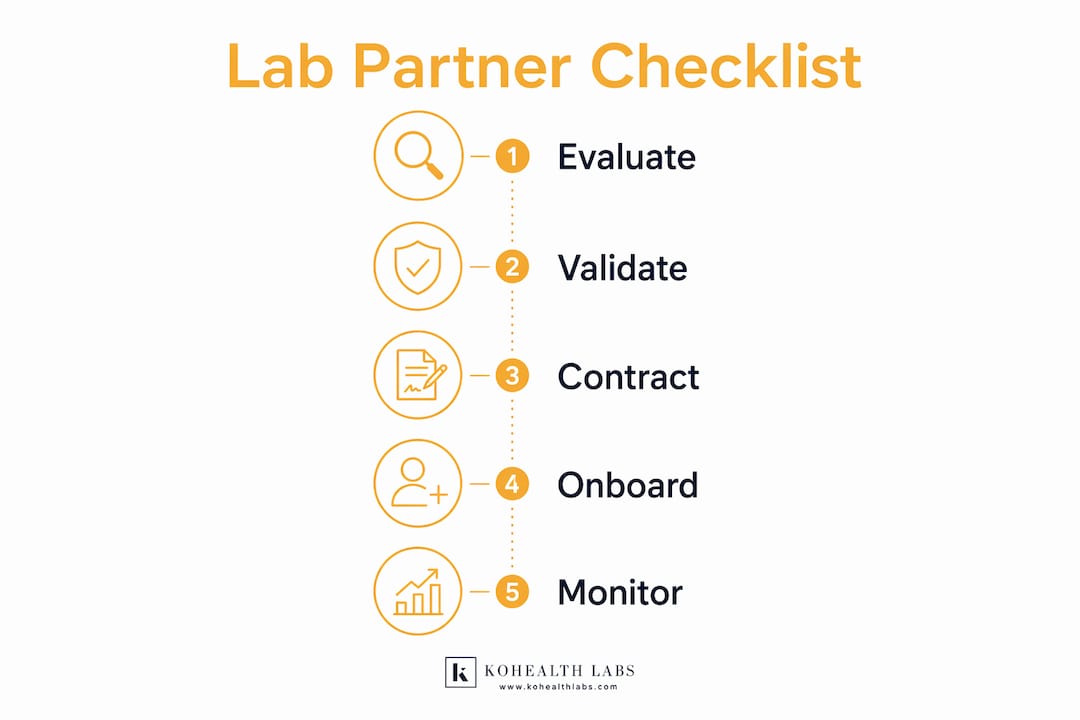
Checklist: what capabilities must you require from a clinical lab partner?
Use this checklist directly in your RFP or vendor scorecard. Score each dimension before shortlisting.
Clinical capabilities
- Biomarker panels covering 100+ analytes, including genomics and IHC
- Digital pathology and whole-slide imaging support
- Specialty assay menu with documented validation packages
Imaging integration
- Standardized DICOM data flows with radiology read services
- Linked subject-level records combining lab and imaging results
Logistics
- Courier SLA with documented temperature excursion protocols
- Specimen stability validation for each assay type
Data and IT
- Full audit trail from collection to data delivery
- HL7/FHIR and CSV delivery options
- EMR/portal integration with order-flow documentation
Clinical operations
- On-site or mobile phlebotomy with trained collectors
- Site staff training and written SOPs
Red flags to reject a vendor immediately:
- No CLIA certification or CAP accreditation on file
- No documented chain-of-custody SOP
- Audit trail gaps or no LIMS connectivity
- Inability to deliver HL7/FHIR-formatted data
Hospital-lab partnerships that include embedded strategic teams and test menu optimization consistently reduce send-outs and improve TAT — both of which belong on your scorecard.
Regulatory and compliance requirements you must verify before contracting
Every clinical lab partner for U.S. trials must hold CLIA certification and CAP accreditation, maintain HIPAA-compliant data flows, and carry FDA-aware documentation for any CDx assay pathway.
Verify each of the following before signing:
- CLIA certification: Current certificate on file; confirm the certificate type covers the complexity of assays you need.
- CAP accreditation: Inspection records and most recent proficiency testing results.
- FDA CDx pathway documentation: Assay validation packages aligned with PMA or 510(k) requirements; bridging study plans if moving from centralized to send-out.
- Chain-of-custody SOPs: Written procedures covering collection, transport, receipt, and disposal.
- Business Associate Agreement (BAA): Executed before any PHI is transferred.
- Data residency and PHI controls: Confirm data stays within U.S. jurisdiction and access is role-restricted.
APHL emphasizes that structured preparedness exercises and standards alignment with CDC and CAP keep sentinel clinical labs ready for high-stakes detection — the same rigor applies to trial-phase lab partners.
Pro Tip: Align your assay validation package with FDA expectations during Phase II, not at the NDA/BLA stage. Retrofitting validation documentation after the trial is complete routinely adds six to twelve months to a CDx submission timeline.
Contracting models, pricing structure, and SLAs to expect
A single-contract platform model is the standard for integrated clinical lab partnerships. It replaces fragmented per-vendor fees with one master service agreement covering all diagnostic services, data delivery, and support.
Typical commercial elements:
- Onboarding and setup fees: Site enablement, SOP alignment, and LIMS connectivity setup.
- Per-specimen test fees: Priced by panel or individual assay; volume tiers apply at defined thresholds.
- Imaging read fees: Per-study or bundled with lab panels for integrated CDx programs.
- Volume discounts: Negotiated at contract execution based on projected enrollment.
- Billing cadence: Monthly reconciliation with itemized specimen-level reporting.
- Indemnity and insurance: Confirm professional liability coverage for lab errors and data breaches.
Laboratory service agreements commonly take the form of joint ventures, service agreements, or test-sharing arrangements — each with different risk and oversight profiles.
| SLA Metric | Definition | Target Range | Review Frequency |
|---|---|---|---|
| Turnaround time (TAT) | Collection to result reporting | 24 hours by assay type | Weekly |
| Specimen rejection rate | Rejected specimens / total received | < 2% | Weekly |
| Data completeness | Analysis-ready datasets / total expected | Above 98% | Monthly |
| Audit log completeness | Logged events / total transactions | 100% | Quarterly |
How to operationalize the partnership from contract to trial-ready
A typical engagement runs 8–12 weeks from contract signature to first patient sample, depending on assay complexity and site count.
- Kickoff and governance: Establish a joint steering committee, assign a dedicated account manager, and confirm escalation paths.
- SOP alignment: Review and reconcile specimen handling, labeling, and temperature-control procedures across all sites.
- Assay validation or bridging: If CDx assays require bridging from a centralized to a distributed model, initiate validation studies immediately.
- Courier and lab connectivity: Confirm courier routes, pickup schedules, and LIMS-to-LIMS or HL7 data links.
- Training and site enablement: Deliver phlebotomy training, manifesting instructions, and escalation contact lists to all site coordinators.
- Pilot batch testing: Run a controlled specimen batch through the full chain before go-live to confirm TAT and data quality.
- Go-live: Activate all sites with real-time monitoring dashboards enabled.
Site enablement essentials for each location:
- Phlebotomy certification verification for all collectors
- Printed and digital manifesting templates
- Specimen labeling kits with barcode integration
- Temperature-controlled transport containers with excursion loggers
- Written escalation path for rejected or compromised specimens
How a hospital lab partner accelerates CDx development and commercialization
Integrated partners enable faster CDx commercialization by combining assay validation with provider network scale. That combination is what closes the gap between a centralized PMA approval and the broad physician access a drug's commercial launch requires.
The practical use cases are straightforward:
- Single-site to network bridge: A sponsor validates the CDx assay at one centralized lab, then the partner's network enables send-out or kitted IVD distribution to community oncology practices.
- Provider-facing order flow: The partner's existing provider relationships mean ordering physicians can access the CDx test through familiar workflows on day one of commercial launch.
- Post-approval access continuity: The same partner that ran trial-phase testing maintains the assay commercially, preserving validation integrity.
Large diagnostic networks are now named as CDx commercialization partners specifically to bridge centralized approval strategies to broader physician and patient access — a model that digital pathology integration is making more scalable across specialty workflows.
Pro Tip: When negotiating the partnership agreement, include a commercial-use clause that allows the partner to fulfill post-approval CDx orders under the same validated SOP. Renegotiating this after approval adds delay and legal cost.
KPIs and reporting standards sponsors should require
The most critical KPIs are TAT, specimen rejection rate, data completeness, and audit log integrity. Require all four in your SLA before signing.
| KPI | Definition | Acceptable Threshold | Monitoring Frequency |
|---|---|---|---|
| Turnaround time (TAT) | Collection to result delivery | Per-assay SLA (typically 24 hrs) | Weekly |
| Specimen rejection rate | Rejected / total received | < 2% | Weekly |
| Analysis-ready dataset rate | Complete, QC-passed datasets / expected | Above 98% | Monthly |
| Audit log completeness | Logged events / total system transactions | 100% | Quarterly |
| Data deviation rate | Flagged deviations / total data points | < 1% | Monthly |
Reporting cadence and audit expectations:
- Real-time dashboards for TAT and specimen status, accessible via the provider portal
- Monthly executive summaries covering all five KPIs with trend lines
- Quarterly formal audits with written corrective action plans for any threshold breach
- Annual SOP review with documented sign-off from both parties
How Kohealth Labs maps to the procurement checklist
Kohealth Labs meets the single-contract, integrated lab and radiology, regulatory-aligned, AI-driven data quality requirements laid out in this guide. The model is built specifically for CROs and pharmaceutical sponsors who need analysis-ready data bundles without managing multiple diagnostic vendors.
Capability mapping:
- Phlebotomy and site enablement: Mobile phlebotomy, courier specimen pickup, and dedicated site training included.
- 100+ biomarker coverage: Panels spanning hematology, chemistry, genomics, IHC, and specialty analytes.
- Imaging integration: Radiology reads delivered in the same structured data bundle as lab results.
- AI-driven data quality: Automated deviation detection and completeness checks before data reaches your team.
- EMR and portal connectivity: HL7/FHIR integration with provider portal access for ordering and results.
- Regulatory alignment: CLIA/CAP-credentialed workflows with FDA-aware documentation for CDx pathways.
| Checklist Requirement | Kohealth Labs Capability |
|---|---|
| Single-contract model | One master agreement covers lab, imaging, data, and support |
| 100+ biomarker panels | Covered across genomics, IHC, and specialty assays |
| Imaging integration | Radiology reads in the same data bundle as lab results |
| AI data quality checks | Automated deviation detection and QC before delivery |
| CLIA/CAP credentials | Regulatory-aligned workflows with FDA-aware documentation |
| EMR/portal integration | HL7/FHIR connectivity with provider portal access |
The single-contract model is the operational core. Sponsors working with Kohealth Labs get one point of contact, one invoice, and one integrated data bundle — which directly reduces the coordination overhead that delays data lock in multi-vendor trial setups. For CDx programs, that means assay validation, provider-facing order flow, and post-approval access continuity all sit under the same agreement.
Pro Tip: Request a sample data bundle from any prospective partner before contracting. The format, completeness, and structure of that sample will tell you more about their data readiness than any capability slide deck.
Key Takeaways
An integrated hospital laboratory partner with single-contract diagnostics, AI-driven data quality, and regulatory-aligned delivery is the most direct path to analysis-ready trial data and faster CDx commercialization.
| Point | Details |
|---|---|
| Single-contract model | One agreement covering lab, imaging, and data delivery reduces vendor complexity and speeds data lock. |
| Regulatory verification | Confirm CLIA certification, CAP accreditation, and FDA-aware CDx documentation before signing any agreement. |
| CDx commercialization | Integrated partners bridge centralized assay validation to provider-facing order flow for post-approval access. |
| KPI requirements | Require TAT, specimen rejection rate below 2%, and analysis-ready dataset rate above 98% in every SLA. |
| Kohealth Labs | Delivers single-contract integrated lab and radiology diagnostics with AI data quality and 100+ biomarker coverage for CROs and sponsors. |
The procurement lens that separates credible partners from capable ones
Most procurement conversations about clinical lab partnerships focus on capability lists. What actually differentiates a credible partner is governance structure and data accountability — two things that rarely appear on a vendor's capability slide.
Speed and continuity pull in opposite directions in this space. A partner with a large provider network can onboard sites fast, but network scale often means looser SOP consistency across locations. A single-site partner offers tighter validation control but limits enrollment geography. The right answer depends on your trial phase: centralized control for Phase I/II validation, network scale for Phase III and commercial bridging.
The governance point is where most sponsors underinvest. A joint steering committee with defined data change control procedures — written escalation paths, documented deviation review cycles, and named decision-makers on both sides — is what keeps a partnership functional when something goes wrong at 2 AM before a data lock. Build that structure into the contract, not as an afterthought after go-live.
The BLUF holds: engage a partner who delivers integrated lab and radiology data under one contract, verify credentials before signing, and build governance into the agreement from day one.
Kohealth Labs: integrated diagnostics built for CROs and pharma sponsors
Clinical trial diagnostics should not require five vendors, three billing systems, and a project manager just to reconcile lab and imaging data. Kohealth Labs delivers integrated laboratory and radiology diagnostics under a single contract, with AI-driven data quality checks, coverage across 100+ biomarkers, and regulatory-aligned delivery built for CDx programs and multi-site trials.
What you get when you engage Kohealth Labs:
- Pilot program: Start with one site to validate TAT, data format, and SOP fit before full rollout.
- RFP support: Receive a pre-populated capability matrix and sample data bundle to accelerate your vendor evaluation.
- Onboarding package: Site enablement, phlebotomy training, courier setup, and LIMS connectivity in one coordinated plan.
- Dedicated account team: A single point of contact for clinical ops, regulatory, and data questions throughout the trial.
Visit kohealthlabs.com to request a pilot or start your RFP conversation with the Kohealth Labs team today.
Selected authoritative sources for compliance and partnership best practices
The references below cover U.S. regulatory standards, lab partnership models, and CDx commercialization context. Use them to verify partner credentials, benchmark SLA terms, and understand the regulatory framework before contracting. Always request a current CLIA certificate, CAP accreditation letter, and assay validation package directly from any prospective partner.
- APHL Clinical Laboratory Partnerships — APHL's framework for clinical lab preparedness, LPX exercises, and standards alignment with CDC and CAP; foundational for evaluating a partner's regulatory readiness.
- CellCarta and Sonic Healthcare CDx Partnership Announcement — Real-world example of a lab-network CDx commercialization model bridging centralized approval to provider-facing order flow.
- HNL Lab Medicine Health System Partnerships — Describes embedded strategic teams, shared services, and test menu optimization in active hospital-lab partnerships.
- Sonic Healthcare USA Hospital-Lab Partnerships — Documents common partnership structures including joint ventures, laboratory service agreements, and test-sharing arrangements.
- Mayo Clinic Laboratories — Reference for consultative pathology services and advanced test menus available through health system partnerships.
- EIV Diagnostics — For Providers — Provider-oriented content on clinical lab value, digital pathology integration, and specialty workflow support.
- UW Health Clinical Laboratory Services — Example of a health system lab operating 24/7 with on-site testing and outreach draw sites; useful benchmark for TAT and access expectations.