

A biomarker panel is defined as a set of measurable biological markers analyzed together to deliver diagnostic, prognostic, and therapeutic data that no single marker can provide alone. The biomarker panel clinical research role has expanded significantly, with multi-marker approaches now achieving diagnostic sensitivity above 90% for complex diseases. A three-marker pancreatic cancer panel, for example, reached an AUC of 0.91 in 2026 validation studies. Regulatory bodies including the FDA and EMA have formalized guidance requiring panels to demonstrate analytical validity, clinical validity, and clinical utility before trial integration. Kohealth Labs supports this standard through integrated diagnostics covering over 100 biomarkers, combining laboratory services, radiology, and AI-driven data quality checks in a single contract.
What roles do biomarker panels serve in clinical research and drug development?
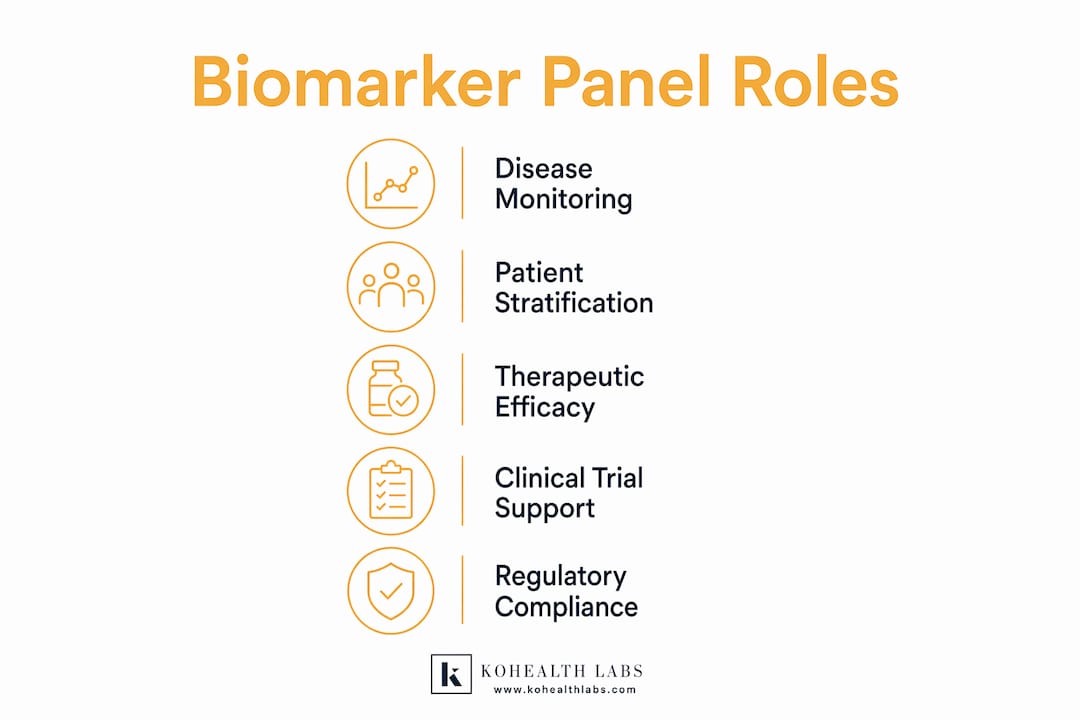
Biomarker panels serve four core functions in clinical research: disease monitoring, patient stratification, efficacy assessment, and safety surveillance. Each function depends on the panel's ability to capture biological signals across multiple analytes simultaneously. That breadth is what makes panels superior to single-marker approaches in complex disease settings.

Disease monitoring and therapeutic response
Multi-marker panels track disease progression and treatment response with a resolution that single biomarkers cannot match. In oncology trials, panels measuring circulating tumor DNA alongside protein markers like CA 19-9 and CEA allow researchers to detect tumor burden changes weeks before imaging findings shift. This early signal gives trial teams the data they need to adjust dosing or flag safety concerns before clinical deterioration occurs. Unified diagnostics in clinical research explains how combining lab and imaging data within one workflow accelerates these monitoring cycles.
Patient stratification in oncology, infectious disease, and cardiovascular research
Stratification accuracy determines whether a trial enrolls the right patients. Panels outperform single scores in this task across multiple disease areas:
- Oncology: Multi-marker panels identify molecular subtypes that predict response to targeted therapies, reducing trial noise from biologically heterogeneous cohorts.
- Infectious disease: A four-biomarker sepsis panel outperforms the standard SOFA score in patients aged 75 and older, improving risk prediction accuracy in a population where single-score tools consistently underperform.
- Cardiovascular research: Combined lipid, inflammatory, and metabolic marker panels stratify participants by actual cardiovascular risk rather than by a single cholesterol reading, enabling more targeted intervention arms.
Regulatory agencies now expect trial sponsors to justify stratification criteria with biomarker evidence. Panels that demonstrate prognostic value in phase 2 studies carry more weight in IND and NDA submissions than single-marker justifications.
Pro Tip: When designing a stratification strategy, select panel markers with established inter-marker independence. Redundant markers inflate panel size without improving predictive power.
How are biomarker panels validated for clinical research use?
Biomarker panel validation follows a four-phase model that moves from discovery to demonstrated patient benefit. Skipping or compressing any phase is the most common reason panels fail regulatory review.
- Discovery phase. Researchers identify candidate markers through genomic, proteomic, or metabolomic screening. The goal is a shortlist of biologically plausible candidates with measurable signal in the target population.
- Analytical validation. Each marker is tested for accuracy, precision, reproducibility, and stability across sample types and storage conditions. The panel as a whole is then tested for inter-assay consistency.
- Clinical validation. The panel is evaluated in a defined clinical population to confirm it measures what it claims to measure. This phase requires blinded, prospective study designs. The Pancreatic Cancer Detection Consortium's blinded bakeoff study is the clearest example of this standard in practice. Head-to-head comparisons between panel candidates identified superior combinations that no single-marker analysis could have surfaced.
- Clinical utility demonstration. The panel must show that its use changes clinical decisions in ways that benefit patients. Analytical accuracy alone does not satisfy this requirement.
Common validation challenges
| Challenge | Impact | Mitigation |
|---|---|---|
| Assay harmonization gaps | Compounding measurement errors across analytes | Variance decomposition and inter-lab standardization |
| Small discovery cohorts | Overfitting to training data | Independent validation cohorts |
| Endpoint misalignment | Panel validated for wrong clinical question | Pre-specify endpoints before analytical validation |
| Ethical access to samples | Delays in clinical validation phase | Biobank partnerships with IRB pre-approval |
Regulatory and ethical standards require that validation studies use pre-specified statistical plans and that data remain blinded until analysis is complete. Post-hoc endpoint changes invalidate clinical utility claims.
Pro Tip: Run a feature stability analysis during analytical validation. Markers that show high variance across batches will compound errors at the panel level, even if each marker performs acceptably in isolation.
What are the key challenges and innovations in biomarker panel development?
Multi-marker panels introduce measurement complexity that single-marker assays do not face. Error accumulation from unharmonized analyte measurement is the leading technical cause of panel failure in late-stage validation. When each marker carries its own measurement variance, those variances multiply across the panel rather than averaging out.
"Analytical harmonization prevents compounding errors that undermine multi-marker panel efficacy. Variance decomposition and feature stability analysis are necessary for panel robustness." — Challenges in Multi-Marker Panel Development
Pattern-based signatures as a solution
Pattern-based biomarker signatures use the relative relationships between markers rather than their absolute concentrations. This internal normalization approach reduces sensitivity to batch effects, instrument drift, and biological variability across patient populations. A panel that flags a specific ratio between two inflammatory markers, for example, remains interpretable even when absolute values shift due to sample handling differences. This is a meaningful technical advance over threshold-based panels that fail when assay conditions vary.
The risk of premature adoption
Premature adoption of biomarker panels, particularly direct-to-consumer multi-marker tests, creates real clinical risk. Without sufficient validation in asymptomatic populations, these panels generate interpretive uncertainty and increase overdiagnosis rates. Key risks include:
- False positives triggering unnecessary invasive follow-up procedures
- Clinician overreliance on panel results without integrating clinical context
- Patient anxiety from results that lack actionable clinical guidance
- Regulatory exposure for sponsors who commercialize panels ahead of clinical utility evidence
The field's adoption rate is currently outpacing the evidence base. Researchers and clinicians must apply the same scrutiny to commercial panels that they apply to investigational ones.
How to effectively integrate biomarker panels into clinical research workflows?
Biomarker panel data produces its highest value when it enters a structured, multidisciplinary review process. Isolated panel use commonly leads to diagnostic errors. The panel result is one input, not a standalone decision.
The molecular tumor board model
Molecular tumor boards bring together oncologists, pathologists, laboratory scientists, genetic counselors, and radiologists to review complex biomarker profiles alongside imaging and histology. This model has become the standard for translating multi-analyte data into treatment decisions in precision oncology. The same structure applies in cardiovascular and infectious disease research, where panel results must be interpreted against clinical presentation and imaging findings before informing trial endpoints.
Integrated diagnostics for specialty care teams outlines how this collaboration model works in practice across different research settings.
Practical integration steps for research teams
- Standardize sample handling protocols before the trial begins. Pre-analytical variability is the most preventable source of panel error.
- Establish data confidentiality agreements that cover all panel results, including incidental findings that fall outside the trial's primary endpoints.
- Align panel reporting timelines with clinical visit schedules so results are available when treatment decisions occur.
- Document clinical context at the time of sample collection, including concomitant medications, recent infections, and comorbidities that could confound panel interpretation.
- Use integrated diagnostic platforms that combine lab results, radiology reads, and clinical data in a single report. Consolidated diagnostics reduce trial delays by eliminating the coordination overhead of managing separate vendors for each data type.
Pro Tip: Assign a dedicated biomarker data manager to each trial arm. This person reconciles panel results with clinical data in real time, catching discrepancies before they become protocol deviations.
Key Takeaways
Biomarker panels deliver superior diagnostic and prognostic accuracy in clinical research when validated through a four-phase process and interpreted within a multidisciplinary clinical context.
| Point | Details |
|---|---|
| Multi-marker panels outperform single markers | A three-marker pancreatic cancer panel reached AUC 0.91, exceeding single-marker sensitivity thresholds. |
| Four-phase validation is required | Discovery, analytical validation, clinical validation, and clinical utility demonstration are each distinct and non-negotiable. |
| Pattern-based signatures reduce error | Relative inter-marker relationships improve panel robustness against batch effects and biological variability. |
| Premature adoption carries real risk | Direct-to-consumer panels without sufficient validation increase overdiagnosis and interpretive uncertainty. |
| Multidisciplinary review is the standard | Molecular tumor boards integrating lab, imaging, and pathology data prevent diagnostic errors from isolated panel use. |
The validation gap is the real problem in biomarker research
The conversation in clinical research tends to focus on which markers to include in a panel. The harder question is whether the panel has been validated well enough to act on. We have seen this gap widen over the past several years as commercial interest in multi-marker testing has accelerated faster than the evidence base supporting it.
Rigorous validation is not a regulatory formality. It is the mechanism that separates a panel that improves patient outcomes from one that generates noise. The blinded bakeoff methodology used by the Pancreatic Cancer Detection Consortium is the right model. It is uncomfortable because it forces head-to-head comparisons that eliminate weaker candidates, but that discomfort is exactly what produces reliable clinical tools.
The other underappreciated issue is data integration. A panel result sitting in a laboratory information system, disconnected from imaging findings and clinical notes, is only partially useful. The researchers and clinicians who get the most from biomarker panels are the ones who have built the workflows to bring all of that data together before making a decision. AI-driven platforms that flag deviations and cross-reference panel results with imaging data are moving this from an aspiration to a standard practice. That shift will define the next decade of translational research.
— Kohealth Labs
Kohealth Labs and biomarker-driven clinical research
Kohealth Labs works directly with Clinical Research Organizations and pharmaceutical sponsors who need biomarker panel data that is analysis-ready from day one.

The single-contract model from Kohealth Labs unifies laboratory testing, radiology, and AI-driven data quality checks across more than 100 biomarkers. That means your team receives one integrated data bundle instead of reconciling outputs from multiple vendors. AI flags deviations in real time, which keeps compliance timelines on track and reduces the manual review burden on your data management team. For CROs managing multiple concurrent trials, this structure cuts coordination time significantly. Explore integrated clinical trial diagnostics to see how Kohealth Labs supports biomarker panel programs from protocol design through final data lock.
FAQ
What is a biomarker panel in clinical research?
A biomarker panel is a set of biological markers measured together to provide diagnostic, prognostic, or therapeutic information that single markers cannot deliver alone. Multi-marker panels consistently achieve higher sensitivity and specificity than single-marker approaches in complex diseases.
How does a biomarker panel improve disease monitoring?
Panels track multiple biological signals simultaneously, detecting changes in disease status or treatment response earlier than single markers. In oncology, combined protein and genomic marker panels can identify tumor burden shifts weeks before imaging findings change.
What is the four-phase biomarker validation model?
The four phases are discovery, analytical validation, clinical validation, and demonstration of clinical utility. Each phase addresses a distinct question, and regulatory agencies require evidence from all four before a panel can be used as a clinical trial endpoint.
Why are pattern-based signatures better than absolute concentrations?
Pattern-based signatures use the relative relationships between markers rather than fixed thresholds. This internal normalization makes panels more reproducible across labs, instruments, and patient populations where absolute values may shift due to handling or biological variability.
What is the risk of using unvalidated biomarker panels?
Unvalidated panels, particularly direct-to-consumer tests used in asymptomatic populations, increase the risk of overdiagnosis, false positives, and clinical decisions made without sufficient evidence. Regulatory guidance requires clinical utility demonstration before panels are used to guide patient care.