

Outpatient diagnostic service bundles are predefined groupings of tests, imaging studies, and related procedures packaged together for billing, clinical, or operational purposes. The types of outpatient diagnostic service bundles in use today fall into three main categories: CMS Ambulatory Payment Classification (APC) bundles, clinical-focused diagnostic packages, and workflow-driven specialty groupings. Each type serves a different administrative goal, and choosing the right one affects your facility's cost structure, compliance posture, and patient experience. Understanding these distinctions gives healthcare administrators a clear framework for making better purchasing and contracting decisions.
1. What are types of outpatient diagnostic service bundles?
Outpatient diagnostic service bundles are structured groupings of diagnostic procedures billed or delivered together during a single outpatient encounter. The industry term for the billing-based version is "packaged services" under the Outpatient Prospective Payment System (OPPS), while clinically designed groupings are commonly called "diagnostic packages" or "diagnostic panels." Both terms appear throughout CMS guidance and hospital operations literature, and you will encounter both in practice.
The core benefit is administrative simplicity. Bundling diagnostic services reduces the complexity of itemized billing for procedures and ancillary items like syringes and supplies. That reduction in billing complexity also aligns hospital incentives with efficient, high-quality care delivery.
Three bundle types dominate outpatient settings:
- CMS Comprehensive APCs (C-APCs): Billing-driven bundles mandated by Medicare payment rules
- Clinical-focused diagnostic packages: Grouped by disease state or care pathway logic
- Workflow-driven specialty bundles: Organized around lab or imaging center operations
Each type has distinct strengths. The sections below break down how each one works and where it fits best.
2. Comprehensive APCs: the CMS billing bundle model
Comprehensive Ambulatory Payment Classifications, or C-APCs, are the federal standard for outpatient diagnostic bundling under Medicare. C-APCs bundle a primary procedure and all related ancillary outpatient services during a single encounter into one payment. CMS sets the payment rate, and the hospital absorbs the cost of all packaged services within that rate.
This model has significant implications for hospital administrators. When a patient receives a primary imaging study, the associated lab draws, contrast agents, and minor supplies are all folded into the single APC payment. There are limited exceptions, including pass-through devices that CMS has not yet incorporated into standard payment rates.
Key administrative features of C-APCs include:
- Single payment rate covering the primary procedure and all ancillary services
- Packaging of supplies including drugs, biologicals, and minor ancillary services
- Pass-through exceptions for qualifying devices not yet bundled into standard rates
- Reduced itemized billing which lowers administrative overhead for billing departments
The clinical challenge with C-APCs is that clinicians sometimes prefer to order tests individually to retain diagnostic control. Administrators must balance that clinical preference against the billing efficiency that C-APCs provide.
Pro Tip: Map your highest-volume outpatient encounters against your current APC assignments before each fiscal year. Misaligned assignments are a common source of revenue leakage that audits rarely catch in time.

3. Clinical-focused diagnostic packages for common health needs
Clinical-focused diagnostic bundles group tests by disease state or care pathway rather than by billing code. Common examples include diabetes management panels, antenatal profiles, pre-employment health screenings, and cardiac risk assessments. Each bundle is designed to give clinicians a complete picture of a patient's condition in a single visit.
The cost advantage is real and measurable. Clinical diagnostic packages typically offer 30–35% cost savings compared to ordering the same tests individually. That savings applies to both the facility and the patient, which improves access and reduces no-show rates driven by cost concerns.
"Bundles created with clinical logic serve patient health comprehensively rather than representing a random grouping of tests. The clinical rationale behind grouping matters as much as the cost savings."
Diagnostic bundles built around clinical logic provide comprehensive snapshots for specific diseases, facilitating faster and more accurate diagnosis. A diabetes panel, for example, typically includes fasting glucose, HbA1c, lipid profile, and kidney function markers. Ordering these together eliminates the back-and-forth of sequential testing and reduces the time to treatment decision.
Operational benefits for administrators include:
- Predictable test volumes that simplify reagent and staffing planning
- Reduced order entry errors because clinicians select a single bundle code
- Faster turnaround since all specimens are collected in one visit
- Improved patient compliance because patients complete all required tests at once
4. Specialty and workflow-driven outpatient diagnostic service packages
Workflow-driven bundles are designed around how a lab or imaging center actually operates, not around a billing code or a disease state. These packages reflect the physical and logistical realities of high-volume outpatient settings. Centralized diagnostics serving specialty workflows reduce handoff errors and cut the time between test order and result delivery.
Common examples of workflow-driven bundles include:
- Breast imaging groups: Mammography paired with ultrasound and radiologist read, scheduled as a single appointment block
- Respiratory care panels: Pulmonary function tests, chest X-ray, and oximetry bundled for COPD or asthma monitoring
- Cardiac testing bundles: ECG, echocardiogram, and troponin draw scheduled sequentially to minimize patient wait time
- Pre-surgical clearance packages: CBC, metabolic panel, coagulation studies, and EKG ordered together for surgical candidates
The key design principle is sequencing. Each test in the bundle feeds into the next, so results are available in the right order for the interpreting clinician. This is different from a clinical-focused bundle, where the grouping is about diagnostic completeness rather than operational flow.
Walk-in diagnostic settings require a different approach. Labs that serve unscheduled patients must maintain non-bundled options alongside standard packages. Forcing every walk-in into a bundle creates access barriers and increases patient dissatisfaction.
Pro Tip: Pre-authorization protocols and patient preparation checklists can reduce rescheduling rates by 20–30%. Build these into your bundle intake process before the patient arrives, not at check-in.
5. Comparing bundle types: clinical logic vs. administrative models
Each bundle type serves a different primary goal. The table below compares the three main categories across the dimensions that matter most to healthcare administrators.
| Feature | C-APC bundles | Clinical-focused packages | Workflow-driven bundles |
|---|---|---|---|
| Primary driver | CMS billing rules | Disease state or care pathway | Lab/imaging operational flow |
| Cost efficiency | High for Medicare billing | 30–35% savings vs. individual orders | High for high-volume specialty settings |
| Clinical specificity | Low (billing-defined) | High (clinician-designed) | Medium (operationally optimized) |
| Administrative ease | High once mapped | Medium (requires clinical input) | Medium (requires scheduling integration) |
| Patient experience | Neutral | Positive (fewer visits) | Positive (faster throughput) |
| Best use scenario | Medicare OPPS compliance | Chronic disease management, screening | Specialty clinics, imaging centers |
| Flexibility for walk-ins | Low | Low to medium | High when designed correctly |
The most effective outpatient diagnostic programs use all three types in parallel. C-APCs govern Medicare billing. Clinical packages serve chronic disease and screening populations. Workflow bundles keep specialty departments running at capacity.
Administrators who treat these as mutually exclusive miss the compounding efficiency gains that come from layering all three. Unified diagnostics across specialties produce better data continuity and reduce duplicate testing across departments.
6. How evolving CMS policies affect outpatient diagnostic bundling
CMS policy changes directly reshape which procedures fall under bundled payment rules and which remain separately billable. CMS proposed in 2026 to move 637 procedures from the inpatient-only (IPO) list to outpatient APCs by 2027, with a full phase-out of the IPO list by 2028. That shift moves a large volume of previously inpatient procedures into the outpatient bundled payment environment.
The administrative implications are significant:
- New APC assignments will require updated charge master entries and billing workflows
- Clinical documentation requirements will increase as formerly inpatient procedures require outpatient-level justification
- Bundle composition reviews will be needed annually as CMS finalizes each year's OPPS rule
- Compliance risk increases if facilities do not update their APC mapping before the effective date
The split-billing structure under OPPS also requires attention. Hospital facility fees are billed through OPPS and APCs, while professional interpretation fees are billed separately under the Medicare Physician Fee Schedule. Patients often receive two separate bills for one outpatient encounter, which creates confusion if your facility does not communicate this clearly upfront.
Administrators who monitor the annual OPPS proposed rule and final rule cycles will have the lead time needed to update bundle structures before payment changes take effect.
Key Takeaways
The most effective outpatient diagnostic programs combine C-APC compliance, clinically designed packages, and workflow-driven bundles to maximize efficiency, reduce costs, and improve patient outcomes.
| Point | Details |
|---|---|
| C-APCs govern Medicare billing | Map APC assignments annually to avoid revenue leakage and compliance gaps. |
| Clinical packages cut costs | Disease-state bundles deliver 30–35% savings compared to individual test ordering. |
| Workflow bundles serve specialty clinics | Sequence tests by operational logic to reduce patient wait time and handoff errors. |
| CMS policy changes require active monitoring | The IPO list phase-out by 2028 will move 637 procedures into outpatient APC bundling. |
| Split-billing needs patient education | Facility and professional fees are billed separately; communicate this before the visit. |
Kohealth Labs' perspective on outpatient diagnostic bundle design
Working across outpatient and clinical research settings, the pattern we see most often is administrators defaulting to billing-driven bundles because they are the path of least resistance. C-APCs are mandatory, so they get attention. Clinical packages and workflow bundles get treated as optional, which is a mistake.
The facilities that consistently deliver better diagnostic throughput are the ones that design clinical packages first, then map them to billing codes. They start with the question "What does this patient need to leave with a complete picture?" and work backward to the APC assignment. That sequence produces bundles that clinicians actually use, rather than bundles that exist only on the charge master.
The split-billing issue is underestimated. Patients who receive two bills for one outpatient visit without prior explanation generate complaints and delayed payments. A one-page billing explainer at registration eliminates most of that friction. It costs almost nothing to implement and pays for itself in reduced billing disputes within the first quarter.
The CMS IPO phase-out is the biggest near-term operational challenge. Facilities that wait for the final rule to update their bundle structures will spend the first half of the year in reactive mode. The proposed rule gives you a six-month window to prepare. Use it.
— Kohealth Labs
Kohealth Labs: integrated diagnostics for outpatient facilities
Outpatient diagnostic efficiency depends on how well your lab, imaging, and data systems work together. Kohealth Labs delivers integrated clinical diagnostics that unify laboratory services, radiology, and AI-driven data analytics under a single contract. That single-contract model removes the vendor coordination burden that slows down bundle implementation in most facilities.
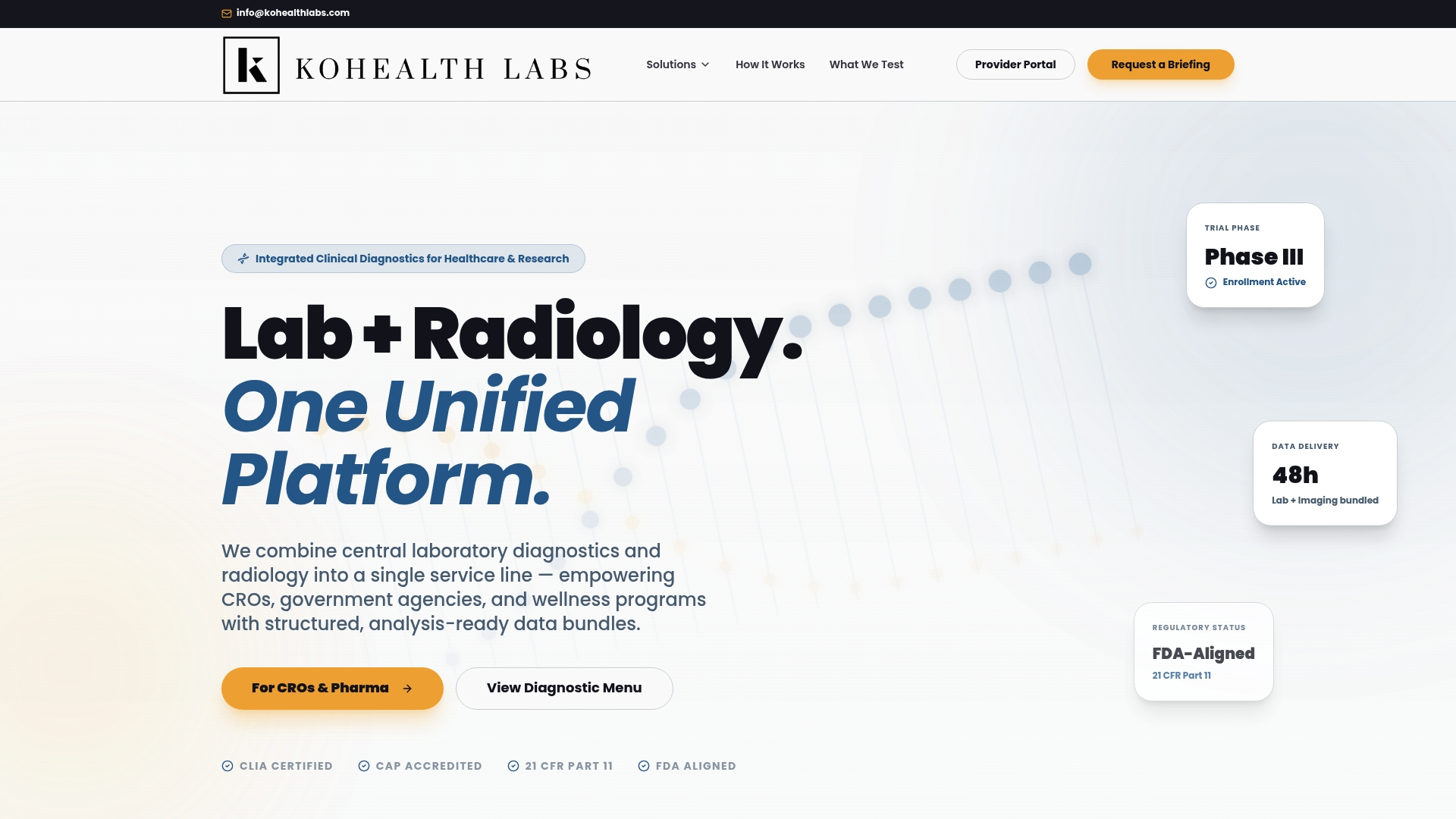
For administrators managing specialty testing programs or clinical trial diagnostics, Kohealth Labs covers over 100 biomarkers and provides analysis-ready data bundles that meet CMS compliance requirements. The AI layer identifies data deviations before they become compliance issues, which shortens turnaround time and supports faster clinical decisions. Connect with Kohealth Labs to see how integrated diagnostics can support your outpatient bundle program.
FAQ
What are outpatient diagnostic service bundles?
Outpatient diagnostic service bundles are predefined groupings of tests and procedures packaged together for billing or clinical purposes during a single outpatient encounter. They reduce administrative complexity and can lower costs by 30–35% compared to individually ordered tests.
What is a Comprehensive APC (C-APC)?
A Comprehensive APC is a CMS Medicare payment model that bundles a primary procedure and all related ancillary services during an outpatient encounter into one payment. Hospitals receive a single rate and absorb the cost of all packaged services within it.
How does the CMS IPO list phase-out affect outpatient bundles?
CMS proposed moving 637 procedures from the inpatient-only list to outpatient APCs by 2027, with full phase-out by 2028. Administrators must update charge master entries, clinical documentation, and APC bundle assignments before the effective date to stay compliant.
Why do patients receive two bills for one outpatient diagnostic visit?
Hospital facility fees are billed through OPPS and APCs, while physician interpretation fees are billed separately under the Medicare Physician Fee Schedule. Clear patient communication at registration prevents confusion and reduces delayed payments.
What is the difference between clinical-focused and workflow-driven bundles?
Clinical-focused bundles group tests by disease state or care pathway to give clinicians a complete diagnostic picture. Workflow-driven bundles sequence tests by operational logic to maximize throughput in labs and imaging centers. Both types serve different but complementary goals in outpatient settings.