
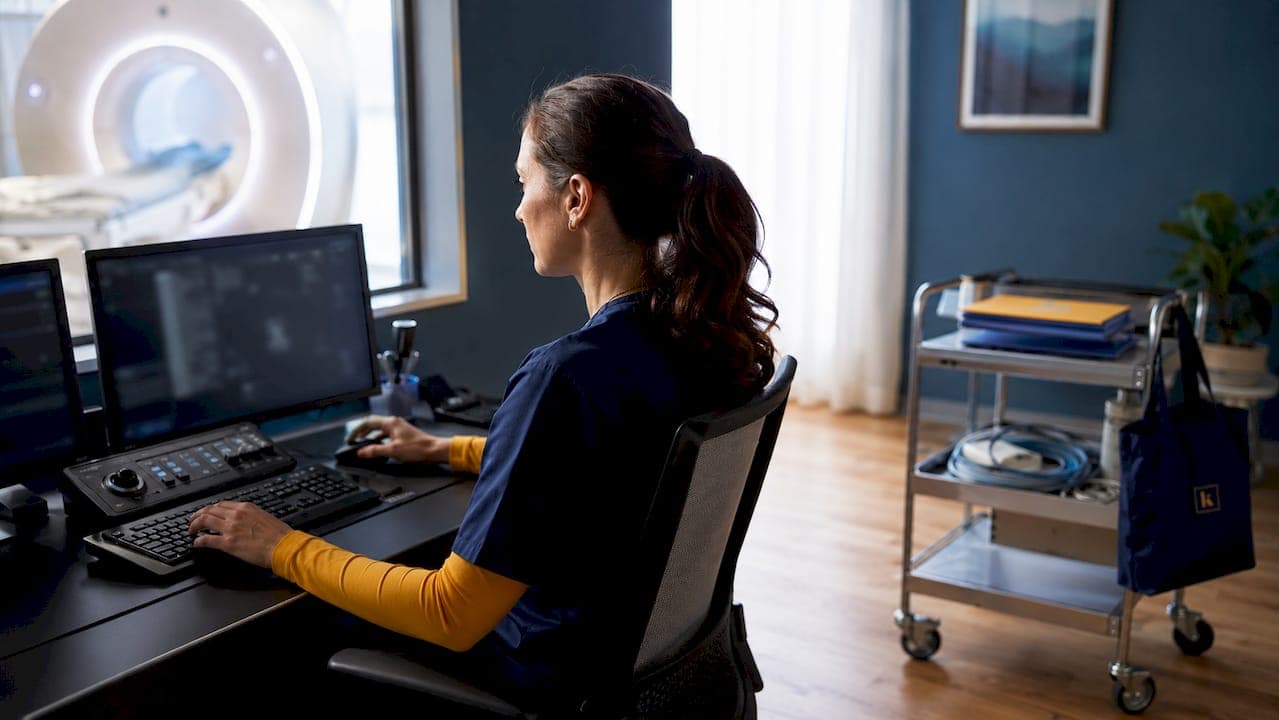
Integrated radiology is the unification of Picture Archiving and Communication Systems (PACS), Radiology Information Systems (RIS), and AI-driven tools into a single, shared diagnostic platform. This is precisely why integrated radiology supports specialty clinics: it removes the manual handoffs, duplicate scans, and data silos that slow diagnosis and raise costs. Without integration, repeat scans rise by 10–15% due to missing prior images and disconnected records. AI-driven workflows, such as those used by Merative, cut emergency time-to-diagnosis by 15–30% and boost radiologist productivity by 23%. For healthcare administrators managing specialty clinics, the case for integration is operational, clinical, and financial all at once.
Why integrated radiology supports specialty clinics: the technology case
Integrated radiology works by eliminating the manual steps between image acquisition, scheduling, and reporting. When PACS and RIS operate as separate systems, staff must re-enter patient data, match records by hand, and chase down prior studies. Each manual step adds time and creates a new point of failure.

AI automation changes that equation directly. 57% of physicians name reducing administrative burden as their top priority for AI in radiology, specifically automated worklist prioritization and quality control. That number reflects a real operational pain: radiologists spending time on clerical tasks instead of reading studies.
The core technology benefits for specialty clinics include:
- Automated worklist prioritization: AI flags urgent cases, such as stroke or pulmonary embolism, and moves them to the top of the queue without manual intervention.
- Quality checks at acquisition: Integrated platforms catch positioning errors or incomplete studies before the patient leaves the room, preventing costly repeat visits.
- Single patient record: One shared data model means the ordering physician, radiologist, and specialist all see the same images and reports without logging into separate portals.
- Cloud-native deployment: Platforms like Evorad and PostDICOM deploy in under 30 days, meaning a specialty clinic can go live without a multi-month IT project.
Pro Tip: When evaluating integrated radiology platforms, ask vendors specifically about their data model. True integration means convergence on a shared schema, not just a connector between two legacy systems. Brittle interfaces break under volume.
Cloud-native platforms also scale with your clinic's growth. A single-site orthopedic practice and a multi-site oncology group can both run on the same architecture, paying for capacity as they use it. That flexibility matters when specialty clinics expand services or add satellite locations.
How does integrated radiology compare to fragmented systems?
The difference between integrated and fragmented radiology is not subtle. Fragmented systems force every workflow step through a manual checkpoint. Integrated systems move data automatically, with rules and AI handling the transitions.
Fragmented workflows carry specific, measurable risks:
- Physicians burning CDs for patient transfers, creating HIPAA exposure and delays.
- Staff faxing reports between departments, with no audit trail or delivery confirmation.
- Radiologists logging into multiple portals to retrieve prior studies, adding minutes to every read.
- Hidden costs from manual record matching, physical media handling, and compliance gaps that go unnoticed until a serious error occurs.
The table below shows the operational difference directly.
| Workflow step | Fragmented system | Integrated system |
|---|---|---|
| Prior image retrieval | Manual portal login, CD import | Automatic pull from shared archive |
| Report delivery | Fax or separate email | Embedded viewer, instant notification |
| Worklist management | Manual sorting by staff | AI-driven prioritization |
| Patient data entry | Re-entered at each system | Single entry, shared across PACS and RIS |
| Compliance tracking | Spreadsheet or manual log | Automated audit trail |
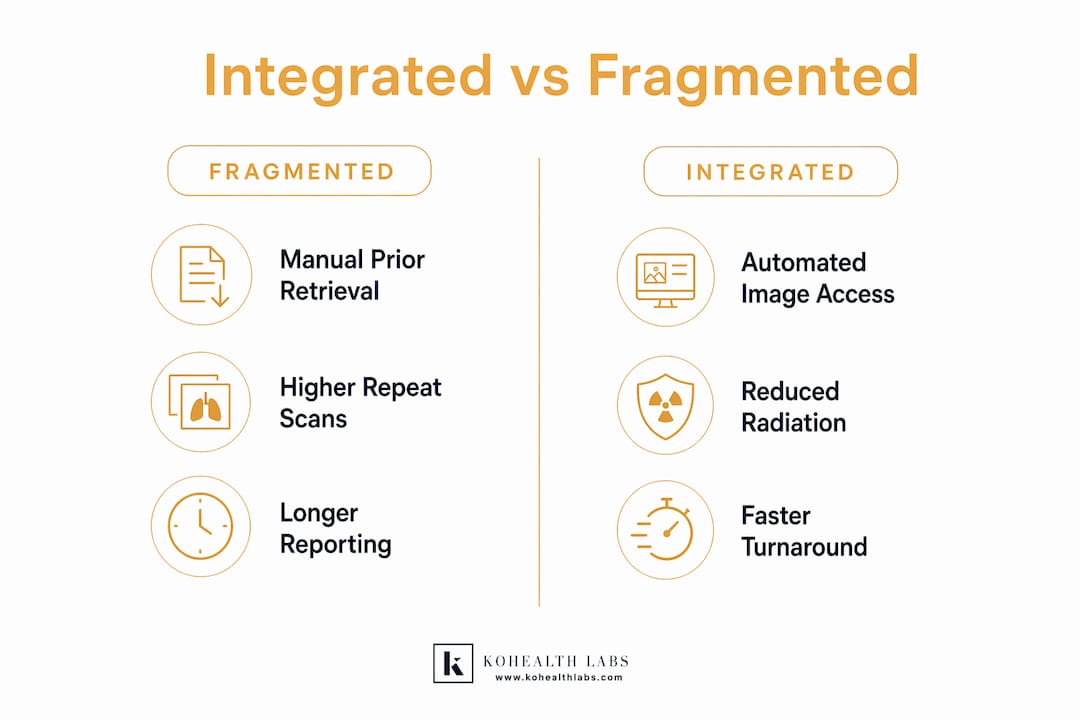
The critical misconception administrators carry into integration projects is that connecting two systems equals integration. True integration, as Merative describes it, means convergence on shared data models, not just a bridge between legacy platforms. Shared data models eliminate the brittle interfaces that fail during high-volume periods or system updates.
Radiation exposure is also a direct consequence of fragmentation. When prior images are unavailable at the point of ordering, clinicians order new studies. That 10–15% repeat scan rate is not a rounding error. It represents real patient harm and real cost that integration removes.
What challenges come with implementing integrated radiology?
Specialty clinics that treat integration as a technology project alone consistently underperform. The operational gains only materialize when data governance, clinical protocols, and staff behavior change together.
Without active data governance and standardized metadata, unified platforms accumulate fragmented, poorly searchable archives over time. The platform may be integrated, but the data inside it remains a mess. That outcome is common and entirely preventable with upfront protocol work.
The implementation challenges that matter most are:
- Metadata standardization: Every study needs consistent tagging for modality, body part, and clinical indication. Without it, AI tools and search functions fail.
- Referring physician adoption: Efficiency gains depend on referring physicians using embedded digital viewers instead of printing PDF reports. Old habits are the most common reason integration underdelivers.
- Transition timing: Scheduling the go-live during a lower-volume period reduces disruption. Most cloud-native platforms go live in under 30 days, so the window of disruption is short if planned well.
- HIPAA risk during migration: Moving legacy data carries compliance exposure. Assign a dedicated compliance lead before migration begins, not after.
Pro Tip: Run a 90-day post-go-live audit on worklist completion times and repeat scan rates. Those two metrics tell you whether the integration is working clinically, not just technically.
Healthcare administrators carry the most responsibility here. Technology vendors deliver the platform. Administrators drive the governance, training, and accountability structures that determine whether the platform delivers results. That is not a technology problem. It is a leadership problem.
What are the practical applications of integrated radiology in specialty clinics?
Integrated radiology changes the daily experience of ordering, reading, and acting on imaging studies. The gains show up in specific, measurable places.
In an integrated workflow, a referring physician places an order in the electronic health record. The RIS schedules the study, the PACS acquires and stores the images, and the radiologist receives an AI-prioritized worklist. The report routes back to the referring physician through an embedded viewer, all without a single manual handoff. That full cycle can complete in minutes for routine studies.
Teleradiology adds a second layer of value within integrated platforms. It has evolved well beyond its original role as overnight coverage. Teleradiology now functions as a strategic business continuity layer, providing surge capacity during high-volume periods and geographic coverage for subspecialty reads. A neurology clinic without an in-house neuroradiologist can access subspecialty interpretation through the same integrated platform its staff uses daily.
The table below shows specific applications by specialty type.
| Specialty | Integrated radiology application | Primary benefit |
|---|---|---|
| Orthopedics | Automated prior study retrieval for comparison | Faster surgical planning |
| Oncology | AI-driven lesion tracking across time points | Consistent response assessment |
| Neurology | Teleradiology for subspecialty neuroradiology reads | Access without in-house hire |
| Urgent care | Emergency triage AI, 15–30% faster time-to-diagnosis | Faster treatment decisions |
| Cardiology | Shared viewer for cardiologist and radiologist collaboration | Reduced report turnaround |
Patient and referrer portals also change the communication model. Referring physicians access reports and images directly without calling the radiology department. Patients receive results faster. Both outcomes reduce administrative call volume and improve satisfaction without adding staff. For cross-specialty diagnostic integration, these portals become the shared interface that keeps every care team member on the same page.
Platforms like Evorad and PostDICOM serve specialty and urgent care clinics specifically, offering cloud-based PACS with built-in RIS connectivity and teleradiology routing. They represent the practical, deployable end of what integrated radiology looks like for a clinic that is not a large hospital system.
Key Takeaways
Integrated radiology reduces repeat scans, cuts administrative burden, and improves diagnostic speed when PACS, RIS, and AI tools operate on a shared data model rather than as separate systems.
| Point | Details |
|---|---|
| Repeat scans drop with integration | Lack of PACS-RIS integration causes a 10–15% repeat scan rate, raising patient radiation and cost. |
| AI cuts time and admin burden | AI-driven tools reduce emergency time-to-diagnosis by 15–30% and increase radiologist productivity by 23%. |
| Fragmented systems carry hidden costs | Manual record matching, CD burning, and faxing create HIPAA risk and operational costs that go untracked. |
| Data governance determines outcomes | Unified platforms still produce fragmented archives without active metadata standards and clinical protocols. |
| Referring physician adoption is critical | Efficiency gains require physicians to use embedded viewers, not legacy PDF reports. |
Kohealth Labs' perspective on integration as a clinical imperative
Healthcare administrators often frame integration as an IT decision. That framing is the first mistake. Integration is a clinical decision with IT implications, not the other way around.
At Kohealth Labs, we work with Clinical Research Organizations, government agencies, and specialty programs that cannot afford diagnostic delays or data gaps. What we see consistently is that the clinics gaining the most from integration are the ones where leadership treats data governance as a standing operational responsibility, not a one-time setup task. The technology is the easy part. The discipline to maintain metadata standards, train referring physicians, and audit outcomes quarterly is where most clinics fall short.
The future of specialty care runs on shared data. AI tools for lesion tracking, emergency triage, and worklist prioritization only work when the underlying data is clean, consistent, and accessible. Clinics that invest in lab and radiology protocol alignment now will be positioned to adopt the next generation of AI tools without rebuilding their data infrastructure from scratch.
Teleradiology is also maturing in ways that most administrators have not fully recognized. It is no longer a staffing patch. It is a resilience strategy. A specialty clinic with integrated teleradiology can absorb volume spikes, cover subspecialty gaps, and maintain 24/7 diagnostic capability without hiring full-time radiologists for every subspecialty. That is a structural advantage, not a convenience.
The administrators who treat integration as a one-time project will get one-time results. The ones who treat it as an ongoing operational standard will build clinics that consistently outperform on diagnostic speed, accuracy, and patient experience.
— Kohealth Labs
Kohealth Labs and integrated diagnostics for specialty clinics
Specialty clinics need diagnostic infrastructure that keeps pace with clinical demands. Kohealth Labs delivers integrated laboratory and radiology services through a single-contract model, removing the vendor complexity that slows turnaround and creates data gaps.
Kohealth Labs combines AI-driven quality checks, over 100 biomarker analytics, and cloud-based data management into one platform built for CROs, government agencies, and specialty programs. The result is analysis-ready diagnostic data with faster compliance and fewer errors. If your clinic is evaluating integrated diagnostic solutions, the Kohealth Labs diagnostics platform gives you a clear starting point. You can also review the full range of available diagnostic tests to see how imaging and laboratory services work together in a single workflow.
FAQ
What is integrated radiology?
Integrated radiology is the unification of PACS, RIS, and AI tools into a single platform where imaging data, scheduling, and reporting share one data model. It eliminates manual handoffs between systems and reduces errors caused by disconnected workflows.
How does integrated radiology reduce costs for specialty clinics?
Lack of PACS-RIS integration causes a 10–15% repeat scan rate, which raises both patient radiation exposure and direct imaging costs. Integration also removes hidden costs from manual record matching, CD burning, and faxing.
How long does it take to implement an integrated radiology platform?
Cloud-native integrated radiology platforms typically reach full operational status in under 30 days. Transition disruption is minimal when clinics schedule go-live during lower-volume periods and assign a dedicated compliance lead before migration.
Why does referring physician adoption matter for integration success?
Efficiency gains from integrated radiology depend on referring physicians using embedded digital viewers instead of printing or downloading PDF reports. Without that behavior change, the workflow remains fragmented even when the technology is unified.
What role does teleradiology play in integrated radiology?
Teleradiology within an integrated platform provides 24/7 diagnostic coverage and surge capacity, functioning as a business continuity layer rather than just overnight staffing support. Specialty clinics use it to access subspecialty reads without hiring full-time subspecialty radiologists.