

Artificial intelligence supports diagnostics across specialties by delivering specialty-adapted models that improve accuracy, reduce diagnostic errors, and accelerate clinical decision-making. AI systems now include the correct diagnosis among their top suggestions in nearly 80% of cases, surpassing clinician performance in complex reasoning tests. That figure comes from a benchmark study using 76 patient charts from an emergency room setting. The implications reach far beyond emergency medicine. From radiology to hematology, AI is reshaping how clinicians gather, interpret, and act on diagnostic data, and how clinical research organizations run faster, cleaner trials.
How AI supports diagnostics across specialties through specialty-adapted models
Generic AI models trained on broad medical datasets perform poorly when applied to narrow clinical domains. A modular vision-language model fine-tuned per specialty improves routing accuracy by 9 to 11 percentage points and simplifies clinical workflow deployment across multiple specialties. That gain comes from training the model on niche datasets specific to each domain rather than forcing one generalist model to handle every case.
The specialties covered by this framework include:
- Gastroenterology: AI flags polyp morphology and mucosal patterns that correlate with malignancy risk.
- Hematology: Models identify cell morphology anomalies in blood smears that signal rare hematologic disorders.
- Ophthalmology: AI detects retinal changes associated with diabetic retinopathy and macular degeneration.
- Pathology: Whole-slide image analysis identifies tissue abnormalities with high consistency across labs.
- Radiology: AI prioritizes worklists by flagging critical findings such as pulmonary emboli or intracranial hemorrhage.
Each specialty benefits from a model that understands its specific imaging modalities, clinical language, and diagnostic priorities. A radiology model trained on chest CT data does not transfer cleanly to ophthalmology fundus images. Specialty-adapted training is not optional. It is the baseline requirement for clinical relevance.
Large language models fine-tuned with Chain-of-Thought reasoning outperform traditional diagnostics by 10–20% in accuracy, precision, and recall for rare diseases. Chain-of-Thought reasoning forces the model to show its work, step by step, before reaching a conclusion. That structure mirrors how experienced clinicians reason through differential diagnoses, which makes the output more auditable and easier for physicians to verify.

Pro Tip: Fine-tune AI models on niche specialty datasets rather than expanding a single generalist model. Smaller, focused models run faster, produce more relevant differentials, and are easier to validate against specialty-specific clinical benchmarks.
Does AI outperform clinicians in diagnostic reasoning?
The short answer is: in structured reasoning tasks, yes, with important caveats. The 80% accuracy figure cited above reflects AI performance on complex, multi-step diagnostic cases where clinicians often miss or delay the correct answer. A more advanced system, the DxDirector model, can autonomously drive the full diagnostic process and achieves a 60–75% replacement rate of specialist diagnoses across 19 clinical departments, including hematology, oncology, pulmonology, and infectious diseases.
That replacement rate does not mean AI should operate without oversight. It means AI can carry a significant portion of the diagnostic reasoning burden, freeing clinicians to focus on ambiguous cases, patient communication, and treatment planning.
"AI diagnostic suggestions include the correct answer in nearly 80% of cases, outperforming human clinicians in complex reasoning tests. Yet AI reasoning models show brittleness under uncertainty, often jumping to conclusions when clinical data is incomplete. Human oversight remains non-negotiable."
The evidence points to three consistent patterns across specialties:
- AI performs best on data-rich cases where imaging, labs, and structured clinical notes are all available.
- AI underperforms when clinical uncertainty is high, physical exam findings dominate, or data is sparse.
- Clinician-AI collaboration consistently outperforms either working alone in complex, multi-specialty cases.
These patterns define where AI adds the most value and where clinician judgment remains irreplaceable.
How AI enables integrated diagnostics and cross-specialty data sharing
Managing complex patient diagnostic data across specialties is one of the hardest operational problems in clinical medicine. A patient presenting with fatigue, weight loss, and abnormal labs may need input from hematology, oncology, and radiology simultaneously. Without a unified diagnostic layer, each specialty works from a partial picture.
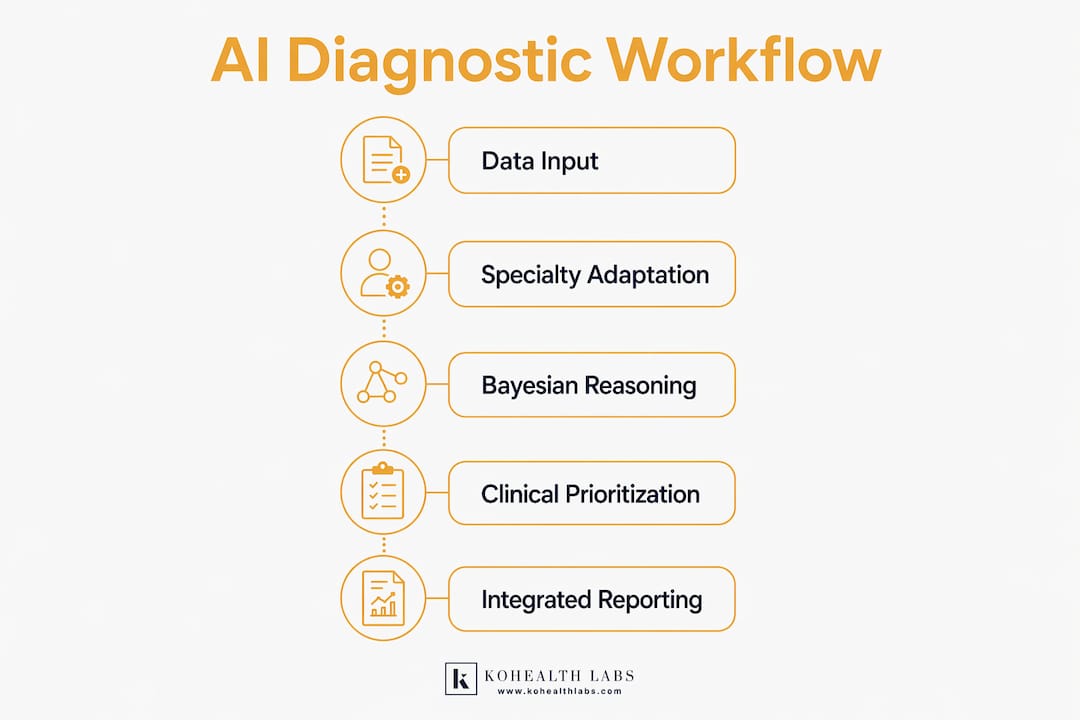
Specialty-adapted AI addresses this by applying Bayesian reasoning weighted by specialty-specific prevalence to prioritize relevant differential diagnoses. Bayesian reasoning means the model adjusts its probability estimates based on how common a condition is within a given specialty context. A hematologist's differential for anemia differs from a gastroenterologist's, and the AI reflects that difference automatically.
The table below shows how AI-integrated diagnostics function differently across specialty contexts:
| Specialty | Primary data source | AI function |
|---|---|---|
| Radiology | Imaging (CT, MRI, X-ray) | Anomaly flagging, worklist prioritization |
| Hematology | Blood smear, CBC, flow cytometry | Cell morphology classification |
| Oncology | Pathology slides, genomic panels | Malignancy grading, biomarker identification |
| Gastroenterology | Endoscopy video, biopsy | Polyp detection, mucosal assessment |
| Ophthalmology | Fundus photography, OCT | Retinal disease staging |
AI also reduces alert fatigue by firing safety alerts only when clinically relevant within a specialty context. A drug interaction warning that matters in oncology may not apply in ophthalmology. Specialty-aware AI filters those alerts intelligently, so clinicians see fewer false alarms and respond more reliably to real ones.
Integrated diagnostics combining labs, radiology, and data analytics accelerate clinical trials by reducing the time between data collection and decision-ready outputs. For clinical research organizations, that speed translates directly into faster trial completions and stronger safety monitoring. Kohealth Labs builds its diagnostic model around exactly this principle, unifying lab and radiology data under a single contract to produce analysis-ready bundles for CROs and research teams.
What are the real challenges of adopting AI diagnostics across specialties?
AI adoption in specialty diagnostics is not without friction. The most documented problem is reasoning brittleness. AI models jump to conclusions under uncertainty, particularly when clinical data is incomplete or contradictory. A model trained on complete, structured records may perform poorly when a patient chart is missing key labs or imaging reports.
A comprehensive review across 18 major malignancies found that breast and prostate cancer have the most advanced AI support, while other oncology fields face significant gaps in external validation and outcome linkage. High AI diagnostic accuracy does not guarantee improved patient outcomes. That distinction matters enormously for clinical research, where the endpoint is patient benefit, not algorithmic performance.
Specialties that rely heavily on physical examination, such as dermatology and musculoskeletal medicine, present a different challenge. AI cannot palpate a lymph node or assess skin texture through touch. In those domains, AI supports the diagnostic process by analyzing images or structured data, but the physical exam remains the primary diagnostic tool.
The human-in-the-loop model is the current standard for safe AI integration. Clinicians maintain final diagnostic authority. AI surfaces differentials, flags anomalies, and prioritizes worklists. The physician reviews, confirms, or overrides. That division of labor works well when both sides understand their roles clearly.
Pro Tip: Before deploying AI in a new specialty, map the cases where physical exam findings dominate. Those cases need the most human oversight and the clearest escalation protocols. AI adds the least value there and the most risk if deployed without guardrails.
Prospective validation remains the field's biggest unmet need. Most AI diagnostic studies use retrospective chart data. Real-world performance in live clinical environments, with incomplete data and time pressure, often differs from benchmark results. Specialty-adapted platforms that align diagnostic accuracy with proven patient-centered outcomes are the next frontier.
Key Takeaways
AI supports diagnostics across specialties most effectively when models are fine-tuned per specialty, integrated with unified lab and radiology data, and deployed within human-in-the-loop frameworks that preserve clinician authority.
| Point | Details |
|---|---|
| Specialty-adapted models outperform generalists | Fine-tuning per specialty improves routing accuracy by 9–11 percentage points across gastroenterology, radiology, and more. |
| AI reaches 80% diagnostic accuracy | AI includes the correct diagnosis in top suggestions in nearly 80% of cases, surpassing clinician performance in complex reasoning. |
| Bayesian reasoning reduces alert fatigue | Specialty-weighted AI prioritizes relevant differentials and fires safety alerts only when clinically appropriate. |
| Integrated diagnostics accelerate clinical trials | Combining labs, radiology, and AI analytics produces analysis-ready data bundles that speed trial completion and safety monitoring. |
| Human oversight remains non-negotiable | AI reasoning brittleness under uncertainty requires clinicians to retain final diagnostic authority in all specialties. |
The case for specialty-adapted AI as a clinical partner, not a replacement
At Kohealth Labs, we have watched the conversation around AI in diagnostics shift from "can it work?" to "how do we deploy it responsibly?" That shift is healthy. The evidence is clear that specialty-adapted AI, when built and deployed correctly, reduces diagnostic errors, flags anomalies earlier, and helps clinical teams manage complex patient data more effectively.
What concerns us is the gap between algorithmic performance and real-world patient outcomes. A model that scores well on benchmark datasets may still fail in a live clinical environment where data is messy, time is short, and the stakes are high. We believe the path forward requires rigorous prospective validation, not just impressive accuracy numbers.
The most meaningful application we see is in integrated clinical research, where AI connects lab results, radiology findings, and specialty-specific protocols into a single, coherent diagnostic picture. That integration is what accelerates clinical trials and improves safety monitoring. It is also where the single-contract, unified data model that Kohealth Labs offers delivers its clearest advantage. Specialty-adapted AI is not a replacement for clinical expertise. It is the infrastructure that lets clinical expertise work faster and with greater confidence.
— Kohealth Labs
Kohealth Labs and AI-enabled specialty diagnostics
Clinical teams managing complex, multi-specialty diagnostic workflows need more than a capable AI model. They need data that is clean, integrated, and ready for analysis the moment it arrives.
Kohealth Labs delivers exactly that through a single-contract model that unifies laboratory services and radiology into analysis-ready diagnostic bundles for CROs, government agencies, and specialty care programs. The platform covers over 100 biomarkers and applies AI-driven quality checks to flag deviations before they affect trial timelines. For physicians and telehealth teams, Kohealth Labs offers specialty-focused diagnostic services that connect directly to AI-powered data analytics. Faster data means faster decisions, and faster decisions mean better outcomes for the patients you serve.
FAQ
How does AI flag diagnostic anomalies in specialty care?
AI flags anomalies by comparing patient data against specialty-specific training sets and surfacing deviations that fall outside expected clinical ranges. Specialty-adapted models reduce false alerts by applying Bayesian reasoning weighted to each specialty's prevalence patterns.
Why do AI diagnostics improve specialty outcomes?
AI improves outcomes by catching diagnostic errors earlier and prioritizing the most relevant differentials for each specialty context. Studies show AI includes the correct diagnosis in nearly 80% of cases, reducing the rate of missed or delayed diagnoses.
Can AI share diagnostic data across specialties effectively?
AI-enabled integrated diagnostic platforms synthesize lab results, imaging, and clinical protocols from multiple specialties into a unified data layer. That unified view gives each specialty team a complete patient picture rather than a fragmented one.
What are the limits of AI in specialty diagnostics?
AI performs poorly when clinical data is incomplete, when physical examination findings dominate, or when the case involves significant uncertainty. Human-in-the-loop frameworks are the current standard to manage these limitations safely.
How does AI in diagnostics support clinical trial workflows?
Integrated diagnostics combining AI-assisted lab and radiology analysis produce analysis-ready data bundles that reduce turnaround time and improve safety monitoring in clinical trials. That efficiency directly accelerates trial completion timelines for CROs and research teams.