

An independent physician lab (IPL) gives CROs and trial sponsors faster, auditable diagnostic data when paired with integrated radiology and AI. For most programs, a turnkey integrated partner outperforms a fully self-built lab on cost, compliance speed, and analysis-ready delivery. If your team is evaluating options right now, a discovery call with Kohealth Labs is the fastest way to map your trial's diagnostic requirements to a compliant, integrated solution.
What is an independent physician lab and how does it differ from other lab models?
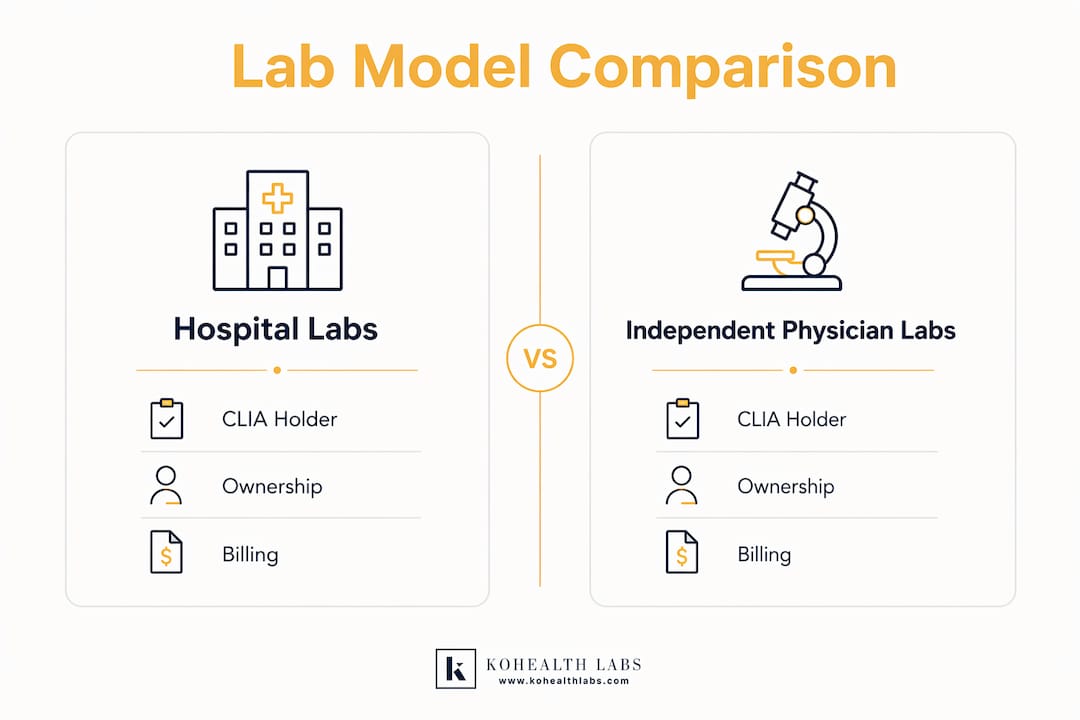
An IPL is a clinical laboratory operating under a CLIA certificate held by the physician practice itself, with tests billed under the practice's NPI. That ownership structure is what separates it from a hospital outreach lab (where the hospital holds the CLIA certificate and captures the revenue) and from a national reference lab (where specimens leave the practice entirely and results return days later).
Three structural variants matter for CROs and providers:
- Practice-owned, in-office IPL. The practice holds the CLIA certificate, employs or contracts lab personnel, and captures all billing. Full operational control, full compliance responsibility.
- Hosted/managed IPL. The practice still holds the CLIA certificate and payer enrollment, but a turnkey partner handles staffing, equipment, and day-to-day operations. This model is the most common for trial-support programs.
- Reference-network hybrid. Routine tests run locally; complex or low-volume assays are sent to a contracted reference lab. Useful for multi-site trials where not every site can justify full in-house capacity.
| Feature | Hospital Lab | National Reference Lab | Independent Physician Lab |
|---|---|---|---|
| CLIA holder | Hospital | Reference lab entity | Practice / physician group |
| Revenue capture | Hospital | Reference lab | Practice |
| Turnaround time | Hours to days | 1–5 days | Hours (in-office) |
| Trial data control | Limited | Limited | High |
| Compliance responsibility | Hospital | Reference lab | Practice (or partner) |
For CRO contracts, the hosted/managed IPL model is usually the cleanest fit: the practice retains ownership and billing rights while the partner absorbs operational complexity.
Why do IPLs and integrated diagnostics matter for clinical trials?
Speed and data traceability are the two variables that most directly affect trial timelines, and IPLs improve both. When lab results are generated in-office or through a managed partner rather than shipped to a national reference lab, turnaround time drops and chain-of-custody documentation stays tighter. A turnkey approach can deliver faster results and allow practices to bill locally for tests previously sent out, recovering revenue that would otherwise leave the practice.
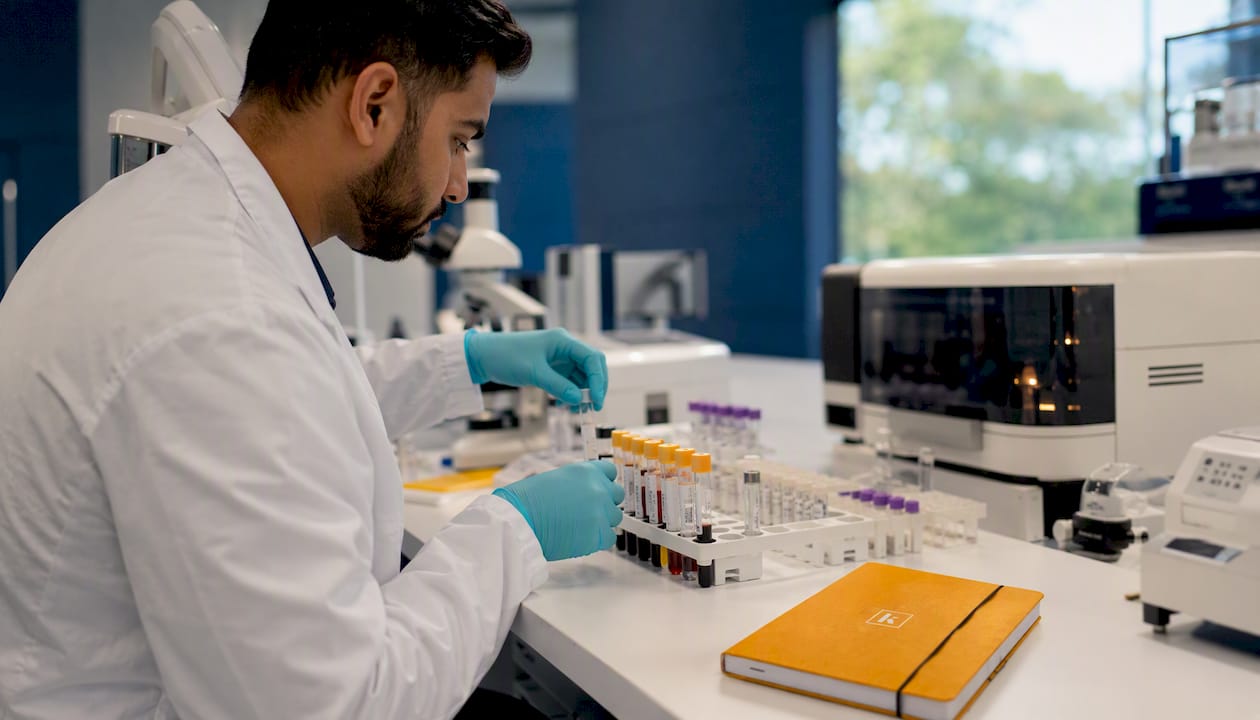
The scale of managed-lab networks confirms this is a proven model. Leading laboratory management partners currently support over 65 managed lab operations nationwide, demonstrating that the infrastructure for compliant, scalable IPL deployment already exists.
The real multiplier for CROs, though, is integration. Combining lab results with radiology imaging and AI-driven quality checks produces analysis-ready data bundles that arrive at the data management team already normalized, flagged for deviations, and linked to the correct subject record. That means fewer cleaning cycles before interim analyses and faster safety signal detection for DSMBs.
Key benefits for trial programs:
- Fewer vendors to manage under a single contract
- Higher data traceability and auditable chain of custody
- Faster turnaround supporting tighter visit windows
- Improved subject retention through local, convenient testing
What delivery models are available for physician-owned lab services?
Full practice ownership
The practice purchases or leases equipment, hires a laboratory director and qualified staff, and operates the lab entirely in-house. This model offers maximum control and the highest revenue capture per test, but it requires upfront capital, ongoing compliance management, and dedicated personnel. It makes sense for high-volume, single-site programs where the test menu is stable and the practice has the administrative bandwidth to manage CLIA renewals, QA programs, and payer credentialing.
Turnkey managed model
Turnkey management providers commonly cover equipment procurement, CLIA and state licensing assistance, payer credentialing, LIS/EHR integration, and ongoing compliance support with little or no upfront capital from the practice. The practice holds the CLIA certificate; the partner handles everything else. For CROs sponsoring multi-site trials, this model reduces site activation time and standardizes data collection across locations.
Reference-network hybrid
Local draws and routine panels run at the site; specialized assays (genomics, advanced imaging biomarkers, confirmatory toxicology) route to a contracted reference network. This is the right fit when trial protocols require low-volume, high-complexity tests that cannot be economically validated at every site. The tradeoff is an additional data integration step to reconcile results from two sources.
Pro Tip: When negotiating commercial terms, a fixed per-test fee gives sponsors predictable budgeting and removes incentive for the partner to over-order. Reserve revenue-share structures for high-volume, long-duration programs where both parties benefit from growth. Always confirm that liability for CLIA compliance and payer enrollment sits explicitly with one party in the contract.
Regulatory and QA checklist for a trial-ready IPL
Compliance is not a one-time event. For a physician-owned lab supporting clinical trials, the following must be verified and maintained continuously.
Credentials and accreditation:
- Active CLIA certificate with the correct certificate type for the complexity of tests performed
- State laboratory licenses for every state where specimens are collected or processed
- CAP accreditation or an equivalent QA program with documented proficiency testing
- Signed Business Associate Agreement (BAA) covering all data handling
- Documented QA/QC processes, including corrective action records
Operational requirements:
- Qualified laboratory director meeting CLIA personnel standards for the certificate type
- Written SOPs for every procedure on the test menu
- Validation and verification records for all instruments and assays
- Specimen chain-of-custody documentation from collection through result reporting
- Courier logistics plan with temperature-controlled transport and documented handoff records
Integration requirements:
- LIS/EMR connectivity supporting HL7 and FHIR standards
- LIMS validation documentation
- Structured result formats compatible with sponsor data management systems
- Inspection support plan, including a designated compliance contact for auditor access
Managed laboratory partners exist precisely to reduce this compliance burden. Verifying that a partner provides ongoing QA programs and inspection support, rather than assuming capability, is the single most important due-diligence step.
Pro Tip: The In-Office Ancillary Services Exception (IOASE) to the Stark Law, 42 C.F.R. §411.355(b), governs whether in-office lab billing is permissible under a given practice structure. Confirm CLIA and NPI ownership with healthcare counsel before launch, as this affects billing, IOASE applicability, and who appears on inspection documents.
What do IPL-style services cost and how long does setup take?
Commercial models
- No-upfront turnkey: Cost-per-test or fixed monthly fee; the partner absorbs equipment and setup costs. Lowest financial risk for sponsors and practices entering a new program.
- Capital purchase with internal ops: Higher upfront investment, lower per-test cost at scale. Justified only when annual test volume is high enough to amortize equipment within the contract period.
- Revenue-share: Partner receives a percentage of net collections. Aligns incentives for volume growth but complicates budgeting for fixed-cost trial protocols.
- Hybrid fee structure: Fixed setup fee plus per-test billing. Common in trial-support programs where onboarding costs are discrete and ongoing costs need to be predictable.
Primary cost drivers
- Equipment purchase or lease and ongoing reagent/consumable costs
- Laboratory director and qualified staff salaries or contracted fees
- LIS/LIMS integration and validation work
- Payer credentialing (which adds lag time, not just cost)
- State license application fees and CLIA certificate fees
Timeline to go-live
Realistic compliant timelines typically fall in a multi-week range once CLIA and state filings, payer credentialing, and LIS/EHR integrations are included. Some vendors advertise faster windows, but filings and integration work consistently extend the schedule.
- Discovery and test menu design (Week 1)
- CLIA and state license applications submitted (Week 1–2)
- Equipment procurement and installation (Week 2–3)
- LIS/LIMS integration and configuration (Week 3–5)
- Assay validation and verification (Week 4–6)
- Staff training and SOP sign-off (Week 5–7)
- Go-live and first specimen processing (Week 6–8)
Budget a contingency of at least two weeks for payer credentialing lag, which runs independently of the technical setup and can delay billing even when the lab is operationally ready. Aligning the test menu to MAC coverage before finalizing the menu protects reimbursement and avoids capitalizing on assays that will not pay in your region.
How do combined lab, radiology, and AI produce analysis-ready data bundles?
The data flow is straightforward in concept but demanding in execution. Specimens and images are captured at the site, ingested into the LIMS and PACS respectively, mapped to HL7 and FHIR standards, passed through AI quality-control checks, and delivered as a normalized, analysis-ready package linked to the subject record. Every step has a documented audit trail.
For CROs, the practical outcomes are significant. Reduced data cleaning time before interim analyses, faster safety signal detection for DSMBs, and auditable provenance that satisfies regulatory reviewers and sponsors alike. Radiology integration shortens trial timelines specifically because imaging endpoints no longer require a separate reconciliation step.
When diagnostics are integrated under a single contract with AI-driven QC, the data management team receives a package that is already normalized and deviation-flagged. That eliminates the manual reconciliation cycle that typically adds days to interim analysis preparation and creates the most common audit findings in multi-vendor trial setups.
Required technical standards for a trial-ready integrated diagnostics pipeline:
- HL7 and FHIR for structured lab result transmission and EHR interoperability
- DICOM for imaging data with automated metadata capture linking images to specimen records
- LIMS APIs for real-time data access and sponsor system integration
- Cloud-based LIS failover to maintain continuity during local outages and support sample redirection
Insisting on DICOM-compliant pipelines with automated metadata capture is the step most often skipped in early-stage trial planning. Without it, image data and specimen results must be reconciled manually, which adds time and introduces transcription risk.
How should you evaluate and select an IPL or integrated diagnostics partner?
Evaluation checklist
- Verified CLIA certificate and state licenses for all relevant jurisdictions
- CAP accreditation certificate or documented equivalent QA program
- Demonstrated LIS/EMR integration with HL7/FHIR examples from prior programs
- Radiology integration capability with DICOM-compliant pipeline documentation
- Specimen logistics plan: courier network, temperature control, chain-of-custody records
- Validated SOPs available for review prior to contract execution
- Staffing plan including laboratory director qualifications and backup coverage
Questions to ask prospective partners
- What are your contractual turnaround time guarantees by test category?
- How do you support sites during regulatory inspections or audits?
- What data delivery formats do you support, and do you offer API access for sponsor systems?
- Who holds the CLIA certificate and payer enrollments, and how are those transferred if the relationship ends?
- What are your onboarding fees, sample volume minimums, and pricing structure?
For lab testing optimization across specialty practices, aligning the test menu to actual patient population and MAC coverage is the most frequently overlooked financial risk.
Red flags to avoid
- Vague QA documentation with no proficiency testing records
- No explicit HL7/FHIR or DICOM integration plan
- Unclear ownership of CLIA certificate and payer enrollments
- No named inspection support contact or audit response process
- Pricing that changes materially after contract signature based on volume thresholds not disclosed upfront
How Kohealth Labs meets IPL and integrated diagnostics needs
Kohealth Labs delivers an integrated diagnostics offering that covers the full evaluation checklist above under a single contract. The core offering includes laboratory services, radiology, phlebotomy, courier specimen pickup, and AI-driven analysis-ready data bundles spanning over 100 biomarkers, genomics, and imaging panels.
Direct checklist coverage:
- CLIA support and state licensing assistance built into onboarding
- HL7/FHIR and API integration with EMR and sponsor data systems
- DICOM-compliant radiology pipeline with automated metadata capture
- AI-driven QC that flags deviations before data reaches the sponsor
- Dedicated onboarding and training with documented timelines
- Inspection support and ongoing compliance assistance
For CROs and sponsors evaluating partners:
- Request the Kohealth Labs capabilities packet, which covers biomarker panels, imaging protocols, and integration specifications.
- Schedule a discovery call to map your trial's specific diagnostic requirements to available service configurations.
- Review the data and AI pipeline documentation to confirm analysis-ready delivery formats match your data management system.
Key Takeaways
Integrated diagnostics combining lab, radiology, and AI is the most direct path to analysis-ready trial data under a single auditable contract.
| Point | Details |
|---|---|
| IPL model clarity | The practice holds the CLIA certificate; a managed partner can handle operations, reducing compliance burden. |
| Realistic setup timeline | Compliant IPL setups typically take 6–8 weeks once filings, credentialing, and LIS integration are included. |
| Integration is the multiplier | Combining lab, radiology, and AI under one contract eliminates manual reconciliation and speeds interim analyses. |
| MAC coverage alignment | Align the test menu to regional MAC coverage before launch to protect reimbursement on PCR, toxicology, and genomic assays. |
| Kohealth Labs | Covers the full evaluation checklist: CLIA support, HL7/FHIR, DICOM radiology, AI QC, and onboarding under a single contract. |
The case for integration over piecemeal lab builds
The conventional wisdom in clinical operations is that building your own lab gives you control. In practice, the teams that struggle most are the ones that built for control and underestimated the operational weight of maintaining it. CLIA renewals, QA program documentation, LIS validation cycles, payer credentialing renewals, and inspection readiness are not one-time tasks. They recur on overlapping schedules, and a single gap in any of them can pause a trial.
The more useful question is not "should we own the lab?" but "what do we actually need to own to protect data quality and trial timelines?" For most CROs and multi-site programs, the answer is the data and the audit trail, not the equipment or the CLIA certificate. A well-structured managed IPL with integrated radiology and AI-driven QC gives you both without the operational overhead of running a lab from scratch.
Kohealth Labs: integrated diagnostics built for trial speed
Kohealth Labs combines laboratory testing, radiology, and AI-driven quality control into a single contract that delivers analysis-ready data bundles directly to your data management team. For CROs and sponsors, that means fewer vendors, tighter turnaround times, and audit-ready provenance from specimen collection through final data delivery.
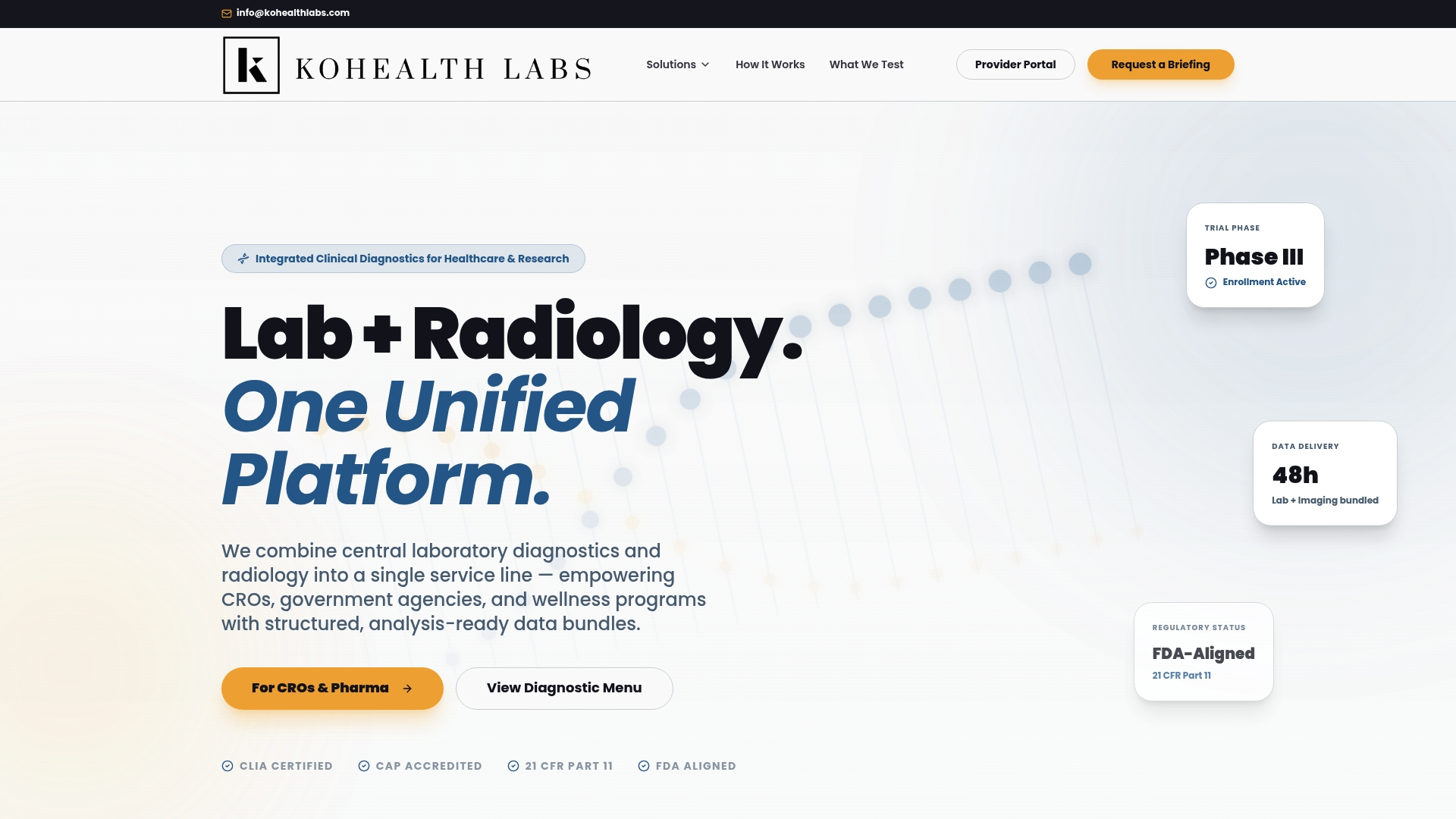
Request a capabilities packet or schedule a discovery call through the Kohealth Labs solutions page to see how the integrated model maps to your trial protocol. For distributed or telehealth-enabled programs, the telehealth diagnostics solution covers remote specimen logistics and data delivery. If your program needs financial and operational modeling before committing to a lab structure, practice-level financial guidance can help you size the investment correctly.
Authoritative sources and further reading
- PlugPOL Physician Office Lab Solutions — CLIA structure, hosted model mechanics, and realistic setup timelines
- Essience Diagnostics: Physician-Owned Labs — Turnkey commercial models and turnaround time considerations
- Select Laboratory Partners — Managed lab scale, QA programs, and LIS failover capabilities
- KOSMD Physician-Owned Lab Setup — Operational readiness, MAC coverage alignment, and staff training priorities
- Kohealth Labs: Data and AI Pipeline — Analysis-ready bundle specifications and AI QC documentation
- Kohealth Labs: Specialty Testing Collateral — Biomarker panels, genomics, and imaging capabilities for RFP and due diligence