

Precision medicine uses a person's genetic makeup, environment, and lifestyle to guide prevention, diagnosis, and treatment decisions rather than applying a one-size-fits-all protocol. The National Institutes of Health describes it as an approach that accounts for individual differences across all three of those dimensions. In practice, that means a cancer patient whose tumor carries a specific genetic mutation may receive a targeted drug designed for that exact change, while someone with a slow-metabolizing gene variant gets a lower dose of a common medication to avoid toxicity. Rare disease patients who spent years without a diagnosis are increasingly getting answers through whole-genome sequencing in days. The National Library of Medicine's MedlinePlus notes that "precision medicine" is now the preferred clinical term over "personalized medicine" because it signals identifying effective approaches for biologically defined groups, not wholly unique treatments for every single person. The FDA, NIH's All of Us Research Program, and the National Cancer Institute all treat this field as a current clinical priority, not a future concept.
How does precision medicine work?
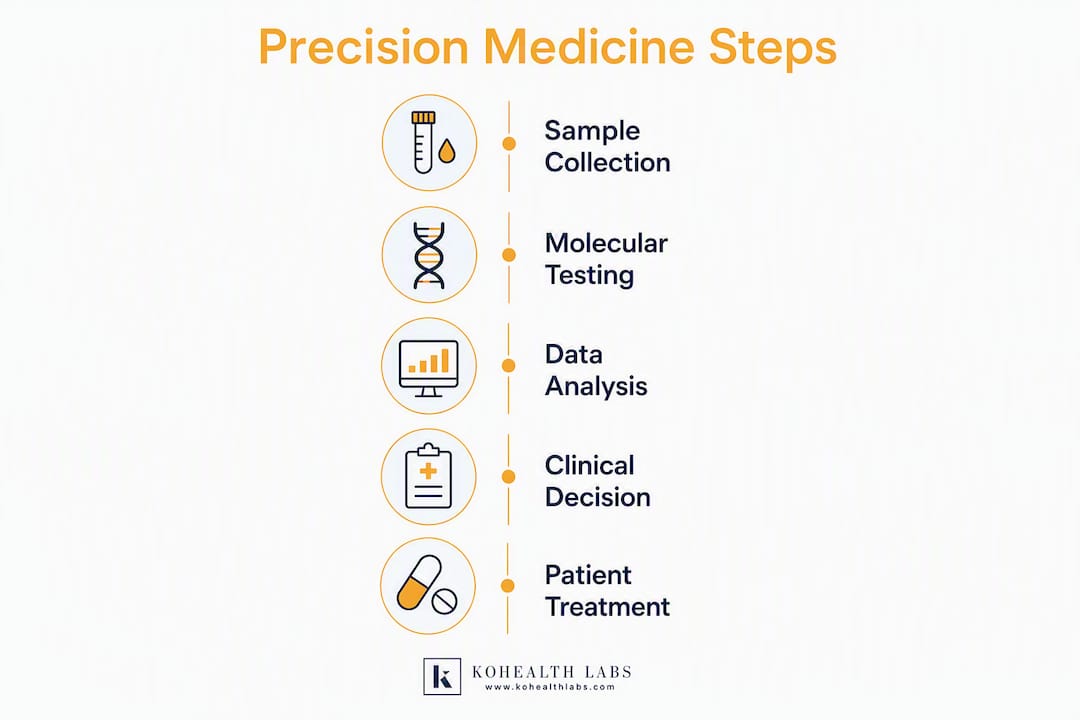
The process starts with a biological sample and ends with a clinical decision backed by data. Here is how the pipeline flows.
A clinician orders a molecular test, such as tumor sequencing, a pharmacogenomic panel, or germline genetic testing. The lab analyzes the sample and identifies relevant biomarkers, which are measurable biological signals like gene mutations, protein levels, or chromosomal changes that predict how a disease will behave or how a patient will respond to a drug. That raw data then moves into an analytics layer where it is combined with imaging results, electronic health records (EHR), and clinical history. The output is a structured report that maps findings to evidence-based treatment options.

Interoperable health IT is the bottleneck most people overlook. Without standardized data formats that allow labs, imaging systems, and EHRs to communicate, personalization stays theoretical. The World Health Organization frames precision approaches as a health-systems priority precisely because the gains depend on mature data infrastructure, not just better tests.
Common tests and what they report:
- Tumor sequencing (somatic): — Identifies mutations driving cancer growth; guides targeted therapy selection
AI and diagnostic analytics are increasingly used to flag data deviations, cross-reference findings against clinical databases, and flag actionable variants faster than manual review allows.
Key insight: A test result is only as useful as the clinical action it enables. The gap between a raw genomic finding and a treatment decision is where integrated data infrastructure either delivers value or creates delay.
Pro Tip: When you receive a precision medicine test report, ask your clinician three things: Which specific biomarker was tested? Is this finding clinically actionable today? What is the strength of the evidence linking this biomarker to the recommended treatment?
Where is precision medicine already making a difference?
Precision oncology
Tumor profiling is the most mature application. When a pathologist sequences a tumor, the results can reveal mutations in genes like EGFR, ALK, KRAS, or HER2. Each of those mutations corresponds to approved targeted therapies designed to interfere with the specific protein driving tumor growth. A patient with non-small-cell lung cancer carrying an EGFR mutation, for example, is a candidate for EGFR inhibitors rather than standard chemotherapy, which typically produces a better response with a different side-effect profile. Immunotherapy selection also relies on biomarkers: PD-L1 expression and tumor mutational burden help predict which patients are likely to respond to checkpoint inhibitors.

Pharmacogenomics
This is precision medicine applied to drug prescribing. Variants in genes like CYP2D6 and CYP2C19 affect how quickly the liver processes dozens of common medications, from antidepressants to blood thinners. Pharmacogenomic testing is now routine at many academic medical centers and is increasingly available through primary care. The Cleveland Clinic and similar institutions use these panels to reduce trial-and-error prescribing, particularly in psychiatry and pain management.
Rare disease diagnosis
Whole-exome and whole-genome sequencing have cut the average diagnostic odyssey for rare disease patients from years to months in many cases. The NIH and NCI cite rare-disease genomics as one of the domains with the strongest present-day clinical impact. For a child with an undiagnosed condition, a single sequencing test can identify a pathogenic variant, confirm a diagnosis, and open the door to disease-specific management or clinical trial eligibility. Partner resources like this genomic medicine breakthroughs guide track how quickly the field is expanding.
Statistic callout: The NIH's All of Us Research Program has enrolled over one million participants to build a diverse genomic and health data resource specifically designed to accelerate precision medicine research across conditions and populations.
What precision medicine can and can't do today
The benefits are real, but so are the limits. Here is an honest look at both.
Benefits:
- Targeted therapies are more selective than chemotherapy, often producing fewer off-target side effects
- Pharmacogenomic testing reduces medication trial-and-error, particularly for psychiatric and cardiac drugs
- Genomic diagnosis for rare diseases can end years of uncertainty and unlock condition-specific care
- Biomarker-driven trial enrollment improves the odds that a patient receives a treatment matched to their biology
Current limitations:
- Targeted therapies only work when the tumor carries the validated biomarker; not every patient qualifies
- Tumors can develop resistance over time, requiring re-biopsy and strategy changes
- Evidence gaps exist for many variants; a finding may be "of uncertain significance" with no clear action
- Cost and insurance coverage remain inconsistent; comprehensive genomic profiling can be expensive and is not always reimbursed
- Access is concentrated at academic medical centers and specialty practices, leaving rural and underserved populations with fewer options
Tumor heterogeneity adds another layer of complexity. A single biopsy captures one region of a tumor, but different regions can carry different mutations. That means a treatment matched to one biopsy site may not address the full picture, which is why serial monitoring and liquid biopsy are growing in importance.
How does data privacy and regulation protect you?
The regulatory framework
Three layers govern precision medicine data in the United States. HIPAA sets the baseline: your genomic and health data is protected health information, and providers must obtain your authorization before sharing it for most secondary uses. The FDA oversees both the diagnostic tests used to identify biomarkers (as in vitro diagnostics) and the targeted therapies approved based on those biomarkers. The FDA's precision medicine page outlines how companion diagnostics, which are tests co-developed with specific drugs, must be approved alongside the therapy they guide.
Data types collected and why interoperability matters:
- Genomic data (sequencing files, variant reports)
- Medical imaging (MRI, CT, PET scans)
- EHR data (diagnoses, medications, lab history)
- Lifestyle and environmental data (in research programs like All of Us)
When these data types sit in separate systems that cannot communicate, clinicians make decisions with incomplete information. The WHO and Duke Personalized Health both identify interoperability as the single biggest operational bottleneck in scaling precision approaches.
Regulatory note: HIPAA protects your health data, but it does not cover all uses of genetic information. The Genetic Information Nondiscrimination Act (GINA) adds protections against discrimination by health insurers and employers based on genetic test results, though it does not cover life, disability, or long-term care insurance.
Pro Tip: Before consenting to genetic testing, ask your provider: Will my data be shared with researchers or third parties? Can I opt out of secondary use? How long will my sample be stored? These questions are your right to ask under informed consent standards.
How integrated diagnostics accelerate clinical trials
Biomarker-driven trials depend on one thing above all else: getting the right data to the right people fast. A typical trial workflow moves from patient enrollment and sample collection through centralized laboratory analysis, imaging, and data aggregation before any regulatory submission can proceed. When those steps involve separate vendors, each handoff introduces delays, format mismatches, and data queries that slow the entire timeline.
Integrated diagnostics, where lab testing, radiology, and data analytics operate under a single contract and a unified data architecture, compress that timeline. Kohealth Labs offers exactly this model: a single-contract solution that combines laboratory services, radiology, and AI-driven analytics into analysis-ready data bundles covering 100+ biomarkers. The AI layer identifies data deviations in real time, flags compliance issues before they become audit findings, and delivers regulatory-aligned outputs that sponsors can act on immediately.
| Workflow stage | Fragmented vendor model | Integrated diagnostics model |
|---|---|---|
| Sample collection to lab result | Multiple handoffs, variable turnaround | Courier pickup, centralized processing, defined SLA |
| Imaging and lab data alignment | Manual reconciliation across systems | Unified data bundle, pre-formatted |
| Data query resolution | Back-and-forth between vendors | Single point of contact, AI-flagged deviations |
| Regulatory submission readiness | Requires additional formatting | Analysis-ready, compliance-aligned output |
Timely diagnostic data delivery is not just a convenience. Delays in data availability directly extend trial timelines and increase per-patient costs. Health system pilots that implemented integrated personalization platforms with dedicated data engines reported administrative cost reductions of 5–10% and quality improvements of 20–25%, according to BCG analysis.
For trial sponsors: The most important questions to ask a prospective integrated diagnostics partner are: What is your guaranteed turnaround time from sample collection to report delivery? What data formats do you deliver, and are they compatible with your EDC system? How do you handle regulatory alignment for multi-site trials?
Pro Tip: Trial sponsors should request a sample data bundle from any diagnostics partner before contracting. The format, completeness, and annotation quality of that sample will tell you more about operational readiness than any sales presentation.
How do you access precision medicine in the United States?
Getting started is more straightforward than most patients expect. Here is a practical sequence.
- Ask about specific tests — For cancer, ask whether tumor sequencing or a pharmacogenomic panel is appropriate. For inherited conditions, ask about germline testing.
- Search for clinical trials. ClinicalTrials.gov lists every federally registered trial in the United States. You can filter by condition, biomarker, and location. Many precision oncology trials require a specific biomarker result for eligibility.
- Consider specialty programs — The NIH's All of Us Research Program is open to U.S. adults and provides participants with access to their own genomic data. Academic medical centers with dedicated precision oncology or genomic medicine programs offer the most complete access to testing and trial options.
Timeline and cost context: From sample collection to a sequencing report, turnaround typically ranges from 7 to 21 days depending on the test type and lab. Pharmacogenomic panels often return faster. Comprehensive tumor profiling takes longer. Out-of-pocket costs for genomic testing range widely; some tests are fully covered under Medicare for specific indications, while others may require appeals or patient assistance programs.
What are the ethical challenges in precision medicine?
Precision medicine raises ethical questions that go beyond standard medical privacy. Informed consent for genetic testing is more complex than consent for a routine blood draw. A single test can reveal information about inherited disease risk, carrier status for conditions you may pass to children, and variants of uncertain clinical significance that create anxiety without clear guidance. Patients have the right to know, but also the right not to know, and those preferences need to be discussed before testing, not after results arrive.
Data privacy concerns extend past HIPAA. Genomic data is uniquely identifying. Unlike a Social Security number, you cannot change your DNA. Once sequencing data is shared, whether with a research biobank, a direct-to-consumer testing company, or a third-party analytics firm, re-identification is theoretically possible even from de-identified datasets. The protections GINA provides do not cover life insurance or long-term care insurance, leaving real gaps for patients with identified genetic risk variants.
Algorithmic bias in AI-driven diagnostic tools is another concern. If the training data for a variant classification model skews toward patients of European ancestry, the model may perform less reliably for patients of other backgrounds. This is not hypothetical: most large genomic databases have historically underrepresented non-European populations, which means variant interpretation can be less certain for those groups.
Ownership of genomic data, particularly data contributed to research programs, is also unsettled. Patients who contribute samples to biobanks or research registries may not have clear rights to benefit from commercial discoveries made using their data.
How do health disparities affect access to precision medicine?
Access to precision medicine in the United States is not evenly distributed, and the gap has clinical consequences. Patients at academic medical centers in major metropolitan areas have far greater access to tumor sequencing, genetic counseling, and biomarker-driven trial enrollment than patients in rural areas or community hospitals. Insurance coverage disparities compound this: patients with Medicaid or no insurance are less likely to receive comprehensive genomic profiling even when it is clinically indicated.
The genomic data problem runs deeper. Most large reference databases used to interpret genetic variants were built predominantly from individuals of European descent. That means a variant found in a patient of African, Asian, or Latino ancestry is more likely to be classified as a "variant of uncertain significance," not because the variant is less important, but because the evidence base to interpret it is thinner. Patients from underrepresented groups therefore receive less actionable results from the same test.
The NIH's All of Us Research Program was designed specifically to address this gap by recruiting a diverse participant population and building a more representative genomic reference dataset. Progress is real, but the disparity in variant interpretation quality will take years of sustained data collection to close. In the meantime, clinicians and patients should understand that a "variant of uncertain significance" finding is not a clean bill of health; it reflects the current limits of the evidence base, not the absence of clinical relevance.
What does the future of precision medicine look like?
Several technologies are moving from research settings into early clinical use.
CRISPR-based therapies have already produced the first FDA-approved gene-editing treatments, including therapies for sickle cell disease and beta-thalassemia approved in late 2023. These treatments correct the underlying genetic defect rather than managing symptoms, representing a fundamental shift in what "treatment" means for inherited conditions.
Personalized cancer vaccines are in late-stage clinical trials. These mRNA-based vaccines are designed using a patient's own tumor mutation profile to train the immune system to recognize and attack cancer cells. Early data from melanoma trials has been encouraging, and the platform is being tested across multiple tumor types.
Polygenic risk scores are moving into preventive medicine. Rather than identifying a single high-risk variant, these scores aggregate thousands of small genetic contributions to estimate lifetime risk for conditions like heart disease, type 2 diabetes, and certain cancers. Their clinical utility is still being validated, particularly across diverse populations.
AI-driven drug discovery is accelerating the identification of new drug targets by analyzing genomic, proteomic, and clinical datasets at a scale no human team could manage. The practical effect is a shorter path from biological discovery to clinical candidate, though regulatory timelines remain a separate constraint.
The National Human Genome Research Institute frames precision medicine as an approach that will continue expanding as genomic knowledge deepens and data infrastructure matures. The trajectory is clear: more conditions, more biomarkers, and more treatment options matched to individual biology.
Key Takeaways
Precision medicine works best when genomic data, imaging, and clinical history are integrated into a single, actionable pipeline rather than managed as separate data streams.
| Point | Details |
|---|---|
| Core definition | Precision medicine uses genes, environment, and lifestyle data to guide individualized prevention and treatment decisions. |
| Strongest applications today | Precision oncology, pharmacogenomics, and rare disease genomic diagnosis have the most mature clinical evidence. |
| Real limits exist | Targeted therapies require a matching biomarker, tumors can develop resistance, and access remains unequal across the U.S. |
| Integrated diagnostics speed trials | Combining labs, radiology, and AI-ready data under one contract reduces handoffs, cuts turnaround time, and improves regulatory readiness. |
| Kohealth Labs | Kohealth Labs delivers single-contract integrated diagnostics covering 100+ biomarkers, with AI-driven analysis-ready data bundles for clinical trials and specialty care. |
The case for integrated diagnostics in precision medicine
The most underappreciated bottleneck in precision medicine is not the science. It is the data plumbing. Clinicians and trial sponsors often have access to excellent tests, but the results arrive in incompatible formats, on different timelines, from different vendors, requiring manual reconciliation before anyone can act on them. That friction costs time in clinical care and money in clinical trials.
Kohealth Labs's position is straightforward: the diagnostic infrastructure supporting precision medicine should be as integrated as the medicine itself. Separating lab results from imaging data from genomic reports and then asking a clinical team to manually synthesize them is an avoidable inefficiency. A unified data bundle, delivered on a defined timeline, with AI flagging deviations before they become compliance issues, is not a luxury for large pharma sponsors. It is the operational standard that makes biomarker-driven trials viable at any scale.
For specialty clinics and telehealth platforms, the same logic applies. When integrated diagnostics support specialty care teams, the clinical team spends less time chasing results and more time acting on them. That is the practical value of infrastructure that matches the ambition of the medicine.
Kohealth Labs supports precision medicine workflows
Clinical research organizations, specialty practices, and government health programs face the same core challenge: getting complete, clean, analysis-ready diagnostic data without managing a fragmented vendor network. Kohealth Labs solves that directly. The single-contract model combines laboratory testing, radiology, and AI-driven analytics into one workflow, covering 100+ biomarkers and genomic panels with regulatory-aligned data delivery built in from the start.
For trial sponsors, that means faster enrollment-to-data timelines and fewer data queries at submission. For specialty clinics, it means a cleaner diagnostic workflow with EMR integration and dedicated onboarding support. If you are evaluating integrated diagnostics for a clinical trial or specialty practice, the Kohealth Labs clinical trials solution is the practical next step. Review the offering and connect with the team to discuss your protocol's specific data and turnaround requirements.
Authoritative sources and further reading
These U.S.-focused resources provide reliable definitions, clinical guidelines, trial listings, and evidence summaries for precision medicine.
- The Promise of Precision Medicine — NIH: The NIH's primary overview of precision medicine, including use cases in oncology and rare diseases and the All of Us Research Program.
- What is precision medicine? — MedlinePlus Genetics (NLM): Consumer-facing definition from the National Library of Medicine; explains the distinction between precision and personalized medicine in plain language.
- Precision Medicine — FDA: FDA's overview of its role in regulating companion diagnostics and approving biomarker-driven therapies.
- Targeted Therapy for Cancer — NCI: National Cancer Institute's explanation of how targeted therapies work and which cancers they are approved for.
- Precision Medicine — National Human Genome Research Institute: Glossary definition and context from the institute that leads U.S. genomic research.
- ClinicalTrials.gov: The federal registry for all U.S. clinical trials; searchable by condition, biomarker, location, and eligibility criteria.
- All of Us Research Program — NIH: NIH's national effort to build a diverse genomic and health data resource; open to U.S. adults who want to contribute to and access their own data.
- Genomic Medicine Breakthroughs: 2026 Guide: A curated list of recent advances in genomic medicine, useful for patients and clinicians tracking the field's progress.
This article provides general health information and is not a substitute for professional medical advice. Confirm current testing options, coverage, and clinical trial eligibility with a qualified healthcare provider or genetic counselor.