

For enterprise buyers running population-level preventive health testing, the verdict is clear: contract a single integrated diagnostics partner that delivers lab and imaging services together, with analysis-ready data bundles, dedicated program teams, and SLA-backed timelines built in from day one. Three reasons support this model immediately.
- Standards alignment: HL7/FHIR for transactional exchange and CDISC (SDTM/ADaM) for regulatory submissions are non-negotiable for FDA Real-World Data guidance compliance.
- Proven latency gains: Direct digital exchange pilots reduced data latency substantially and eliminated transcription errors entirely.
- Single-contract accountability: Unifying lab and imaging under one master contract cuts monitoring hours and reduces queries per patient compared with multi-vendor models.
Kohealth Labs delivers exactly this model for CROs, government health agencies, and employer wellness programs.
Key Takeaways
Integrated lab and imaging under a single contract, with HL7/FHIR and CDISC alignment, is the most reliable path to analysis-ready preventive health testing data at population scale.
| Point | Details |
|---|---|
| Issue an integrated RFP | Require lab, imaging, data, and analytics in one contract to eliminate vendor fragmentation from the start. |
| Run a structured pilot first | Target ≥95% data completeness within 48 hours and ≤3.5-day data latency for lab data (as documented in DDE pilots) as go/no-go acceptance criteria. |
| Lock in data standards early | Demand HL7/FHIR for exchange and CDISC SDTM/ADaM alignment before the first collection event, not after. |
| Verify SLAs with named contacts | Require named project team members with individual SLA commitments for the first 90 days of the program. |
| Kohealth Labs as your partner | Kohealth Labs delivers integrated lab + radiology, AI QC, and analysis-ready data bundles under a single contract for CROs, agencies, and wellness programs. |
Why does a program-level integrated approach outperform ad-hoc screening?
Buying preventive health testing as a managed program rather than ordering ad-hoc clinical screenings changes the economics and the science simultaneously. Long-term preferred-provider lab partnerships deliver predictable pricing, consistent quality control, and dedicated teams that understand your protocols — advantages that per-study vendor selection simply cannot replicate.
The operational benefits compound quickly:
- Fewer vendor interfaces to manage and audit
- Unified QC standards (Westgard rules applied consistently across sites)
- Centralized audit trails that satisfy both HIPAA and GxP requirements
- Predictable turnaround time (TAT) written into a single SLA
- Consistent analytics pipelines that make data comparable across cohorts
Two concrete examples show what this looks like in practice. The DDE pilot cited above cut data latency substantially, which directly shortened monitoring cycles and reduced end-of-study cleanup. Separately, a phase II trial integrating real-time informatics made lab abnormalities available within a median of 6 hours and semi-automated RECIST imaging measures available within a median of 2 days, with clinicians and data managers reporting higher accuracy throughout.
Pro Tip: When evaluating partners, ask specifically for TAT distributions, not just averages. A partner with a median of 6 hours but a 90th-percentile TAT of 3 days has a logistics problem that will surface during scale.
What capabilities must your integrated testing partner actually have?
Treat the following as mandatory RFP line items, not optional add-ons. A partner missing even two of these may create gaps that compound during scale.
- Phlebotomy workflows and imaging protocols (DICOM handling, modality-specific QC)
- Courier and cold-chain logistics with chain-of-custody documentation
- Site onboarding with a named project manager and defined escalation paths
- Local lab partnerships for geographic reach and redundancy
- QA/QC using Westgard rules and automated anomaly detection
- Test menu covering 100+ biomarkers, genomics, and specialty panels
- AI-driven QC that flags deviations before data reach the sponsor
- Provider portal with real-time status and role-based access
- Audit trails with full versioning for every data transformation
- HL7/FHIR and CDISC-aligned data delivery from collection to submission
The data flow should look like this: specimen collection or imaging scan → local processing or scan center → central ingestion → HL7/FHIR/CDISC transformation → analysis-ready dataset delivered to your EDC or data warehouse. Every handoff in that chain needs a documented SLA.
Pro Tip: Require a named project team with individual SLA commitments for the first 90 days. Generic "team-level" SLAs let accountability diffuse. Named contacts do not.
How should you structure the contract: FSP, FSO, or hybrid?
Choose FSP or a hybrid model when your team needs control over data infrastructure and systems integration. Choose FSO when single-point accountability and lower management overhead matter more than owning the data pipeline. Industry sourcing models are shifting toward FSP and hybrid as sponsors prioritize data ownership, but FSO remains valid for programs where internal informatics capacity is limited.
Model comparison:
- FSP: You own the data systems; the partner supplies defined functional services. Higher governance control, more internal resource required.
- FSO: Partner owns end-to-end delivery. Lower management overhead, less flexibility on data architecture.
- Hybrid: Split by function (e.g., partner owns logistics and imaging; you own data transformation). Best for programs with strong informatics teams and complex regulatory requirements.
Centralized EDC and single-source platforms reduce setup time and accelerate submission readiness regardless of which model you choose, so platform selection should happen in parallel with sourcing-model decisions.
Contract checklist:
- TAT SLAs for lab results (specify median and 90th percentile)
- Data completeness within 48 hours for each collection event
- Imaging availability at point of care (median target: 2 days per RECIST evidence)
- Escalation paths with named contacts and response-time commitments
- Change-order pricing caps to prevent scope creep
- Data ownership and transfer format specifications (CDISC SDTM/ADaM)
- BAAs for all subcontractors handling PHI
Pilot scope template: Define objectives, minimum sample size (recommend 50–100 subjects across 3–5 site phenotypes), acceptance criteria (data completeness ≥95%, latency ≤3.5 days for lab data using direct digital exchange), a 12-week execution window, and explicit go/no-go gates before authorizing scale.
Pro Tip: Build a change-order pricing cap into the master contract before the pilot starts. Scope changes during scale are inevitable; uncapped change orders are where program budgets collapse.
What data standards and integration strategies deliver analysis-ready data from day one?
Demand HL7/FHIR for transactional exchange and CDISC SDTM/ADaM alignment for regulatory submissions. Interoperability planning must happen during study design, not after data collection begins. Post-hoc fixes are expensive and often incomplete.
Implementation checklist:
- Source-to-target mapping documented before first collection event
- Common data model (CDM) selected and version-locked
- Dictionary versioning (MedDRA, LOINC, SNOMED) with change-log controls
- Provenance and audit metadata captured at every transformation step
- Automated validation pipelines (range checks, cross-field logic, completeness flags)
- Raw source data retained separately from transformed datasets
Extraction strategy trade-offs:
Flexible extraction strategies suit different site capabilities. Map-to-CDM works well for high-maturity EHR sites with structured data; it preserves site autonomy but requires upfront mapping investment. Central Transformation suits lower-maturity sites where the coordinating center handles all transformation; it reduces site burden but concentrates risk. Network Consortium models distribute transformation across nodes and work best for federated programs with strong governance.
A central coordinating center that handles technical, governance, and operational support improves feasibility and broadens site participation across all three strategies. For rural or lower-resource sites, central transformation typically reduces burden most.
Pro Tip: Preserve raw source data in its original format and keep transformation logic versioned and auditable. Regulators and sponsors increasingly request source-to-derived traceability during inspections.
How do you operationalize preventive testing programs at scale?
Define site phenotypes first, then match SLAs and logistics expectations to those phenotypes. A high-volume academic medical center and a rural community clinic have different IT maturity, phlebotomy capacity, and imaging equipment specs. Treating them identically in your SLA structure creates failures at the weakest sites.
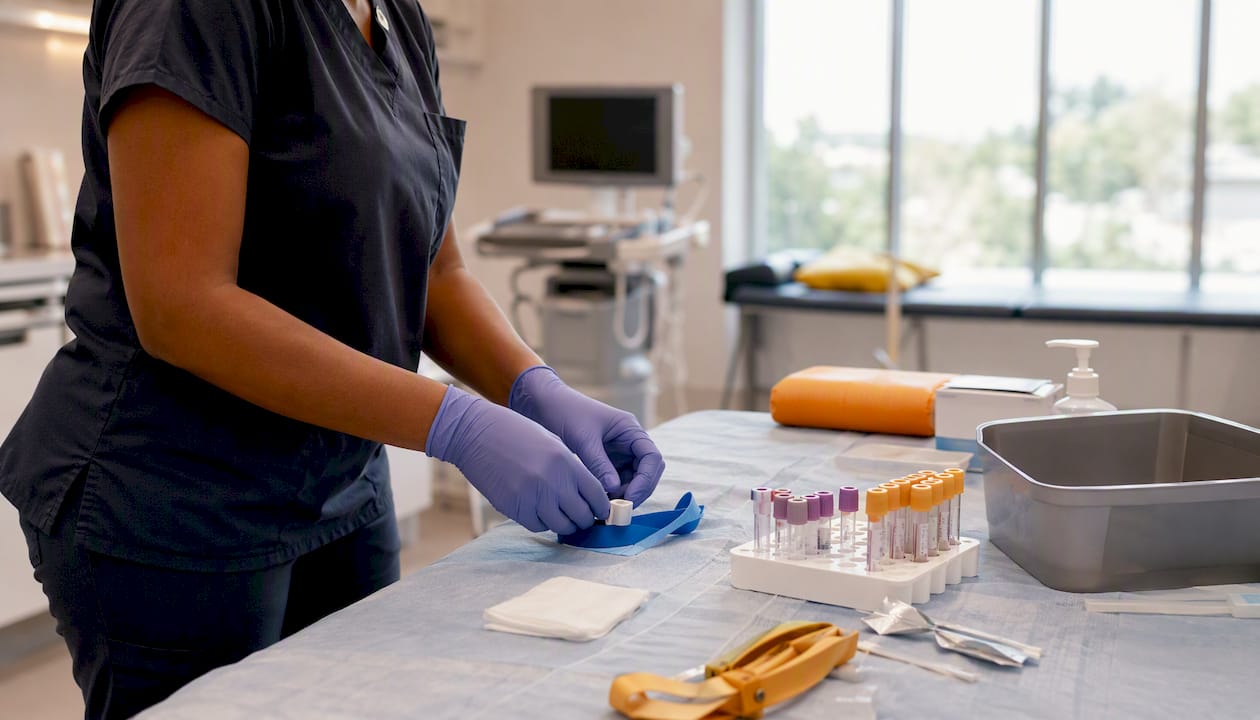
Site-phenotype checklist: IT maturity and EHR capabilities, geographic reach and courier access, phlebotomy capacity and staffing, imaging equipment specifications, local lab availability, and regulatory readiness (IRB, consent workflows).
KPI targets for pilot and scale:
| KPI | Recommended Target |
|---|---|
| Lab result TAT (median) | ≤6 hours for lab abnormalities (as shown in phase II trial); specify whether this applies to all results or only critical values per program scope |
| Data completeness within 48 hours | ≥95% per collection event |
| Imaging availability at point of care | ≤2 days (median, as per RECIST measures in cited phase II trial) |
| Query rate per patient | <2 queries per subject per visit |
| Sample loss rate | <1% |
Rollout cadence:
- Pilot (weeks 1–20): 3–5 sites, 50–100 subjects, full KPI monitoring
- Regional scale (weeks 20–36): 10–20 sites, logistics and onboarding refinement
- National scale (weeks 36+): Full site network, governance and QC automation active
Aligning imaging and lab protocols across sites before regional scale prevents the protocol drift that forces expensive re-work later.
What do regulators expect from your data and compliance controls?
Compliance requires both procedural controls (consent, de-identification, audit trails) and technical controls (encryption, role-based access, provenance metadata). Neither alone satisfies FDA RWD guidance or HIPAA.
Regulatory action items:
- Align data collection and transformation to FDA RWD guidance where applicable
- Document all CDISC mapping decisions with rationale and version history
- Maintain eSource validation and GxP data integrity practices throughout
- Apply HIPAA safeguards: data minimization, secure transfer, BAAs for all partners
- Implement role-based access controls and full audit logs for every data access event
- For wearable and high-frequency device data: define aggregation rules upfront, submit only analysis-relevant epochs, and retain raw files for audit
Pro Tip: De-identification is not a one-time step. Re-identification risk increases as datasets are linked across sources. Build a formal re-identification risk assessment into your data governance plan before combining lab, imaging, and EHR data.
What do pilot results show about integrated diagnostics programs?
Pilots integrating direct lab exchange and real-time informatics consistently produce faster, cleaner, and more actionable data than multi-vendor approaches. The numbers are specific.
The DDE pilot reduced data latency substantially and eliminated transcription errors in the pilot cohort. The phase II real-time informatics trial delivered lab abnormalities within a median of 6 hours and RECIST imaging measures within a median of 2 days, with clinicians and data managers reporting higher accuracy than prior workflows.
Lessons from early programs:
- Start with high-maturity domains (established local labs with structured outputs) to generate early wins
- Expect mapping issues in the first 4–6 weeks; budget time for source-to-target reconciliation
- A central coordinating center materially reduces site burden and improves participation rates
- Faster data delivery shortens monitoring cycles and reduces end-of-study query backlogs
These metrics are the internal business case. Bring them to procurement and finance teams when justifying the integrated-partner model over multi-vendor alternatives.
What does a realistic RFP-to-scale roadmap look like?
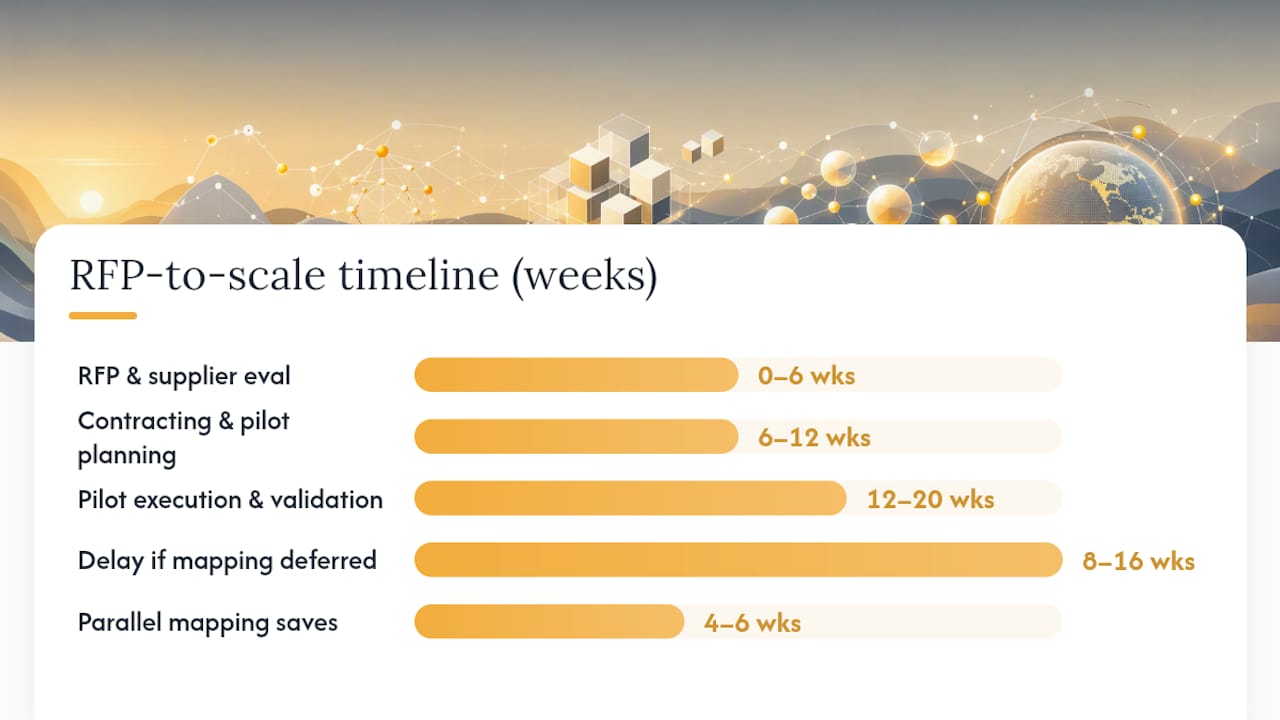
A realistic timeline from RFP to national scale is 6–12 months when mapping and onboarding are prioritized from the start. Programs that defer mapping work to post-contract consistently run 8–16 weeks late.
- Weeks 0–6 (RFP and supplier evaluation): Issue integrated RFP covering lab, imaging, data, and analytics; score against mandatory capability checklist; shortlist to 2–3 partners.
- Weeks 6–12 (Contracting and pilot planning): Finalize master contract with SLAs, data ownership terms, and change-order caps; define pilot scope, site phenotypes, and acceptance criteria; begin source mapping in parallel.
- Weeks 12–20 (Pilot execution and validation): Execute pilot across 3–5 sites; monitor KPIs weekly; validate data completeness, latency, and error rates against acceptance criteria; conduct go/no-go gate review at week 20.
- Weeks 20+ (Scale and operationalize): Authorize scale based on gate criteria; expand site network in regional cohorts; activate governance, QC automation, and training programs.
Parallelizing source mapping with contracting saves 4–6 weeks. Assign a dedicated informatics resource to mapping from week 6 rather than waiting for contract execution.
Deliverables per phase: RFP scoring matrix → signed master contract + pilot protocol → validated pilot dataset + KPI report → scale authorization memo with governance plan.
Why Kohealth Labs built an integrated diagnostics offering
Vendor fragmentation is the single biggest driver of data latency and quality failures in population-level preventive testing programs. We built Kohealth Labs' integrated diagnostics offering specifically to eliminate that fragmentation and make analysis-ready data the default output, not a post-processing project.
The single-contract model reduces coordination overhead that typically consumes program management hours across separate lab, imaging, and data vendors. First-pass data completeness improves because QC, transformation, and delivery are governed by one set of rules, one team, and one accountability structure. For sponsors and agencies that need to move from collection to submission-ready datasets without rebuilding the pipeline for each study, that consistency is the operational advantage that matters most.
We welcome conversations about pilot design, site phenotype mapping, and alignment with your program's specific regulatory and data requirements.
Kohealth Labs delivers integrated diagnostics built for program-level scale
When your program needs lab results, imaging data, and analysis-ready bundles under one contract, an integrated partner like Kohealth Labs can provide exactly that. The offering covers integrated lab and radiology services, AI-driven QC, HL7/FHIR and CDISC-aligned data delivery, dedicated onboarding, and SLA-backed KPIs for TAT and data completeness.
Service capabilities map directly to buyer needs: pilot design and site onboarding, specimen logistics and cold-chain management, imaging protocol alignment, analytics delivery, and regulatory-ready data packages for CROs, government agencies, and employer wellness programs. The clinical trials service page covers the full scope for research sponsors. For wellness and employer programs, the integrated diagnostics solutions page outlines program options and contact paths.
To request a pilot scoping conversation, visit Kohealthlabs and connect with the program team directly.
Sources
The following primary sources support the evidence, standards guidance, and operational recommendations in this article. Use them when building your internal business case.
- Contracting with central laboratories | Contract Pharma
- Clinical informatics research on interoperability (ScienceDirect)
- Harnessing technology to improve clinical trials: real-time informatics (PMC4878068)
- Direct data extraction and exchange of local labs for clinical research protocols (J SCDM, Buckley)
This article is general information, not a substitute for advice from a qualified doctor. Consult a qualified healthcare professional about your own circumstances before acting on anything here.