

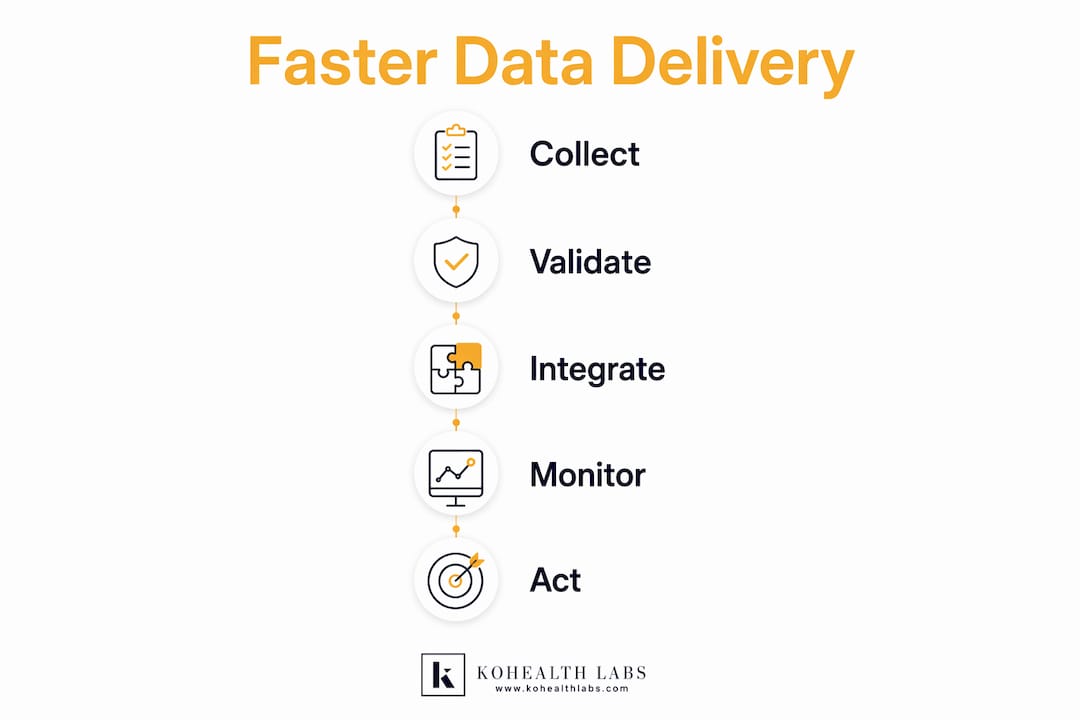
Faster data delivery in clinical trials is not a convenience. It is the difference between catching a safety signal in days versus weeks, between making a protocol adjustment before enrollment stalls, and between submitting a clean regulatory package on schedule or facing months of back-and-forth with the FDA. When trial teams have access to validated, real-time data, they can act while the window is still open. That is the core reason why faster data delivery improves trial outcomes across every phase of research.
The evidence backs this up clearly. The FDA's Real-Time Clinical Trials initiative transmits safety signals to regulators within days rather than the weeks or months that traditional batch reporting requires. MIT CISR research found that companies operating with real-time data capabilities demonstrate 97% higher profit margins and 20% better operational efficiency than those relying on delayed workflows. In clinical research, those numbers translate directly to faster go/no-go decisions, fewer protocol deviations, and better outcomes for participants.
Here is a quick summary of what faster, integrated data delivery delivers in practice:
- Faster safety signal detection so teams can intervene before adverse events escalate
- Shorter trial timelines through continuous data cleaning and reduced query backlogs
- Better regulatory compliance with auditable, up-to-date data that meets ICH E6(R3) expectations
- Reduced administrative burden on clinical research associates (CRAs) and site staff
- Earlier go/no-go decisions supported by live evidence rather than retrospective batch reviews
- Improved participant recruitment through real-time enrollment tracking and predictive dropout modeling
- Lower operational costs from eliminating redundant manual data entry across diagnostic and monitoring workflows
1. How big data analytics and predictive modeling rely on faster data
Big data analytics only delivers its full value when the data feeding it is current. Predictive models that forecast participant dropout, adverse event likelihood, or site underperformance need a continuous stream of clean inputs. When data arrives in weekly or monthly batches, those models are always working from a lagging picture, and the interventions they recommend arrive too late to matter.

Real-time data pipelines close that gap. They allow faster analytics that enable action while opportunities are still relevant, not just better dashboards. For clinical trials, this means a sponsor can identify a site trending toward high dropout rates and deploy additional support before enrollment numbers fall below the statistical threshold the trial needs.
How predictive analytics improves trial performance with faster data:
- Early dropout prediction — Models flag participants showing disengagement patterns before they withdraw, allowing coordinators to intervene with targeted outreach.
- Adverse event forecasting — Continuous biomarker feeds allow algorithms to detect pre-adverse-event signatures earlier than scheduled site visits would reveal.
- Protocol deviation alerts — Automated checks against protocol criteria trigger alerts the moment a deviation occurs, rather than during a periodic data review.
- Enrollment optimization — Real-time site performance data lets sponsors redirect recruitment resources to high-performing sites faster.
- Dose adjustment modeling — Pharmacokinetic models fed by live lab results can recommend dose modifications between scheduled visits.
AI and machine learning amplify each of these capabilities. When lab results, imaging reads, and patient-reported outcomes flow into a single environment, machine learning models can cross-reference data types that would otherwise sit in separate silos. A participant's radiology finding combined with a concurrent lab deviation, for example, may signal a safety concern that neither data stream would flag independently. Sponsors who implement governed real-time data flows achieve meaningful acceleration in development programs precisely because their analytical models are working with complete, current information.
Cost reduction follows naturally. When predictive models catch problems early, sponsors avoid the expensive protocol amendments, site remediation visits, and enrollment delays that result from late detection. Resource allocation improves because teams are responding to live signals rather than reconstructing what happened from stale records.
Pro Tip: Set up automated threshold alerts within your analytics platform so that site performance metrics trigger a response workflow the moment they cross a predefined boundary, not during the next scheduled review meeting.
2. Real-time data monitoring makes trial management proactive, not reactive
Traditional clinical trial monitoring operates on a lag. Site visits happen on a schedule, data queries pile up between visits, and quality issues surface weeks after they occur. Real-time monitoring flips that model entirely. When operational and quality metrics are visible as they happen, trial teams can intervene before a small problem becomes a protocol deviation or a safety event.

The regulatory case for this shift is well established. ICH E6(R3) guidance places active, risk-based oversight responsibility squarely on sponsors, and real-time data access provides the auditable, continuous monitoring record that regulators expect to see. Sponsors can demonstrate not just that they reviewed data, but exactly when they reviewed it and what action they took.
Operational benefits of real-time monitoring:
- Continuous data cleaning reduces query backlogs by catching entry errors at the point of data capture rather than during periodic reviews
- Shared live dashboards give sponsors, CROs, and sites a single view of trial status, reducing miscommunication and duplicated effort
- Immediate dose modification alerts allow medical monitors to act on safety signals within hours rather than waiting for the next data lock
- Proactive risk mitigation lets teams address emerging issues before they require protocol amendments
- Auditable monitoring records satisfy regulatory expectations for documented, ongoing oversight
The shift in the CRA role is one of the most practical benefits. Real-time integration converts CRAs from data checkers to protocol compliance partners. Instead of spending site visit hours reconciling data discrepancies, CRAs can focus on participant safety, site staff training, and protocol adherence. That reallocation of attention strengthens site relationships and improves data quality at the source.
Collaboration between sponsors and sites also improves when everyone is working from the same live data. Disagreements about site performance are easier to resolve when both parties can see the same metrics in real time. Sites that feel supported rather than audited tend to maintain higher enrollment and retention rates throughout a trial.
Pro Tip: Build shared, role-appropriate dashboards for sponsors, CROs, and sites from the start of a trial. When all parties see the same live data, escalation conversations become shorter and more productive.
3. Real-world data integration strengthens trial design and outcomes
Real-world data (RWD) includes electronic health records, insurance claims, patient registries, wearable device outputs, and pharmacy records. When integrated quickly into a trial's data environment, RWD gives sponsors a richer picture of how participants are responding compared to broader patient populations. That context supports better protocol design, more realistic eligibility criteria, and more meaningful safety monitoring.
The growing use of RWD to design adaptive, patient-centered trials reduces both time and cost risks. RWD integration supports clinical planning, recruitment optimization, and protocol design adjustments that improve the probability of trial success. A sponsor designing an oncology trial, for instance, can use claims data to identify the realistic size of the eligible population before finalizing enrollment targets, avoiding the common problem of overestimating recruitment feasibility.
Key benefits of faster RWD integration:
- Enhanced generalizability by comparing trial participants to real-world patient populations throughout the study
- Recruitment optimization through pre-screening of potential participants against real-world eligibility data
- Protocol refinement using historical RWD to set more accurate primary endpoints and visit schedules
- Concurrent safety monitoring that flags when trial participant outcomes diverge from real-world norms
- Adaptive design support allowing protocol modifications based on emerging real-world evidence during the trial
Managing RWD is not without challenges. Data from disparate sources arrives in different formats, with varying levels of completeness and coding consistency. Integrating claims data with electronic health records and trial-specific lab results requires standardized data models, such as OMOP CDM, and governance frameworks that ensure data quality before the records enter analytical workflows. Without that structure, faster access to RWD creates noise rather than signal.
The timeline impact of well-managed RWD is real. Sponsors who can pull and analyze RWD quickly make protocol decisions based on current evidence rather than assumptions. That speed reduces the number of protocol amendments needed mid-trial, and fewer amendments mean fewer regulatory submissions, shorter timelines, and lower costs.
4. How integrated data delivery transforms clinical trial workflows and reduces timelines
Fragmented data is one of the most persistent sources of delay in clinical research. When laboratory results, radiology reads, electronic data capture (EDC) entries, and patient-reported outcomes live in separate systems managed by separate vendors, every handoff is a potential bottleneck. Data must be manually reconciled, reformatted, and re-entered, and each step introduces errors and delays.
Unified data platforms eliminate that redundancy. Integrating patient engagement, diagnostics, and monitoring into a single environment shifts clinical trial management from a coordination exercise into a continuous evidence-generation process. Sponsors gain earlier visibility into emerging trends, and sites spend less time on administrative tasks that add no clinical value.
The regulatory efficiency gains are substantial. The FDA spends 40% of review time tracing data flow because of fragmented sources. Unified diagnostic platforms improve traceability and speed regulatory feedback by ensuring that every data point carries consistent metadata from collection through submission. Fewer traceability questions from regulators means faster review cycles and earlier approvals.
| Workflow area | Traditional fragmented approach | Integrated data delivery |
|---|---|---|
| Lab and radiology data | Separate vendors, manual reconciliation | Single platform, automatic consolidation |
| Data query resolution | Periodic batch review, weeks of backlog | Continuous cleaning, near-zero backlog |
| CRA site visit focus | Data discrepancy resolution | Protocol adherence and participant safety |
| Regulatory submission | Manual traceability documentation | Automated audit trail with consistent metadata |
| Go/no-go decision timing | After data lock, retrospective review | Ongoing, based on live evidence |
The case for integration is not theoretical. In a migraine Phase II/III study, an integrated data delivery approach reduced missing data to 0.3% and cut the data backlog to 17.6%, compared to more than 29% missing data in traditionally managed studies. That level of data completeness changes what sponsors can do with their results. Clean, complete data supports stronger regulatory submissions and reduces the risk of post-submission queries that extend approval timelines.
For CRAs, the operational shift is equally significant. When automated validation handles routine data checking, CRAs can redirect their attention to the work that actually requires human judgment: building site relationships, coaching staff on protocol requirements, and monitoring participant welfare. Sites that receive more meaningful support from CRAs tend to perform better on enrollment, retention, and data quality metrics.
Understanding how unified diagnostics function within clinical research helps teams make the case internally for platform consolidation. The operational and regulatory benefits compound over the course of a trial, and the earlier integration happens, the more value it delivers.
5. How Kohealth Labs' integrated diagnostics accelerate clinical trials
Kohealth Labs was built around a specific problem: clinical research organizations and sponsors were losing time and data quality managing multiple diagnostic vendors under separate contracts. Laboratory results arrived through one channel, radiology reads through another, and neither was formatted to flow directly into the trial's analytical environment. The result was manual reconciliation work, delayed reporting, and data quality issues that surfaced late in the trial when they were most expensive to fix.
Kohealth Labs addresses this with a single-contract model that unifies laboratory services and radiology under one platform, delivering analysis-ready data bundles directly to CROs, government agencies, and wellness programs. The integration covers more than 100 biomarkers, and AI-powered validation runs continuously to identify deviations before they become data quality events. That combination of breadth and automation means trial teams receive clean, structured data without the manual cleaning step that traditionally adds days or weeks to reporting cycles.
| Kohealth Labs capability | Trial impact |
|---|---|
| Single-contract lab and radiology integration | Eliminates vendor coordination delays and contract complexity |
| AI-powered data validation | Catches deviations at the point of data entry, not during periodic review |
| Analysis-ready data bundles | Reduces time from data collection to sponsor review |
| 100+ biomarker coverage | Supports complex, multi-endpoint trials without additional vendor agreements |
| Continuous compliance monitoring | Maintains auditable records for ICH E6(R3) and FDA oversight requirements |
The patient safety implications are direct. When safety-relevant lab and imaging data flow into a single monitored environment, medical monitors can act on emerging signals without waiting for a scheduled data transfer or a vendor reconciliation cycle. That speed matters most in oncology, rare disease, and first-in-human studies where early safety signals require rapid protocol response.
Kohealth Labs' approach reflects exactly that shift. By removing the friction between data collection and data availability, the platform gives trial teams the live evidence they need to make decisions at the pace the trial requires. Sponsors working with Kohealth Labs report fewer data-related delays and cleaner regulatory submissions, because the data arriving at the sponsor's desk is already validated, traceable, and formatted for analysis.
For teams dealing with common pharmaceutical trial data delays, the single-contract model removes one of the most persistent sources of friction: the gap between when diagnostic data is collected and when it is available in a form the trial team can actually use.
The radiology and lab integration Kohealth Labs provides is particularly valuable in trials where imaging endpoints and biomarker results must be interpreted together. When both data types arrive through the same platform, on the same timeline, medical reviewers can make more informed assessments without waiting for one vendor to catch up to another.
What to look for when evaluating faster data delivery for your trial
Not every data delivery solution delivers the same benefits. The difference between a platform that accelerates your trial and one that adds complexity often comes down to a few specific capabilities.
Integration depth matters more than speed alone. A platform that delivers lab results quickly but requires manual reconciliation with radiology data has not solved the core problem. True integration means all diagnostic data types arrive in a single, consistent format without manual intervention between collection and analysis.
AI-powered validation should happen at the point of entry. Validation that runs after data is submitted catches errors too late. The most effective systems flag deviations as data is entered, so corrections happen before the data enters the analytical workflow. That is the difference between a 0.3% missing data rate and the 29%-plus rates common in traditionally managed studies.
Regulatory traceability must be built in, not added on. Every data point needs a complete audit trail from collection through submission. Platforms that generate traceability documentation automatically reduce the time FDA reviewers spend reconstructing data flow, which is a meaningful factor given that fragmented sources consume a substantial portion of regulatory review time.
The contract structure affects your timeline. Managing multiple diagnostic vendors under separate contracts creates coordination overhead that accumulates throughout a trial. A single-contract model removes that overhead and gives sponsors one point of accountability for data quality and delivery timing.
For teams evaluating CRO diagnostic data delivery options, these criteria provide a practical framework for comparing platforms without getting lost in feature lists. The goal is clean, validated, traceable data delivered fast enough to support real-time decision-making. Everything else is secondary.
Pro Tip: When evaluating integrated diagnostics platforms, ask vendors specifically how their system handles discrepancies between lab and radiology data from the same participant. The answer reveals how deeply the integration actually runs.
Regulatory considerations for faster data delivery in US clinical trials
Speed without compliance is not an advantage. Faster data delivery only improves trial outcomes when the data meets the regulatory standards that govern how it can be used in submissions. In the US market, that means aligning with FDA guidance, ICH E6(R3) requirements, and 21 CFR Part 11 electronic records standards.
The FDA's Real-Time Clinical Trials initiative represents the clearest regulatory signal that faster delivery is not just operationally beneficial but actively encouraged. Under this model, safety signals reach the FDA within days rather than weeks or months, allowing regulators to respond to emerging safety concerns during the trial rather than after it concludes. That shift benefits participants directly and gives sponsors earlier regulatory feedback on their programs.
ICH E6(R3) reinforces this direction by placing explicit responsibility on sponsors for active, risk-based monitoring supported by documented, continuous oversight. Real-time data access provides the compliance documentation that risk-based monitoring requires. Sponsors who can demonstrate continuous, auditable oversight are better positioned during regulatory inspections than those relying on periodic monitoring visit reports.
21 CFR Part 11 compliance requires that electronic records and signatures meet specific standards for authenticity, integrity, and confidentiality. Integrated platforms that generate automatic audit trails and maintain consistent metadata across data types satisfy these requirements more reliably than manual workflows, where documentation gaps are common.
The practical implication for trial teams is that regulatory compliance and operational speed are not competing priorities when the underlying data infrastructure is designed correctly. A platform that delivers validated, traceable data in real time satisfies both requirements simultaneously.
Challenges in implementing faster data delivery and how to address them
Faster data delivery requires more than technology. The organizational habits that built around scheduled batch reporting do not disappear when a new platform goes live. Teams accustomed to weekly data reviews need to develop new decision rhythms that match the pace of the data they are now receiving.
Implementing real-time data delivery requires breaking the habit of scheduled batch reporting and ensuring that decision rhythms match data speed for the change to deliver real value. A sponsor who receives live data but still waits for the monthly steering committee meeting to act on it has not gained the benefit of real-time delivery. The data infrastructure and the decision-making process must evolve together.
Common implementation challenges and practical responses:
- Data standardization across sources. Lab systems, imaging platforms, and EDC tools use different data formats. Establishing a common data model before integration begins prevents downstream reconciliation problems.
- Staff training on new workflows. CRAs, data managers, and medical monitors need training not just on the platform but on how to interpret and act on live data. Alert fatigue is a real risk when teams are not prepared to triage incoming signals.
- Governance for real-world data. RWD sources vary in quality and completeness. Defining data quality thresholds and validation rules before RWD enters the analytical environment protects the integrity of trial results.
- Vendor contract alignment. Moving to a single-contract integrated model requires renegotiating existing vendor relationships. Starting this process early in trial planning avoids delays at startup.
- Regulatory documentation of the new workflow. Regulators need to understand how the integrated platform works and how data quality is maintained. Preparing clear documentation of the validation process and audit trail structure before the trial begins reduces inspection risk.
The teams that navigate these challenges most successfully treat the transition to faster data delivery as a process change, not just a technology upgrade. The platform enables speed. The organization has to be ready to use it.
Key Takeaways
Faster, integrated data delivery improves clinical trial outcomes by enabling real-time safety monitoring, reducing administrative backlogs, and giving sponsors the live evidence they need to make decisions before delays compound.
| Point | Details |
|---|---|
| Real-time safety monitoring | FDA's Real-Time Clinical Trials initiative transmits safety signals within days, not weeks or months. |
| Data quality improvement | Integrated delivery reduced missing data to 0.3% versus more than 29% in traditionally managed studies. |
| Regulatory efficiency | Fragmented data sources consume a substantial portion of FDA review time; unified platforms reduce that burden through consistent traceability. |
| Operational shift for CRAs | Automated validation converts CRAs from data checkers to protocol compliance partners focused on participant safety. |
| Competitive advantage | Companies with real-time data capabilities demonstrate 97% higher profit margins and 20% better operational efficiency than delayed-workflow peers. |
Ready to accelerate your trial with integrated diagnostics?
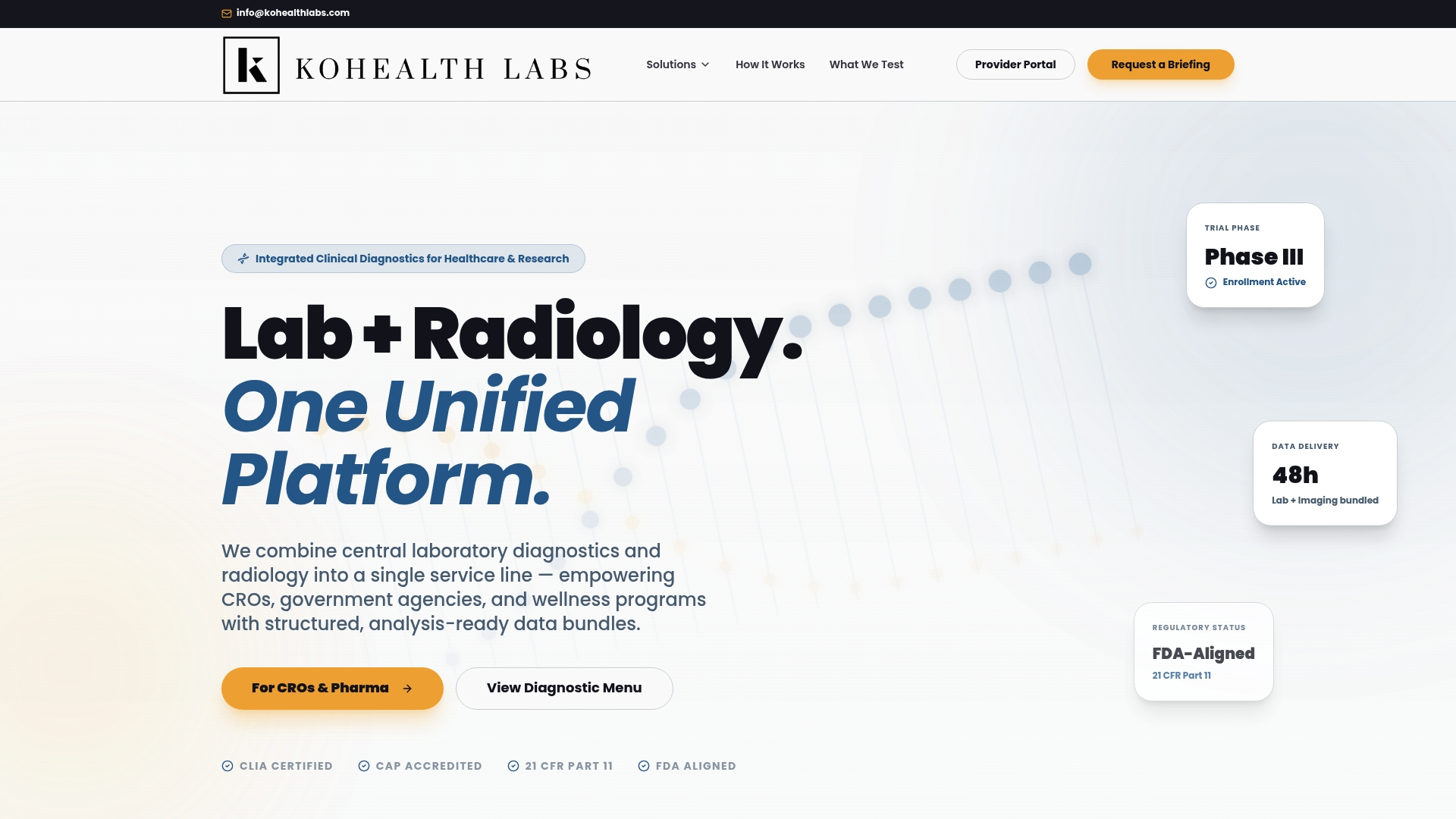
Kohealth Labs brings laboratory services, radiology, and AI-powered data validation together under a single contract, so your trial team receives clean, analysis-ready data without the coordination overhead of managing multiple vendors. Whether you are running a Phase II oncology study or a large-scale Phase III program, the integrated platform delivers the data speed and quality your team needs to make confident decisions at every stage.
Explore how Kohealth Labs supports clinical trials with integrated diagnostics built for CROs, government agencies, and pharma sponsors. You can also review the full integrated diagnostics and AI capabilities that power faster, cleaner data delivery across more than 100 biomarkers. For teams working with integrated healthcare data platforms, the case for consolidation is clear: faster data, fewer delays, and better outcomes for every participant in your trial.