

Centralized laboratory services are defined as consolidated diagnostic facilities that process specimens from multiple clinical sites under uniform protocols, and their role in chronic disease management is to deliver standardized, high-integrity data that supports early detection, continuous monitoring, and population-level care decisions. Unlike distributed testing models, a centralized lab applies the same reference ranges, reagents, and quality controls across every sample it processes. That consistency is the foundation of reliable longitudinal data, which physicians and clinic administrators need to track disease progression over months and years. Kohealth Labs integrates laboratory services with radiology and AI-powered analytics to give clinical teams a single, analysis-ready data source for chronic condition workflows.
How does centralized lab testing improve chronic disease detection?
Standardized diagnostic testing is the most direct way a centralized lab reduces variability in chronic disease monitoring. When every specimen follows the same pre-analytical and analytical protocol, result-to-result comparability improves across time points and across sites. That comparability is what makes longitudinal data clinically useful rather than statistically noisy.
Modern centralized labs use advanced biomarker panels and AI to push detection accuracy further. Biomarker-based AI testing in centralized labs has demonstrated a sensitivity of 0.86, a specificity of 0.88, and an area under the curve of 0.90 for early chronic disease detection. Those numbers mean a physician can trust a negative result and act confidently on a positive one.

Alignment with National Committee for Quality Assurance (NCQA) standards reinforces this reliability. Standardizing platforms and reference ranges in centralized labs reduces variability, enabling the longitudinal data integrity that quality population health management requires. Without that standardization, comparing a patient's HbA1c from march to september becomes an exercise in guesswork rather than clinical judgment.
Key benefits of standardized centralized testing for chronic disease include:
- Uniform reference ranges across all collection sites, eliminating inter-lab drift in values for markers like creatinine, lipid panels, and HbA1c
- Validated biomarker panels covering more than 100 analytes, giving care teams a complete metabolic and inflammatory picture in a single draw
- AI-assisted deviation detection that flags anomalous results before they reach the clinician, reducing the risk of acting on a compromised specimen
- Longitudinal data integrity that supports NCQA-aligned quality metrics and value-based care reporting
Pro Tip: When ordering chronic disease panels through a centralized lab, request a site-specific pre-analytical checklist. Tube type, centrifugation speed, and temperature window all affect result accuracy, and a written protocol reduces rejected samples before they happen.
What operational advantages do centralized labs offer chronic care workflows?
Predictable turnaround time is the operational advantage physicians cite most often when choosing centralized over distributed testing. Hub-and-spoke cluster consolidation combined with total laboratory automation allows centralized reference labs to meet strict 90th-percentile turnaround time standards consistently. For a clinic managing hundreds of diabetic or hypertensive patients, that predictability translates directly into appointment scheduling confidence.
The operational model works in a clear sequence:
- Specimen collection at the clinic site using pre-labeled kits and standardized shipping schedules supplied by the central lab
- Logistics handoff through a temperature-controlled courier network that maintains cold-chain integrity from collection to processing
- Automated processing at the central facility using robotics and total lab automation, which removes manual handling variability
- Result transmission through middleware integrated with the clinic's hospital information system (HIS) or laboratory information system (LIS), delivering structured data directly into the patient record
Strict sample handling requirements are the hidden operational cost of centralized labs. Disregarding precise centrifugation, temperature control, and specific tube requirements leads to sample rejection and patient recollections, disrupting both clinic workflow and patient experience.
Operational challenges like sample rejection are real, but they are manageable with the right preparation. Clinics that treat the central lab as a system design partner, integrating standardized workflows and shipping schedules into their daily routine, see far fewer pre-analytical failures. The investment in staff training on collection protocols pays back in fewer repeat draws and faster results for patients.
How do centralized labs support population health and predictive analytics?
Centralized labs generate the longitudinal data that makes population health management possible. Labs now co-lead population health initiatives by providing risk stratification data and shifting from passive testing to active care governance. That shift changes the lab from a cost center into a clinical decision partner.
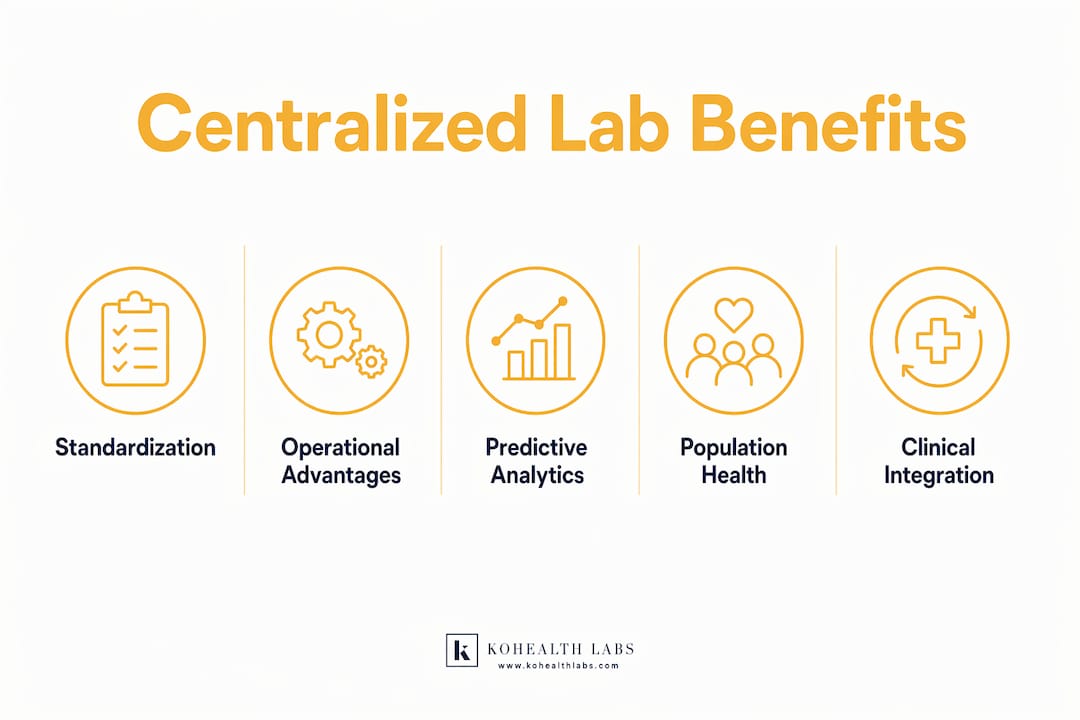
The mechanism is middleware integration. Advanced labs use middleware platforms integrated with HIS and LIS systems to enable automated clinical alerts and proactive care pathway triggers for chronic disease teams. When a patient's eGFR crosses a threshold, the system flags the care coordinator automatically rather than waiting for the next scheduled visit.
The table below shows how centralized lab data functions across different population health use cases:
| Use case | Lab data input | Clinical output |
|---|---|---|
| Diabetes risk stratification | HbA1c, fasting glucose, insulin resistance markers | Tiered patient lists for intervention priority |
| Cardiovascular monitoring | Lipid panels, hsCRP, BNP, troponin trends | Automated alerts for care team escalation |
| Chronic kidney disease staging | Creatinine, eGFR, urine albumin-to-creatinine ratio | Nephrology referral triggers |
| Preventive screening programs | Complete metabolic panels, CBC, thyroid function | Population-level gap closure reporting |
The Clinical Lab 2.0 movement formalizes this shift, highlighting how predictive and preventive lab-driven care models use longitudinal data to manage chronic diseases before they escalate. Clinic administrators who embed lab data into their population health dashboards gain a real-time view of disease burden across their patient panel, not just individual results.
Pro Tip: Ask your centralized lab partner whether their middleware supports HL7 FHIR messaging. FHIR-compatible data feeds integrate directly with most modern electronic health record systems, cutting manual data entry and reducing transcription errors in chronic disease registries.
For clinics exploring how integrated diagnostics improve efficiency, the combination of lab middleware and population health analytics represents the clearest path from reactive to proactive chronic care.
Do centralized and decentralized testing work together in chronic disease care?
Centralized and decentralized testing are not competing models. They serve different clinical moments, and the strongest chronic disease programs use both deliberately. Centralized labs and point-of-care testing together create resilient chronic care by balancing precision with patient access and timely decision-making.
The practical division of labor looks like this:
- Centralized labs handle complex, high-volume panels where standardization and longitudinal comparability matter most, such as quarterly HbA1c monitoring, annual lipid panels, and renal function tracking
- Point-of-care testing handles time-sensitive decisions at the bedside or in the exam room, such as INR checks for anticoagulation management or rapid glucose readings during a hypoglycemic episode
- Governance and oversight sits with the centralized lab, which sets the reference standards, validates point-of-care devices, and reconciles results across the network
- Patient engagement benefits from decentralized access, particularly in rural or underserved settings where travel to a central draw site creates a barrier to consistent monitoring
The integrated lab and radiology model extends this logic further, combining centralized diagnostic precision with community-level access points to serve patients who would otherwise fall out of monitoring programs. Clinic administrators designing chronic disease workflows should map which tests require central precision and which require local speed, then build collection and routing protocols accordingly.
Key Takeaways
Centralized labs deliver the standardized, longitudinal diagnostic data that chronic disease management requires, and their impact grows when integrated with population health analytics and point-of-care testing networks.
| Point | Details |
|---|---|
| Standardization reduces variability | Uniform protocols and reference ranges make longitudinal chronic disease data clinically reliable. |
| AI and biomarkers improve detection | Centralized labs using AI-assisted panels achieve high sensitivity and specificity for early chronic disease identification. |
| Middleware drives proactive care | HIS/LIS integration enables automated alerts that shift care teams from reactive to preventive management. |
| Pre-analytical protocols matter | Strict sample handling is the most common source of centralized lab failures and requires active clinic training. |
| Hybrid models are the standard | Centralized precision and point-of-care speed serve different clinical moments and work best together. |
Kohealth Labs' view on what clinics get wrong about central lab partnerships
The most common mistake clinics make is treating a centralized lab as a vendor rather than a clinical partner. You send the sample, you get the result, and the relationship ends there. That model wastes the most valuable thing a central lab produces: structured, longitudinal data that can tell you where your patient panel is heading before individual patients show symptoms.
We have seen clinics with excellent collection compliance still fail to close the loop on population health because their lab data sits in a separate system that no one queries between appointments. The Clinical Lab 2.0 framework exists precisely because this gap is widespread. Moving from siloed reports to collaborative, data-driven care governance is the real barrier, not the technology.
The clinics that get the most from centralized diagnostics do three things differently. They train front-desk and nursing staff on pre-analytical protocols with the same rigor they apply to clinical procedures. They connect lab middleware to their population health dashboard so results trigger workflows, not just chart entries. And they schedule quarterly reviews with their lab partner to audit result turnaround, rejection rates, and data completeness.
The future of chronic disease management runs on specialty lab reporting that feeds directly into care decisions. Clinics that build that infrastructure now will manage chronic conditions more effectively and demonstrate better outcomes in value-based contracts.
— Kohealth Labs
Kohealth Labs: integrated diagnostics for chronic disease programs
Kohealth Labs was built for clinical teams that need more than a results report. The platform combines centralized laboratory services with radiology and AI-powered analytics under a single contract, giving physicians and clinic administrators one source of analysis-ready data for chronic disease workflows.
Kohealth Labs covers more than 100 biomarkers, integrates with HIS and LIS systems through middleware, and delivers automated alerts that support proactive care decisions. For programs managing diabetes, cardiovascular disease, or chronic kidney disease at scale, the single-contract model removes the coordination burden of managing multiple diagnostic vendors. Telehealth-enabled collection options extend access to patients who cannot visit a draw site regularly. Visit Kohealth Labs to review service options, or explore AI-powered data integration to see how analytics connect lab results to population health outcomes.
FAQ
What is the role of a centralized lab in chronic disease management?
A centralized lab provides standardized, longitudinal diagnostic data that supports early detection, ongoing monitoring, and population health risk stratification for chronic conditions. Its uniform protocols make result comparisons reliable across time points and clinical sites.
How does centralized lab testing reduce variability in chronic disease monitoring?
Centralized labs apply the same reference ranges, reagents, and quality controls to every specimen, eliminating the inter-lab drift that makes longitudinal comparisons unreliable. NCQA-aligned standardization is the recognized benchmark for this consistency.
What are the biggest operational challenges with centralized labs?
Strict pre-analytical requirements, including precise centrifugation, temperature control, and correct tube selection, are the most common source of sample rejection and workflow disruption. Clinics that train staff on collection protocols and use pre-labeled kits from the lab see significantly fewer failures.
How do centralized labs support predictive analytics for chronic conditions?
Middleware integration with HIS and LIS systems allows centralized labs to trigger automated clinical alerts when patient results cross defined thresholds, enabling care teams to intervene before a chronic condition escalates.
Should clinics use centralized labs or point-of-care testing for chronic disease?
Both models serve distinct clinical needs. Centralized labs provide the precision and standardization required for quarterly monitoring panels, while point-of-care testing delivers the speed needed for time-sensitive bedside decisions. The most effective chronic disease programs use both in a coordinated network.