

Therapeutic area diagnostic support refers to specialized diagnostic tools and tests developed to assist in disease detection, treatment selection, and patient monitoring within specific medical fields. The FDA defines companion diagnostics as essential for the safe and effective use of a corresponding therapeutic, requiring co-development within the drug's clinical program. Across oncology, infectious diseases, cardiology, and neurology, examples of therapeutic area diagnostic support now shape how clinical teams select treatments, monitor patients, and design trials. Kohealth Labs integrates laboratory services, radiology, and AI-driven analytics to deliver analysis-ready data bundles that support these exact workflows.
1. Examples of therapeutic area diagnostic support in oncology
Oncology generates the highest demand for precision diagnostics of any therapeutic field. Oncology accounts for 28% of all clinical drug trials started between 2018 and 2023. That volume drives continuous development of biomarker assays, genomic panels, and companion diagnostics tied directly to targeted therapies.
Key oncology diagnostic support examples include:
- PD-L1 immunohistochemistry (IHC) assays: These tests identify patients whose tumors express the PD-L1 protein, guiding selection of checkpoint inhibitor therapies.
- Tumor genomic profiling panels: Next-generation sequencing panels screen for actionable mutations across dozens of genes simultaneously, replacing single-gene tests.
- Liquid biopsy: Circulating tumor DNA tests detect cancer-related mutations from a blood draw, enabling real-time treatment monitoring without repeat tissue biopsies.
- Multi-cancer early detection (MCED) tests: These blood-based tests screen for multiple cancer types simultaneously and represent the fastest-growing segment of early detection diagnostics.
- PTEN loss companion diagnostic: The FDA approved the first IHC assay assessing PTEN protein loss in prostate adenocarcinoma as a companion diagnostic for capivasertib in 2026.
Payer coverage shapes real-world access to these tests. Coverage for colorectal, prostate, and breast cancer early detection tests exceeds 63% among U.S. commercial lives, while kidney cancer screening coverage sits at just 12%. That gap signals where clinical adoption lags despite scientific readiness.
Pro Tip: When evaluating a new oncology diagnostic, check its inclusion in NCCN or ASCO guidelines before assuming payer coverage. FDA clearance alone does not guarantee reimbursement.

2. Diagnostic support in infectious diseases and immunology
Infectious diseases represent 13% of clinical drug trials, making this the second most active therapeutic area for diagnostic development. Diagnostic support here focuses on rapid, accurate pathogen identification and immune response monitoring.
Concrete examples from this therapeutic area include:
- Molecular PCR assays for viral detection: Real-time PCR tests for SARS-CoV-2, HIV, and hepatitis B and C viral load quantification are now standard in both clinical and trial settings.
- Point-of-care (POC) rapid antigen tests: These lateral flow devices deliver results in 15–30 minutes without laboratory infrastructure, enabling decentralized trial monitoring.
- Companion diagnostics for antimicrobial therapies: Molecular resistance panels identify pathogen genotypes that predict response to specific antivirals or antibiotics.
- Immunological assays for vaccine trials: Enzyme-linked immunosorbent assay (ELISA) and neutralization assays measure antibody titers and T-cell responses in vaccine efficacy studies.
- Cytokine profiling panels: These multiplex assays track immune activation and suppression, supporting both autoimmune therapy trials and post-infectious monitoring.
Integration of diagnostics into infectious disease programs accelerates vaccine development timelines. When immune response data from standardized assays feeds directly into trial databases, safety monitoring committees receive cleaner signals faster. Integrated diagnostics for specialty teams reduce the coordination burden that typically slows infectious disease trial reporting.
3. Cardiology and metabolic disorders: diagnostic support examples
Cardiology and metabolic disease represent two of the most diagnostically active areas outside oncology. Biomarker testing, lipid panels, and imaging work together to stratify patient risk and guide therapy selection.
Diagnostic support examples in this area include:
- Cardiac troponin assays: High-sensitivity troponin I and T tests detect myocardial injury at concentrations previously undetectable, enabling earlier intervention in acute coronary syndromes.
- Lipid panels and apolipoprotein testing: Standard lipid panels combined with ApoB and Lp(a) measurements give a fuller picture of cardiovascular risk than LDL cholesterol alone.
- Natriuretic peptide biomarkers (BNP and NT-proBNP): These markers guide diagnosis and treatment monitoring in heart failure, with companion diagnostic applications emerging for newer heart failure therapies.
- Continuous glucose monitoring (CGM) integration: CGM data feeds into metabolic trial endpoints, replacing intermittent HbA1c snapshots with longitudinal glucose profiles.
AI-assisted risk stratification is changing how cardiology diagnostics translate into clinical decisions. Algorithms trained on biomarker panels, imaging data, and electronic health records can flag high-risk patients before a cardiac event occurs. Kohealth Labs covers over 100 biomarkers through its analytics platform, including the cardiac and metabolic markers most relevant to specialty care teams.
| Diagnostic type | Clinical application | Key biomarker or method |
|---|---|---|
| Cardiac injury biomarker | Acute coronary syndrome triage | High-sensitivity troponin |
| Heart failure monitoring | Therapy titration | BNP, NT-proBNP |
| Lipid risk assessment | Cardiovascular prevention | ApoB, Lp(a), LDL-C |
| Metabolic monitoring | Diabetes trial endpoints | CGM, HbA1c |
4. Neurology and rare diseases: diagnostic support examples
Neurology accounts for approximately 8% of clinical trials, yet it presents some of the most complex diagnostic challenges in medicine. Biomarker discovery in neurodegeneration has accelerated, and diagnostic tools are finally catching up with therapeutic development.
Current diagnostic support examples in neurology and rare diseases include:
- Cerebrospinal fluid (CSF) biomarker panels: Amyloid beta 42/40 ratios and phosphorylated tau levels now serve as diagnostic and trial eligibility markers in Alzheimer's disease programs.
- Blood-based neurodegeneration markers: Plasma p-tau217 assays offer a less invasive alternative to CSF testing and PET imaging for Alzheimer's screening.
- Genetic panels for rare disease diagnosis: Whole exome sequencing and targeted gene panels identify pathogenic variants in rare neurological conditions, enabling companion diagnostic development for gene therapies.
- Diagnostic imaging integration: MRI volumetry and amyloid PET scans provide structural and molecular confirmation of neurodegeneration, often required for trial enrollment criteria.
- Lateral flow assays for decentralized settings: Simpler diagnostic platforms like lateral flow assays deploy rapidly in ICU and community settings without adding significant workload to clinical staff.
Rare disease programs face a specific challenge: small patient populations make it harder to generate the clinical utility data payers require for coverage decisions. Designing diagnostics that are both scientifically valid and operationally simple from the start improves the odds of real-world adoption. Unified diagnostics in clinical research addresses this by consolidating data streams from imaging and lab tests into a single workflow.
Pro Tip: For rare disease trials, select diagnostic platforms with the lowest operator burden from the outset. Complex lab-developed tests create deployment barriers that delay enrollment and increase protocol deviations.
5. Strategies for effective diagnostic support across therapeutic areas
Choosing the right diagnostic approach depends on the therapeutic area, the regulatory pathway, and the healthcare setting. No single diagnostic type fits every program.
The co-development model integrates diagnostic and therapeutic development from Phase I onward. This approach produces synchronized regulatory submissions and reduces the risk of a therapy reaching approval without a validated companion test. It is now the standard expectation for targeted therapies in oncology and is expanding into neurology and rare diseases.
Payer coverage decisions follow a clear logic. Reimbursement depends on clinical efficacy data, demonstrated population health impact, cost-effectiveness analysis, and inclusion in national clinical guidelines. A diagnostic that meets all four criteria reaches broad adoption. One that misses guideline inclusion often stalls, regardless of its scientific merit.
| Diagnostic strategy | Best fit | Key success criterion |
|---|---|---|
| Companion diagnostic (CDx) | Targeted therapies with defined biomarker | FDA co-approval with drug labeling |
| Biomarker assay panel | Risk stratification and monitoring | Clinical utility in guideline-defined populations |
| Molecular imaging | Neurology, oncology staging | Regulatory acceptance of imaging endpoint |
| Point-of-care test | Infectious disease, decentralized trials | Sensitivity, specificity, and operator simplicity |
| Genetic panel | Rare diseases, gene therapy programs | Variant classification and clinical actionability |
Consolidated diagnostic platforms reduce trial delays by eliminating the vendor coordination that fragments data collection. When lab results, imaging reads, and biomarker data arrive in a single analysis-ready bundle, sites spend less time reconciling records and more time advancing the science.
Key takeaways
Effective diagnostic support across therapeutic areas requires co-development of diagnostics with therapies, guideline inclusion for payer access, and integrated data platforms that reduce trial complexity.
| Point | Details |
|---|---|
| Oncology leads diagnostic demand | Oncology represents 28% of clinical trials, driving the most companion diagnostic development. |
| Companion diagnostics require co-development | FDA mandates synchronized development of CDx with the corresponding therapeutic drug. |
| Payer coverage follows guidelines | Inclusion in national clinical guidelines is the decisive factor for reimbursement, not FDA clearance alone. |
| Simpler platforms improve deployment | Lateral flow assays and POC tests reduce operator burden and accelerate real-world adoption. |
| Integration accelerates trial timelines | Unified lab, radiology, and data platforms reduce vendor fragmentation and speed up data delivery. |
The case for integration over fragmentation
The most consistent pattern across therapeutic areas is this: diagnostic programs that are built in isolation from therapeutic development almost always struggle at the market access stage. The science may be sound, but if the diagnostic arrives after drug approval, payers have no framework for coverage, and clinicians have no guideline to follow. That sequencing failure is avoidable.
What we see at Kohealth Labs is that the teams who move fastest are the ones who treat diagnostics as part of the trial infrastructure from day one, not as a downstream deliverable. When lab data, radiology reads, and biomarker panels feed into a single data stream, the safety monitoring committee gets cleaner signals, the regulatory submission is more complete, and the payer dossier builds itself as the trial progresses.
The next frontier is AI-enabled diagnostics across Alzheimer's, oncology, and neurological disorders. These tests will improve early diagnosis and shorten the time from detection to treatment initiation. But the teams that benefit most will be those who have already built the data infrastructure to receive and act on those signals. The diagnostic technology is advancing faster than most organizations' ability to integrate it. Closing that gap is the real work.
— Kohealth Labs
Kohealth Labs and integrated clinical diagnostics
Clinical research teams managing multi-site trials across therapeutic areas need diagnostic data that arrives clean, complete, and on time. Kohealth Labs delivers exactly that through a single-contract model that unifies laboratory services, radiology, and AI-powered analytics into one analysis-ready bundle.
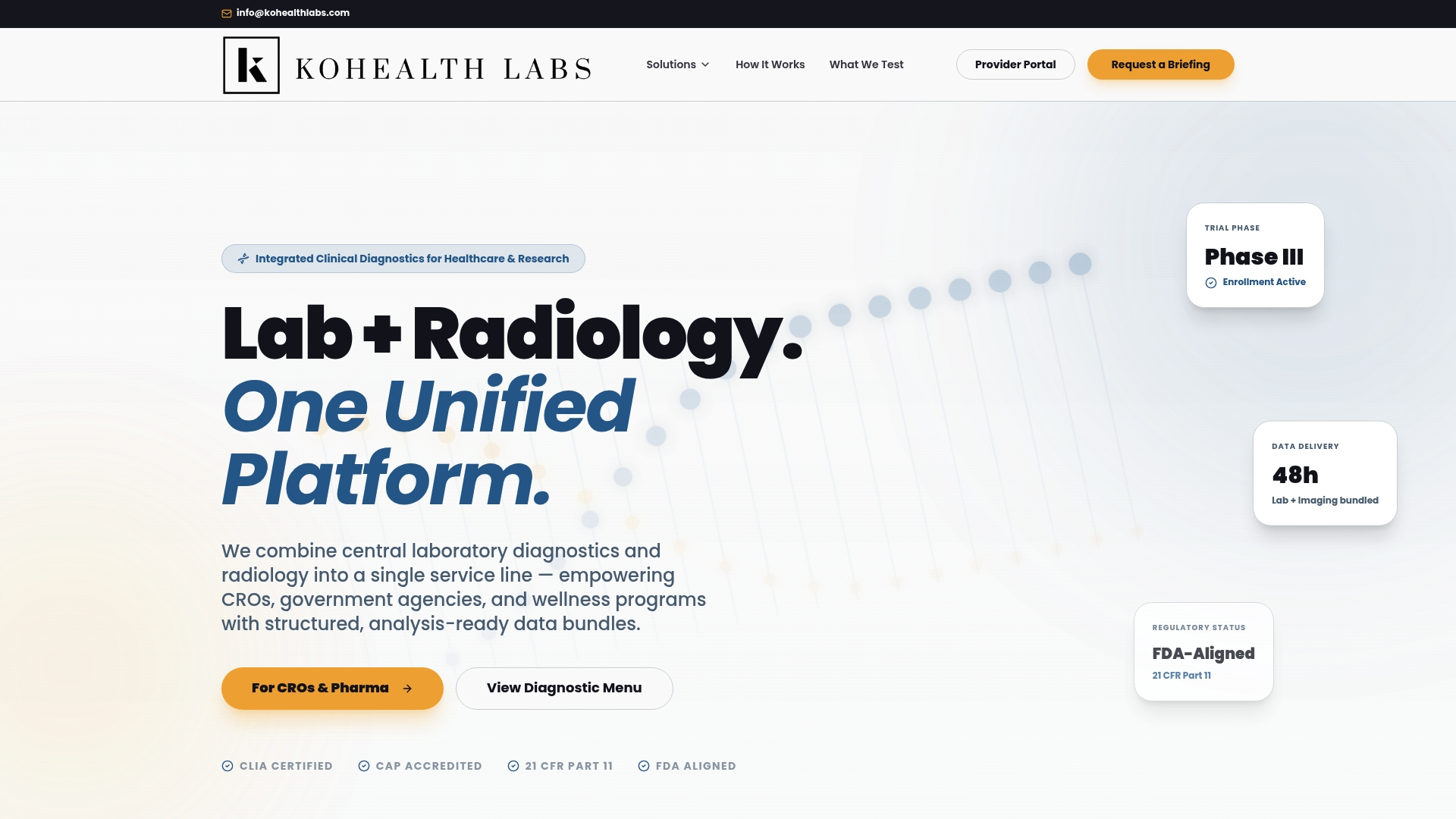
Kohealth Labs covers over 100 biomarkers and applies AI to flag data deviations before they become protocol violations. CROs, pharma sponsors, and specialty care teams use Kohealth Labs to reduce vendor complexity and accelerate trial timelines. Whether your program sits in oncology, cardiology, or rare diseases, integrated clinical diagnostics from Kohealth Labs give your team the data foundation to move faster and with greater confidence.
FAQ
What is therapeutic area diagnostic support?
Therapeutic area diagnostic support refers to diagnostic tools and tests developed specifically to assist in disease detection, treatment selection, and patient monitoring within a defined medical field such as oncology, cardiology, or neurology.
What is the difference between a biomarker test and a companion diagnostic?
A companion diagnostic is mandated by drug labeling and required for safe use of a specific therapy, while a general biomarker test is optional and used for risk assessment or monitoring without a regulatory tie to a specific drug.
Which therapeutic area has the most diagnostic support activity?
Oncology leads all therapeutic areas, representing 28% of clinical drug trials between 2018 and 2023, which drives the highest volume of companion diagnostic and biomarker test development.
How does payer coverage affect diagnostic adoption?
Payer coverage decisions depend on clinical efficacy data, cost-effectiveness, and inclusion in national clinical guidelines. A diagnostic with FDA clearance but no guideline inclusion frequently fails to achieve broad reimbursement.
How does integrated diagnostics accelerate clinical trials?
Integrated platforms that combine laboratory results, radiology reads, and biomarker data into a single workflow reduce vendor coordination time, minimize data reconciliation errors, and deliver analysis-ready datasets that speed regulatory submissions.