
AI healthcare diagnostics work best right now as a second reader, not a replacement for clinical judgment. Diagnostic errors affect more than 12 million Americans every year, with aggregate costs exceeding $100 billion, which is the real argument for adopting tools that have earned their evidence. The strongest signal you can demand from a vendor is prospective, externally validated performance data paired with a post-market monitoring plan, not a retrospective accuracy claim from a single site.
Before you pilot anything, do three things:
- Request the external validation dataset and the post-deployment monitoring plan, not just the headline accuracy number.
- Confirm the tool integrates with your labs, radiology system, and EHR through documented APIs or data bundles (integrators like Kohealth Labs handle this by design).
- Pick one narrow, measurable workflow, such as stroke triage or sepsis flagging, for the pilot instead of a hospital-wide rollout.
Key Takeaways
AI healthcare diagnostics deliver real value today when paired with external validation, human oversight, and integrated data infrastructure rather than deployed as standalone decision-makers.
| Point | Details |
|---|---|
| Demand external validation | Require multi-site validation and a post-market monitoring plan before any clinical pilot. |
| Match evidence to risk | Higher-stakes tools need prospective trials; screening triage tools can start with external validation. |
| Track drift quarterly | Set a fixed cadence for subgroup performance and drift checks, written into the vendor contract. |
| Integration speed matters | HL7/FHIR and DICOM compatibility often determine pilot timelines more than model accuracy does. |
| Kohealth Labs streamlines trial data | Its single-contract lab-and-radiology model with AI-checked data bundles cuts vendor handoff delays in clinical trials. |
Where AI Healthcare Diagnostics Are Actually Deployed Today
Radiology leads the field. AI models flag suspicious findings on CT, MRI, and CT angiography, and in stroke care they act as a first reader that speeds triage before a radiologist confirms the call. That stroke use case is one of the most promising real-world applications, though the review notes that outcome benefits still need real-world confirmation, not just controlled-study performance.
Digital pathology uses deep learning to flag suspicious tissue regions on whole-slide images, cutting the time a pathologist spends scanning low-yield fields. Dermatology tools triage lesion images for likely malignancy before a dermatologist reviews the case directly. In genomics, models prioritize candidate variants out of thousands of possibilities, narrowing what a geneticist has to interpret manually. EHR-based risk models flag early signs of sepsis or clinical deterioration, giving nurses and physicians a head start on intervention.
- Radiology: AI as first reader for high-volume screening, human confirms every positive.
- Pathology: pattern detection on digital slides, pathologist verifies diagnosis.
- Dermatology: image triage for referral prioritization, not standalone diagnosis.
- Genomics: variant ranking to focus expert review, not automated calling.
- EHR analytics: risk flagging for early intervention, clinician decides response.
Pro Tip: Ask any vendor whether their tool is positioned as a "first reader" or "decision support." The regulatory and liability expectations differ sharply between the two, and vendors sometimes blur the distinction in marketing copy.
Multimodal telehealth platforms are the newest entrant, combining images, vitals, and patient-reported symptoms in a single visit. You can see how that plays out in practice through real telehealth diagnostic examples.
How AI Models Actually Reach a Diagnostic Conclusion
Most systems fall into a handful of model families. Classical machine learning handles structured tabular data, like lab values feeding a risk score. Deep learning, particularly convolutional neural networks, dominates image-heavy tasks in radiology and pathology. Transformer-based language models parse clinical notes and support dialogue-style intake. Multimodal foundation models fuse images, lab results, and free-text notes into one reasoning pipeline, which tends to outperform single-modality tools on complex cases.
The frontier right now is agentic diagnostic systems: models that don't just classify an image but actively request more information, such as ordering a follow-up test, the way a resident would. Agentic architectures have shown reduced physician effort while holding accuracy steady across large case sets, but they still require a clinician able to intervene at any step.
- Classical ML: structured data, risk scoring, easiest to audit.
- Deep learning: image pattern recognition, harder to explain.
- Transformers: clinical text and dialogue, prone to hallucination without guardrails.
- Multimodal fusion: combines images, labs, and notes for higher accuracy.
- Agentic systems: manage multi-step workflows, need human override at every stage.
Pro Tip: Before adopting an agentic tool, ask whether it is state-aware (it tracks what's already been checked) and whether a clinician can take over mid-workflow without losing context. A system with no gating mechanism is a liability, not a convenience.
What Counts as Validated Evidence for a Diagnostic AI Tool
"Validated" gets used loosely in vendor decks. There's a real hierarchy, and where a tool sits on it should determine how much you trust its output.
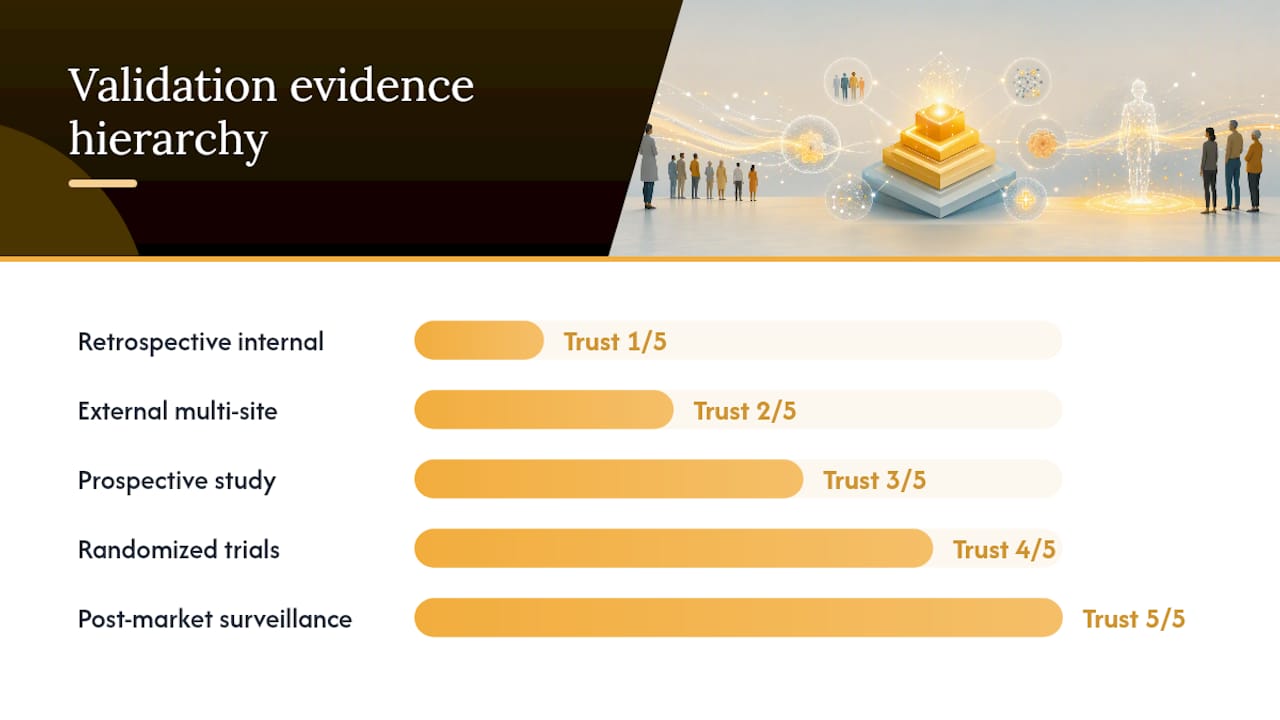
Retrospective internal validation, tested on the vendor's own historical data, is the weakest tier and should never be the sole basis for clinical use. External multi-site validation, tested on data the model never saw during training, is the practical minimum. Prospective studies, run on real patients in real time, are stronger still. Randomized or controlled implementation trials, comparing outcomes with and without the tool, are the gold standard. Post-market surveillance, tracking performance after deployment, closes the loop and catches drift before it causes harm.

| Evidence Tier | Minimum Threshold to Request |
|---|---|
| External validation | Tested on an independent dataset, not the training cohort |
| Prospective study | Real-time patient data, pre-registered endpoints |
| Sensitivity/specificity | Reported separately, not blended into one accuracy figure |
| Calibration | Reported calibration plot, not just AUC |
A narrative review of AI in health care, drawing on 44 studies pulled from an initial pool of nearly 8,800 articles, found AI can genuinely improve diagnostic accuracy and efficiency, but flagged persistent, unresolved concerns about bias, transparency, and privacy across the literature. Given that diagnostic errors already carry a $100 billion annual burden, that governance gap is exactly why rigorous validation matters more than a flashy demo.
- Ask for sensitivity and specificity separately, never a single blended "accuracy" number.
- Request AUC alongside a calibration plot; a model can have strong AUC and poor calibration.
- Ask for decision-curve analysis if the tool influences a treatment decision, not just a screening flag.
Weighing the Real Benefits Against the Real Risks
The measurable upside is genuine. Screening tools can shave meaningful time off diagnosis in high-volume settings, and repeat readings from AI tend to be more consistent than repeat readings from a fatigued human reader. Track speed-to-diagnosis, detection sensitivity on your specific screening task, and workload hours saved per FTE as concrete KPIs, not vague satisfaction scores.
The risks are equally concrete. Dataset bias shows up when a model trained on one demographic underperforms on another. Model drift happens when real-world data shifts away from training data over months, quietly eroding accuracy. Black-box explainability limits make it hard to say why a model flagged a case, which complicates both trust and liability. False positives cascade into unnecessary follow-up tests, and independent evaluations from groups like Stanford HAI confirm that standalone large language models still fall short of reliable stand-in diagnosticians.
- Dataset bias: test performance across demographic subgroups before go-live, not after.
- Model drift: re-validate quarterly at minimum, more often for high-volume screening tools.
- Explainability gaps: require interpretable outputs for any tool touching treatment decisions.
- Cascading false positives: measure downstream test rate, not just sensitivity.
Pro Tip: Set a bias-testing and drift-monitoring cadence in the contract, not as an informal promise. Quarterly subgroup performance reviews are a reasonable floor for any tool used on a diverse patient population.
Building an AI Diagnostic Pilot Into an Existing Workflow
Rolling out a diagnostic AI tool safely follows a fairly predictable sequence, and skipping steps is where most pilots stall.
- Align stakeholders: clinicians, IT, and data science need shared success metrics before anything gets deployed.
- Map your data: identify exactly which labs, imaging systems, and EHR fields the tool will draw from.
- Design a narrow pilot: one workflow, one patient population, clear before/after metrics.
- Train clinicians: cover both how the tool works and when to override it.
- Launch with monitoring active from day one, not bolted on after complaints surface.
- Iterate based on real performance data, adjusting thresholds or scope as needed.
Integration lives or dies on compatibility. HL7/FHIR standards for EHR data and DICOM for imaging are non-negotiable technical requirements, and API-based data bundles that deliver analysis-ready lab and imaging results cut weeks off a typical pilot timeline. A useful reference on this is how integrated diagnostics improve clinic efficiency.
- Expect 4 to 8 weeks for data mapping and integration testing before any patient-facing use.
- Budget 2 to 4 weeks for clinician training and workflow rehearsal.
- Plan your first performance review at 90 days post-launch, not at the one-year mark.
What Regulatory and Legal Documents You Should Review First
Before any clinical use, request the tool's FDA clearance status, whether it went through 510(k) or De Novo review, and the actual clearance summary rather than a marketing paraphrase of it. If the vendor operates internationally, ask for CE marking documentation too. None of this substitutes for asking about the post-market surveillance plan directly, since clearance covers a point in time, not ongoing performance.
On privacy, confirm HIPAA alignment, get a written data provenance statement, and ask specifically whether patient data used for model training carried informed consent or was properly de-identified. On liability, insist on a human-in-the-loop policy in writing, audit logs that trace every AI-influenced decision, and a defined incident-response service-level agreement.
- FDA clearance summary (510(k) or De Novo), not a marketing summary of it.
- HIPAA-aligned data handling with a written provenance statement.
- Human-in-the-loop policy with audit logs and a defined incident-response SLA.
A Procurement Checklist Before You Sign With Any AI Vendor
Ask these questions before committing budget, not after:
- What datasets were used for validation, and how many were external to the training set?
- How does the model detect and respond to drift once deployed?
- What explainability method does the model use, and can a clinician see it in real time?
- What data formats does it accept, and does that match your lab and imaging systems?
- Confirm ongoing AUC and sensitivity checks are reported on a fixed schedule post-deployment.
- Require subgroup performance breakdowns by demographic category, not an aggregate score.
- Track time-to-interpret as a workflow metric, not just diagnostic accuracy.
- Negotiate contract terms for data access, model versioning, rollback rights, and update governance before signing.
A tool for oncology trials needs a different subgroup breakdown than a general screening tool, so tailor these questions to your patient population rather than treating the checklist as generic.
How Integrated Diagnostics Speed Up Clinical Trials
Clinical trials lose weeks to vendor coordination alone: one contract for labs, another for imaging, a third for data cleanup before anything reaches a biostatistician. Combining labs, radiology, and AI-driven data quality checks under one contract removes that friction, which is the practical logic behind Kohealth Labs' model for CROs and sponsors.
- A single-contract model covering labs and radiology removes multi-vendor coordination delays.
- AI-driven checks flag data deviations early, speeding compliance review before submission.
- Analysis-ready bundles across more than 100 biomarkers reduce manual data cleanup for trial teams.
Trial timelines suffer less from any single vendor's slowness than from the handoffs between vendors. Removing a handoff removes a delay, every time.
Pro Tip: When evaluating a diagnostics partner for a trial, ask specifically how fast a data deviation gets flagged and routed back to the site. That turnaround, not the raw biomarker panel size, is usually what determines your actual timeline.
You can see the underlying model laid out directly in how unified diagnostics work in clinical research.
The case for evidence-first adoption
I think the industry's biggest mistake is treating AI diagnostic adoption as a technology decision when it's really a data infrastructure decision. A model is only as good as the labs, imaging, and records feeding it, which is why Kohealth Labs built its approach around unifying those pieces before AI ever touches the data, and why our onboarding and training work exists to make that integration safe from day one.
Get Your Trial Data Pipeline Validated Faster
Every step in this guide, external validation, workflow integration, monitoring cadence, depends on clean data arriving on time from your labs and imaging vendors. Kohealth Labs removes the multi-vendor bottleneck entirely: one contract covers phlebotomy, courier specimen pickup, radiology, and AI-checked, analysis-ready data bundles across more than 100 biomarkers, so your data science team spends time analyzing results instead of chasing down mismatched files.
If you're designing a trial protocol or evaluating a diagnostics partner for an upcoming study, review Kohealth Labs' clinical trial services or explore the AI-ready data bundle offerings to see how a single-contract integration model fits your specific therapeutic area and timeline.
Primary Sources for Further Reading
- GAO-23-106285: diagnostic error burden and cost data.
- Narrative review, PMC: AI benefits and risks across studies.
- npj Digital Medicine: stroke triage and the AI chasm.
- Nature Medicine: multimodal diagnostic reasoning trial.
- Stanford HAI: LLM diagnostic limitations.
Frequently Asked Questions
Is AI healthcare diagnostics ready to replace radiologists or pathologists? No. Current evidence supports AI as a first reader or decision-support tool, not a standalone replacement, and every major review to date calls for human verification.
What's the biggest evidence gap in AI healthcare diagnostics right now? Real-world outcome data. Many tools perform well in controlled studies but haven't proven the same benefit once deployed across the full AI chasm of routine clinical workflow.
How does integrated diagnostics data improve clinical trial speed? Combining labs, radiology, and AI-checked data under one vendor contract removes the handoff delays that typically stall trial timelines between separate diagnostic vendors.
What should clinicians ask before adopting a new diagnostic AI tool? Request external validation results, subgroup performance data, the drift-monitoring plan, and documentation of FDA clearance status before any patient-facing use.
This article is general information, not a substitute for advice from a qualified doctor. Consult a qualified healthcare professional about your own circumstances before acting on anything here.
Sources
- U.S. Government Accountability Office report GAO-23-106285
- Benefits and Risks of AI in Health Care: Narrative Review - PMC
- Transforming diagnosis through artificial intelligence | npj Digital Medicine
- Advancing conversational diagnostic AI with multimodal reasoning | Nature Medicine
- Can AI Improve Medical Diagnostic Accuracy? | Stanford HAI