

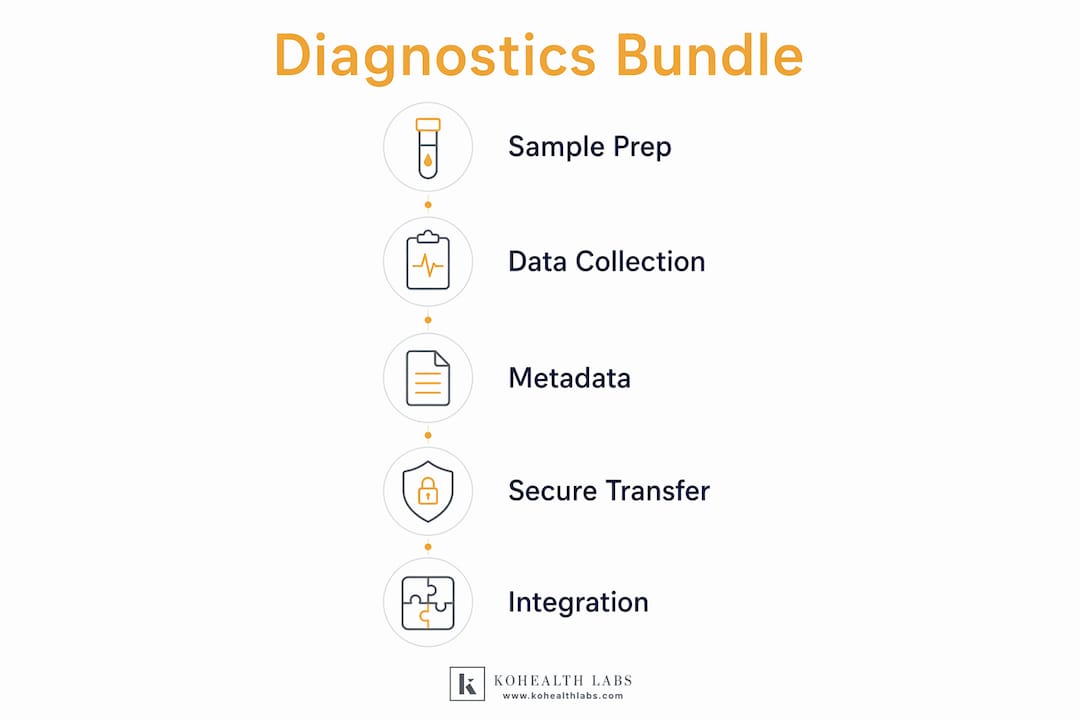
For biomarker-driven oncology trials, integrated diagnostics must deliver a single-contract, data-ready bundle combining molecular results (NGS, ctDNA), structured pathology reports, DICOM imaging, and harmonized metadata — all from a CLIA/CAP-accredited lab with HIPAA-compliant data pipelines. Anything less forces your team to reconcile formats, chase missing QC logs, and manage vendor escalations that eat directly into enrollment timelines.
The NCI's biomarker testing guidance makes clear that companion diagnostics and targeted therapies are inseparable: the right treatment selection depends entirely on the quality and completeness of the molecular data behind it. That dependency makes diagnostics a trial accelerant, not a support function.
Quick checklist for contracting teams:
- Single-contract scope covering labs, radiology, and data delivery
- Molecular deliverables: raw FASTQ/BAM/VCF files plus annotated variant calls
- Structured pathology synoptic reports with IHC scores
- DICOM imaging files paired with radiologist reports
- QC logs, chain-of-custody records, and sample-level metadata
- CLIA/CAP accreditation confirmed; HIPAA-compliant data transfer verified
- SLA turnaround times defined per assay type, with re-test obligations spelled out
What diagnostic modalities does your oncology trial actually need?
No single test diagnoses cancer or qualifies a patient for a biomarker-driven trial. Diagnosis typically combines lab tests, imaging, and biopsy with pathology reporting — and each modality produces distinct data artifacts your team must specify in the protocol.
Molecular and genomic modalities:
- Tissue NGS (targeted panels, whole-exome): Delivers raw FASTQ/BAM files, processed VCF with variant annotations, and a clinical interpretation report. CLIA/CAP accreditation required for results used in eligibility decisions.
- ctDNA / liquid biopsy: FDA-approved liquid biopsy tests exist for specific indications; liquid biopsy is particularly useful when tissue is insufficient or serial monitoring is needed. Deliverables include plasma-derived VCF and allele-frequency tables.
- Proteomics: Protein expression data from mass spectrometry or multiplex immunoassay; delivered as normalized intensity matrices with sample metadata.
Pathology and tissue-based modalities:
- IHC and digital pathology: Structured synoptic reports with H-scores or Allred scores, whole-slide images (WSI) in SVS or NDPI format, and tumor cellularity estimates.
- Cytology and bone marrow biopsy: Morphology reports with quantitative cell-count data.
Imaging:
- CT, MRI, and PET scans delivered as DICOM files paired with structured radiologist reports. Harmonized metadata (acquisition parameters, site ID, timepoint) is mandatory for multi-site trials.
When a result will gate patient eligibility or support a regulatory submission, the assay must be either an FDA-cleared IVD or a CLIA/CAP-validated lab-developed test (LDT). Know which category applies before you finalize the protocol.
Why integration shortens timelines and cuts screen-failure risk
Fragmented diagnostics create three specific failure modes: suboptimal tissue handling that invalidates NGS results, delayed pathology sign-out that stalls eligibility review, and inconsistent data formats that require manual reconciliation before the data can enter your EDC. Integration eliminates the handoffs responsible for each.

Multigene panels and liquid biopsies are now standard tools for matching patients to targeted therapies, but their value depends entirely on pre-analytic quality and structured data delivery. A result that arrives as a PDF narrative rather than a structured VCF with annotations requires manual abstraction — adding days and introducing transcription error. The benefits of unified diagnostics across lab and radiology functions are well-documented: fewer re-biopsies, faster eligibility decisions, and cleaner data at database lock.
Integration directly mitigates the main failure modes:
- Suboptimal tissue: Pre-analytic FFPE workflows with defined minimum tumor content thresholds prevent failed assays before they happen.
- Delayed pathology: Single-vendor accountability means pathology sign-out and molecular results move on the same SLA clock.
- Inconsistent formats: A unified data pipeline delivers all modalities in agreed schemas, so EDC ingestion is automatic rather than manual.
What must a data-ready diagnostics bundle contain?
A data-ready bundle is one your biostatistics team can ingest directly without reformatting or chasing missing fields. Specify these elements in your scope of work.
| Deliverable | Required format | Key metadata fields |
|---|---|---|
| Raw genomic files | FASTQ, BAM | Sample ID, collection date, preservation method |
| Processed variant calls | VCF with annotations | Tumor cellularity, coverage depth, QC pass/fail |
| Pathology report | Structured synoptic (CAP protocol) | IHC scores, tumor percentage, pathologist ID |
| Imaging files | DICOM | Site ID, acquisition parameters, timepoint |
| Radiology report | Structured PDF or HL7 | Lesion measurements, RECIST version |
| QC logs | CSV or JSON | Rejection reason, re-test flag, timestamp |
| Chain-of-custody record | Signed PDF or audit trail | Collection → accessioning → analysis timestamps |
Minimum schema fields to insist on: sample ID mapping to the trial subject ID, collection timestamp, preservation method (FFPE, fresh-frozen, plasma), tumor cellularity percentage, and pathology interpretation codes (SNOMED or ICD-O-3).
For data delivery, require S3 or secure SFTP with encryption at rest and in transit, plus HL7/FHIR-compatible metadata pointers for EDC integration. Define completeness thresholds in the SLA: a bundle missing QC logs or chain-of-custody records should trigger an automatic notification, not a manual discovery weeks later. Timely diagnostic data delivery is directly linked to enrollment speed and database lock timelines.
What SLA and contract terms protect your trial timelines?
Must-include SLA elements:
- Turnaround times by assay (e.g., NGS panel: 10–14 business days from accessioning; IHC: 5 business days; DICOM delivery: 48 hours post-scan)
- Sample rejection criteria and notification window (within 24 hours of accessioning)
- Re-test obligations: who bears cost, timeline for repeat analysis, and escalation path
- Penalty and remediation clauses tied to TAT breaches
- Change-control procedures for assay updates mid-trial
Regulatory requirements to confirm in writing:
- CLIA and CAP accreditation certificates, current and on file
- HIPAA Business Associate Agreement (BAA) executed before first sample transfer
- Clinical validation evidence for each assay used in eligibility decisions
- IVD vs. LDT classification documented for each test
Operational policies to specify:
- Cold-chain requirements for fresh tissue and plasma (temperature logs included in chain-of-custody)
- FFPE block and slide handling standards, including minimum viable tissue area
- Accessioning SLA from site receipt to lab entry
- Per-sample cost structure, repeat-testing fees, and shipping cost ownership
Pro Tip: Negotiate re-test and re-biopsy pathways before the trial starts, not after the first failure. Require the vendor to define, in the contract, the maximum number of re-tests covered under the base price and the turnaround commitment for each. This single clause prevents the most common source of unplanned timeline extensions.
How to specify diagnostics in your protocol and operational documents
Your protocol, SAP, and operational documents must leave no ambiguity about what the diagnostic partner is expected to deliver and when.
Sections to update:
- Eligibility criteria: Name the specific assay, required result threshold, and acceptable specimen types.
- Sampling schedule appendix: Define collection windows, specimen handling instructions, and shipment timelines per visit.
- Central lab section: List accreditation requirements, data formats, and TAT expectations.
- Data flow diagram: Show the path from site collection through the diagnostic partner to EDC ingestion and biostatistics.
Map each diagnostic output to a specific CRF field. For example, a VCF-derived variant call maps to a genomic eligibility CRF field; an IHC H-score maps to a biomarker CRF field. This mapping prevents the most common EDC ingestion failure: a result that arrives in a format the CRF was not designed to accept.
"Sponsors increasingly require data-ready bundles at submission. Advanced genomic profiling only delivers trial value when results are paired with structured pathology reporting and integrated into the protocol from day one." — NCI diagnostic guidance
Pro Tip: Include a specimen handling appendix with photographs of acceptable vs. unacceptable FFPE sections. Sites that receive visual standards reject far fewer samples than those working from text descriptions alone.
How AI and harmonization improve data quality across sites
AI-driven QC does not replace scientific review; it accelerates it by catching deviations before they reach the data manager's desk. Automated workflows flag outliers, harmonize vocabularies, and surface cross-site inconsistencies in hours rather than days.
Specific AI use cases in oncology diagnostics:
- Automated pathology QC: Flags slides with insufficient tumor area or staining artifacts before sign-out.
- DICOM harmonization: Normalizes acquisition parameters across scanner models and sites so imaging data is directly comparable.
- Variant annotation harmonization: Reconciles gene nomenclature and transcript versions across sequencing runs and sites.
- Deviation detection: Identifies TAT breaches, missing metadata fields, and chain-of-custody gaps in real time.
Kohealth Labs' AI-enabled data QA approach applies these workflows across all modalities in a single pipeline, so deviations surface at accessioning rather than at database lock. The AI and data integration capabilities behind this approach cover automated sample QC flagging, variant-calling concordance checks, and cross-modality harmonization routines.
How do you choose the right biomarker assay for your trial?
The right assay depends on your trial's objective, not on what is technically available.
Decision framework:
- Exploratory biomarker discovery: Broad NGS or whole-exome sequencing (WES) maximizes discovery potential but requires larger tissue volumes and longer TATs.
- Registration or label-linked programs: Use validated companion diagnostics or targeted panels with FDA clearance. Biomarker tests tied to specific therapies require companion diagnostic status for regulatory submissions.
- Serial monitoring: Liquid biopsy (ctDNA) is preferred when repeat tissue biopsy is impractical or when tracking treatment response over time.
Factors to weigh when selecting an assay:
- Clinical actionability of the biomarker in the target population
- Biomarker prevalence (affects screen-failure rate projections)
- Minimum tissue requirements and FFPE compatibility
- Assay sensitivity and specificity for the variant class of interest
- Turnaround time relative to enrollment windows
- Cost per sample, including repeat-testing scenarios
Robust pre-analytical FFPE workflows are non-negotiable for NGS success. Poor tissue handling is the most frequent cause of failed assays and avoidable re-biopsies. Define minimum tumor content (typically ≥20% viable tumor cells) and minimum DNA input requirements in your protocol before sites begin collecting.
Which KPIs should you track to measure diagnostics performance?
| KPI | Definition | Calculation | Target range |
|---|---|---|---|
| Assay TAT | Time from accessioning to result delivery | Result date minus accession date | Per-assay SLA (e.g., NGS: ≤14 business days) |
| Sample rejection rate | Percentage of samples failing QC at accessioning | Rejected samples ÷ total received × 100 | <5% |
| Screen-failure rate | Percentage of screened patients not randomized | Screen failures ÷ total screened × 100 | Trial-specific; track trend |
| Time-to-randomization | Days from first sample collection to randomization | Randomization date minus first collection date | Minimize; benchmark against prior studies |
| Data-ready bundle rate | Percentage of patients with complete bundles delivered on time | Complete bundles ÷ total patients × 100 | — |
| Assay concordance | Agreement rate between central and local lab results | Concordant results ÷ total paired results × 100 | — |
Faster data delivery directly reduces time-to-randomization and lowers the cost per enrolled patient. Track these KPIs monthly and require the diagnostic partner to report them in a standardized dashboard.
Your pre-contract checklist for evaluating a diagnostics partner
Confirm before signing:
- Single-contract scope covering labs, radiology, and data delivery
- SLA TATs defined per assay, with breach notification and remediation terms
- CLIA and CAP certificates current; HIPAA BAA ready to execute
- Data formats and API access (S3, SFTP, HL7/FHIR) confirmed
- Sample logistics policy: cold chain, FFPE handling, accessioning SLA
- Re-test policy: cost, timeline, and escalation path documented
- Audit rights: sponsor and CRO access to QC logs and chain-of-custody records
Vendor questions for RFPs and due diligence calls:
- What are your per-assay TAT commitments, and what remediation applies to breaches?
- How do you handle sample rejection — what is your notification window and re-collection process?
- What data formats do you deliver, and do you support HL7/FHIR or direct EDC API integration?
- How do you harmonize results across multiple trial sites using different scanners or sequencers?
- What AI or automated QC tools do you use, and at what point in the workflow do they flag deviations?
- Can you provide CLIA/CAP certificates and a sample HIPAA BAA for review?
- What is your change-control process if an assay is updated mid-trial?
Pro Tip: Negotiate pilot-phase acceptance criteria before full deployment. Define the minimum data-ready bundle rate, TAT compliance rate, and sample rejection rate the vendor must hit during a 30-day pilot before you commit to full-trial volume. This gives you an objective off-ramp if performance falls short.
Kohealth Labs in practice: single-contract integrated diagnostics
Kohealth Labs delivers labs, radiology, and data as a single contracted service for CROs and pharma sponsors, with a unified diagnostics model designed to eliminate the vendor coordination that delays enrollment.
Under this model, a sponsor receives one contract, one SLA, and one escalation path covering NGS panels, IHC, DICOM imaging, and structured data delivery. AI-enabled QC runs across all modalities, flagging deviations at accessioning rather than at database lock. The result is a measurable reduction in sample rejection rates, TAT variability, and the manual data reconciliation that typically precedes EDC lock.
Kohealth Labs covers a broad portfolio of biomarkers, with CLIA/CAP accreditation and HIPAA-compliant data pipelines as standard.
Pro Tip: Ask Kohealth Labs for a sample data-ready bundle from a prior trial. Reviewing the actual file structure, metadata completeness, and QC log format before contracting is the fastest way to confirm the delivery matches what your EDC team needs.
Key Takeaways
Integrated oncology diagnostics, specified correctly in the protocol and contracted under a single-vendor model, directly reduce screen-failure rates, TAT variability, and the data rework that delays enrollment and database lock.
| Point | Details |
|---|---|
| Require data-ready bundles | Specify FASTQ/BAM/VCF, structured pathology reports, DICOM, QC logs, and chain-of-custody in every scope of work. |
| Insist on accreditation and APIs | CLIA/CAP certificates and HL7/FHIR-compatible data delivery are non-negotiable for regulatory-grade results. |
| Define SLAs for TAT and re-tests | Per-assay turnaround commitments and documented re-test obligations prevent the most common source of timeline extensions. |
| Track six core KPIs | Monitor assay TAT, sample rejection rate, screen-failure rate, time-to-randomization, data-ready bundle rate, and assay concordance monthly. |
| Kohealth Labs as integrated partner | Kohealth Labs delivers labs, radiology, and data under a single contract with AI-enabled QC and a 100+ biomarker panel. |
The case for treating diagnostics as a trial design decision
The most consistent mistake in oncology trial planning is treating diagnostics as a procurement afterthought — something to finalize after the protocol is locked. By the time the protocol is written, the assay choice, data format requirements, and sample handling standards should already be decided. Retrofitting them creates the ambiguity that drives screen failures and re-biopsies.
Under-specifying FFPE requirements is the single most avoidable source of NGS failure. Sites that receive clear minimum tissue standards — tumor cellularity thresholds, block age limits, fixation time windows — submit usable samples at a materially higher rate than those working from vague language. The practical recommendation: write the specimen handling appendix before you write the eligibility criteria, not after.
Kohealth Labs: one contract for labs, radiology, and data
Clinical trials move faster when diagnostics are treated as a single integrated service rather than a collection of separate vendor relationships. Kohealth Labs gives CROs and pharma sponsors exactly that: one contract covering laboratory testing, radiology, and analysis-ready data delivery, with AI-driven QC built in and more than 100 biomarkers covered.
If your team is scoping diagnostics for an upcoming oncology trial, Kohealth Labs can provide a sample data bundle, a draft SLA framework, and a pilot-phase proposal. Visit Kohealth Labs' clinical trials solutions page to request a consultation or download the specialty testing datasheet.
Authoritative references and regulatory resources
These primary sources support the clinical and regulatory claims in this article. Each is a direct reference for trial teams conducting further due diligence.
- Biomarker Testing for Cancer Treatment — NCI: Covers companion diagnostics, targeted therapy selection, and the role of liquid biopsy in oncology.
- Tests and Procedures Used to Diagnose Cancer — NCI: Describes the full diagnostic workflow, structured pathology reporting, and protocol integration requirements for NGS.
- Cancer Diagnosis and Treatment — Mayo Clinic: Clinical overview of imaging modalities, DICOM standards, and radiology report requirements.
- Biomarker and Tumor Marker Tests — American Cancer Society: Explains genomic profiling, panel tests, and liquid biopsy use cases across tumor types.
- TruSight Oncology Comprehensive — Illumina: Technical guidance on FFPE pre-analytic requirements, minimum tissue thresholds, and NGS failure modes.