

Regulatory hurdles, decentralized procurement, communication gaps, staffing shortages, and procedural bottlenecks are the primary drivers of common delays in academic trial diagnostics, and they routinely push study start-up timelines well beyond what sponsors initially plan for. Site activation commonly takes several months or longer at many sites, and a substantial portion of sites report that activation timelines have grown longer compared to two years prior. Academic settings compound these problems because they lack the plug-and-play diagnostic infrastructure that industry trials typically rely on, forcing site teams to verify assays, calibrate equipment, and negotiate contracts largely from scratch at every study.
The core delay categories trial managers need to account for:
- Regulatory and IRB/ethics review delays, including submission backlogs and infrequent committee meetings
- Contract and budget negotiation slowdowns, often the single largest barrier to site initiation
- Decentralized procurement failures, leading to reagent shortages and sample analysis bottlenecks
- Staffing and resource constraints, more acute in academic settings than in industry-sponsored trials
- Communication breakdowns between sponsors, CROs, sites, and patients
- Late delivery of protocol-adjacent documents such as CRF templates and lab manuals
- Equipment calibration and maintenance gaps at local institutional labs
- Data management and reporting lags that stall diagnostic workflows
- Training and qualification delays for diagnostic personnel
Each of these categories is addressable. The sections below break down the causes and what you can do about them.
What drives study start-up delays in academic clinical trials?
Academic trials face a structurally harder start-up environment than industry-sponsored studies, and the gap shows up clearly in the data.
Regulatory and IRB review hurdles
Six distinct drivers contribute to regulatory delays in global randomized trials: disparate regulations, submission delays, additional post-approval requirements, reliance on local ethics committees, infrequent IRB meetings, and regulatory backlogs. Academic trials bear a disproportionate share of these because they often lack the dedicated regulatory affairs staff that industry sponsors maintain. In the JOGH survey, 70% of academic research institution respondents cited communication and correspondence with IRBs and competent authorities as a primary submission hurdle, compared to 33% for industry-sponsored trials.
Infrequent committee meetings alone can add weeks to a timeline that was already tight. When a minor document error surfaces after initial submission, the site may wait for the next scheduled meeting before resubmission is even possible.
Contract and budget negotiation bottlenecks
Budget negotiations are a major barrier to site initiation, with 72% of sites citing budget negotiations as the leading obstacle to site initiation. In one global trial, contract execution could take several months, with 66% of sites reporting such contract and budget negotiation delays occur 'often' or 'always'. Academic institutions typically have smaller legal and contracting teams, less experience with sponsor templates, and limited authority to deviate from institutional boilerplate, all of which extend cycle times.
Patient recruitment and screening bottlenecks
Academic trials report insufficient personnel resources at a rate of 60%, and recruitment problems affect 60% of academic studies. Narrow eligibility criteria, common in trials requiring advanced diagnostics, generate high pre-screening failure rates that delay the diagnostic workflow from the start. When a site cannot enroll participants at the projected pace, the entire diagnostic pipeline, including sample collection schedules and lab capacity planning, has to be recalibrated.
Protocol complexity and advanced diagnostic requirements
Trials that require multi-biomarker panels, specialized imaging, or novel assays add verification steps that simply do not exist in standard-of-care workflows. Each new diagnostic method needs site-level validation before it can be used on study samples, and academic labs often run these validations with limited technical staff. The result is a compounding effect: complex protocols take longer to approve, longer to set up, and longer to run.
Key drivers at a glance:
- IRB communication failures and infrequent meeting schedules
- Inexperienced contracting staff and rigid institutional templates
- High pre-screening failure rates from narrow eligibility criteria
- Multi-step assay verification requirements at each academic site
- Financial constraints forcing sequential rather than parallel start-up activities
What operational obstacles slow down academic trial diagnostics specifically?
The diagnostic layer of an academic trial carries its own set of obstacles that go beyond general start-up friction. These are problems specific to how labs and imaging services are organized, supplied, and maintained in academic settings.
Decentralized procurement and reagent shortages
Academic trials face decentralized procurement challenges that cause reagent shortages and sample analysis bottlenecks, unlike industry trials that typically operate through central laboratory partnerships. Each academic site procures independently, which means supply disruptions at one site do not trigger a coordinated response across the study. Buffer stocks are rarely maintained because academic labs operate on tight budgets, and emergency supplier relationships are usually nonexistent before a shortage actually occurs.

Late delivery of protocol-adjacent documents
CRF templates and lab manuals arrive an average of 5.8 weeks late, and in some cases the delay stretches to 20 weeks. Sites receive critical documents in a timely manner less than 60% of the time. Lab manuals, in particular, are prerequisites for method verification and staff training, so a late manual does not just delay one task. It delays everything downstream.
Equipment calibration and maintenance gaps
Academic institutional labs often share equipment across multiple research programs. Calibration schedules are set by institutional policy rather than trial-specific requirements, and maintenance windows are not coordinated with study timelines. When a centrifuge or analyzer goes out of service during a critical sample collection window, the site has limited options for rapid repair or replacement. Proficiency testing requirements add another layer: staff must demonstrate competency on study-specific equipment before processing trial samples, and scheduling those assessments takes time.
Pro Tip: Build a reagent and supply buffer plan into your site qualification checklist. Identify at least one emergency supplier for every critical reagent before the study opens, and document the contact in the site's lab manual. This single step prevents the most common procurement-driven sample analysis delays.
Operational obstacles summarized:
- Independent procurement at each site with no coordinated shortage response
- Lab and pharmacy manuals arriving weeks after sites need them for training
- Shared equipment with calibration schedules misaligned to trial timelines
- Proficiency testing requirements that cannot begin until equipment is qualified
- No centralized visibility into which sites are running low on critical supplies
How do communication gaps and staffing shortages delay diagnostic trials?
Human factors account for a larger share of diagnostic delays than most trial managers expect. The systems and processes are often adequate on paper; the breakdowns happen between people.
Sponsor and CRO communication failures
47% of sites rate sponsor and CRO communication as average or poor on start-up timeliness. When sites cannot get clear answers about protocol questions or escalate contracting issues to a named sponsor contact, momentum stalls. CRO-managed negotiations require active sponsor oversight; without it, weeks can pass while an email sits in the wrong inbox. Lack of visibility into what is stuck in the activation queue is a problem for 24% of organizations, and manual workflows make it worse.

Staffing shortages at academic institutions
Academic sites run leaner than industry sites. The same coordinator managing regulatory submissions may also be handling patient scheduling, data entry, and lab logistics. When a key staff member leaves or goes on leave, there is rarely a trained backup, and the gap can take months to fill at an academic institution with slow hiring processes. Insufficient personnel resources affect 60% of academic trials.
Patient communication and retention during delays
Participants with progressive diseases experience measurable dissatisfaction when communication is not transparent or collaborative, and that dissatisfaction translates directly into dropout rates. Involving patient advocacy organizations in communication planning is a professional best practice that most academic trial teams underuse. When patients understand why a diagnostic step is delayed and what is being done about it, retention holds up far better.
Communication and staffing delay drivers:
- No named sponsor escalation contact for site contracting issues
- Manual workflows with no real-time visibility into activation status
- Single-person coverage for multiple start-up functions at academic sites
- Slow institutional hiring processes when staff vacancies occur
- Insufficient patient communication during diagnostic delays
What are the most effective strategies for improving trial diagnostics start-up?
Addressing delays in academic trial diagnostics requires a combination of structural changes and practical operational fixes. No single intervention solves the problem, but the following approaches consistently reduce timelines.
Centralize and harmonize diagnostics where possible
Centralizing diagnostic services under a single contract eliminates the redundant verification work that each site would otherwise perform independently. When all sites use the same analytical platform and the same reference ranges, data from site A and site B are directly comparable without additional harmonization steps. Consolidated diagnostics also give sponsors real-time visibility into sample status across the entire study, which is the single most effective way to catch a bottleneck before it becomes a delay.
Integrate lab and radiology services under one agreement
Separating laboratory and imaging services into different vendor agreements creates coordination overhead that compounds at every study milestone. When a patient's lab results and imaging data need to be reviewed together for an eligibility decision, two separate turnaround timelines become the bottleneck. Integrated platforms that cover both services under one contract reduce that friction and produce analysis-ready data bundles rather than raw outputs that site teams have to reconcile manually.
Use AI-enhanced quality control to catch errors early
AI-driven quality control identifies data deviations at the point of entry rather than during monitoring visits. Catching a sample labeling error or a reference range discrepancy in real time prevents the downstream cascade: query generation, site response, data correction, and re-monitoring. For academic sites with limited data management staff, this kind of automated oversight is especially valuable because it reduces the burden on coordinators while improving data integrity.
Build procurement resilience before the study opens
Procurement planning should happen during site qualification, not after the first shortage. Identify critical reagents, confirm supplier lead times, and establish buffer stock levels as part of the site initiation checklist. For multi-site diagnostic research, a shared procurement framework across sites prevents the situation where one site is overstocked while another is waiting on a backorder.
Deliver protocol-adjacent documents on a fixed schedule
Lab manuals, CRF templates, and pharmacy manuals should be delivered to sites at least four weeks before the planned site initiation visit. Late delivery of protocol-adjacent documents averages 5.8 weeks, and in some cases the delay stretches to 20 weeks. Sponsors who maintain a document readiness tracker and assign ownership to specific team members consistently outperform those who treat document delivery as an afterthought.
Pro Tip: When evaluating unified diagnostic platforms, ask specifically whether the platform produces analysis-ready data bundles or raw outputs. The difference determines whether your data management team spends hours reconciling files or minutes reviewing a clean report.
Best practices at a glance:
- Centralize diagnostics under one contract to eliminate redundant site-level verification
- Integrate lab and radiology services to remove inter-vendor coordination delays
- Deploy AI quality control to catch errors at the point of data entry
- Build buffer stock and emergency supplier plans into site qualification
- Deliver lab manuals and CRF templates at least four weeks before site initiation
- Assign named escalation contacts for contracting and protocol questions
- Involve patient advocacy organizations in communication planning from day one
How Kohealth Labs addresses diagnostic delays in academic trials
Kohealth Labs was built specifically to address the inefficiencies that slow academic and CRO-managed trial diagnostics. The platform integrates laboratory services and radiology under a single contract, which removes the vendor coordination overhead that typically adds weeks to site activation. Rather than managing separate agreements with a central lab, an imaging provider, and a data management vendor, trial teams work with one point of contact and receive analysis-ready data bundles that are ready for review without additional reconciliation.
The AI layer in the Kohealth Labs platform monitors data quality continuously, flagging deviations and compliance issues as they occur rather than surfacing them during a monitoring visit. This is particularly valuable for academic sites where data management staff are stretched thin. The platform covers over 100 biomarkers, which means it can support the multi-panel diagnostic requirements that are common in complex academic protocols without requiring site-level assay verification for each individual test.
| Metric | Pre-integration (typical academic site) | Post-integration (Kohealth Labs) |
|---|---|---|
| Vendor agreements per study | — | 1 unified contract |
| Data reconciliation time | Manual, hours per data point | Automated, minutes per bundle |
| Error detection timing | Monitoring visit (weeks later) | Real-time AI flagging |
| Biomarker panel coverage | Limited by site lab capacity | 100+ biomarkers, centralized |
| Sample turnaround visibility | Site-level only | Cross-site, real-time |
Kohealth Labs' single-contract model and AI-driven quality control directly target the two most time-consuming diagnostic bottlenecks in academic trials: vendor coordination and late error detection.
Kohealth Labs partners with leading research stakeholders and CROs, which means the platform is already familiar to many of the regulatory and operational teams you work with. For trial managers who have spent months managing reagent shortages, late lab manuals, and data reconciliation backlogs, the shift to a unified diagnostic model produces measurable time savings at every stage of the study.
How data management and reporting delays affect diagnostic workflows
Data management delays are often invisible until they become critical. A sample arrives at the lab on schedule, the analysis runs correctly, but the result sits in a queue waiting for manual entry, format conversion, or a query resolution before it reaches the clinical database. At that point, the diagnostic process has technically completed, but the trial cannot act on the result.
Academic sites are particularly exposed to this problem because data management is rarely a dedicated function. Coordinators who handle data entry are also managing patient scheduling, regulatory binders, and lab logistics. When query volumes spike, data entry falls behind, and the lag between sample analysis and reportable result can stretch from days to weeks.
Reporting delays compound the problem at the study level. When individual site data arrives on inconsistent schedules, the sponsor cannot perform interim analyses on time, safety monitoring committees cannot meet on schedule, and protocol amendments triggered by interim findings are delayed. For diagnostic-heavy protocols where interim biomarker data drives dosing decisions, a reporting lag is not just an administrative inconvenience. It directly affects patient safety oversight.
Structured data management plans, assigned query turnaround targets, and electronic data capture systems with built-in validation rules reduce these lags. Sites that use integrated diagnostics that produce pre-formatted, validation-ready outputs eliminate the manual entry step entirely for a large share of their data points.
Why training and qualification delays for diagnostic personnel slow trials down
Training delays are one of the most underestimated sources of diagnostic process obstacles in academic trials. Before a site coordinator or lab technician can process a study sample, they must complete protocol-specific training, demonstrate competency on study equipment, and in many cases receive certification from the sponsor or central lab. Each of these steps has a prerequisite: the training materials must exist, the equipment must be qualified, and a qualified trainer must be available.
In academic settings, these prerequisites rarely align cleanly. Lab manuals arrive late, as noted earlier, which means training cannot begin on schedule. Equipment qualification depends on calibration records that may not be current. Trainers from the sponsor or CRO have competing site visit schedules, and academic sites are often lower on the priority list than larger commercial sites.
The downstream effect is that sites are technically open but not operationally ready. A site that has IRB approval and a signed contract but unqualified diagnostic staff cannot enroll participants, because the first diagnostic procedure cannot be performed. This gap between regulatory readiness and operational readiness is one of the most common sources of activation delays that clinical research professionals report in 2026.
Addressing this requires treating training as a parallel workstream, not a sequential one. Training materials should be finalized and distributed at the same time as the protocol, not after. Remote training options, including video-based competency assessments, reduce the dependency on in-person trainer availability and let sites complete qualification steps on their own schedule. For clinical pathology services that require specialized technique training, pre-recorded demonstrations reviewed by a qualified assessor are a practical alternative to on-site visits.
Kohealth Labs cuts through diagnostic delays for academic trials
Trial managers who have worked through the delays described in this article know how quickly a six-week start-up estimate becomes a six-month reality. Kohealth Labs offers a direct path to faster activation by replacing the fragmented vendor model with a single, integrated diagnostic service that covers labs, radiology, and data in one agreement.
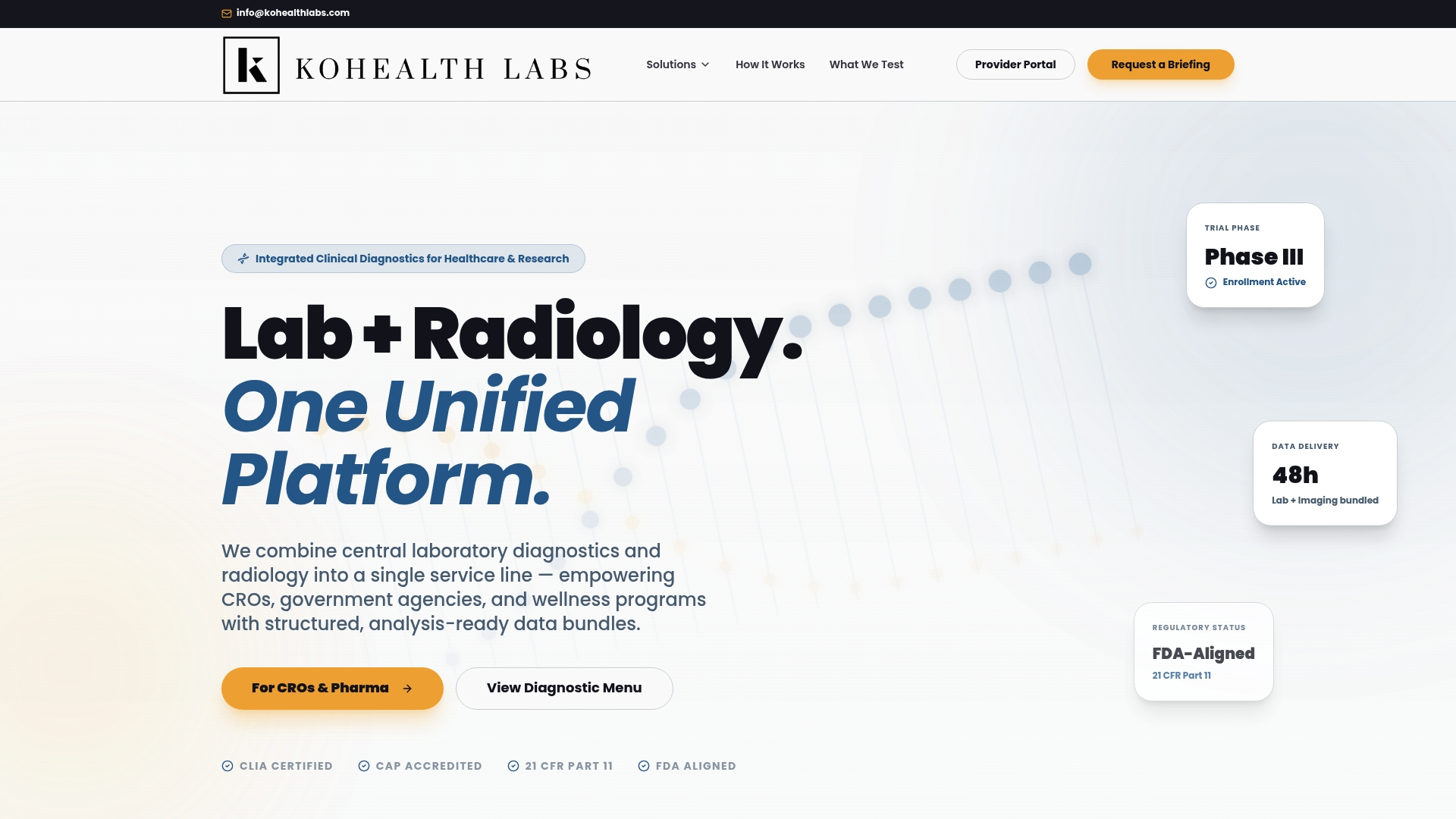
The practical difference for your team: no separate lab manual from one vendor and imaging protocol from another, no manual reconciliation of outputs in different formats, and no waiting for a monitoring visit to find out that a data entry error occurred three weeks ago. Kohealth Labs' AI-driven quality control catches deviations in real time, and the platform's 100-plus biomarker coverage means most academic protocol requirements are met without site-level assay development.
If your trial is in start-up or you are planning a diagnostic-heavy academic study, explore Kohealth Labs' clinical trial services to see how the integrated model applies to your protocol. The team works directly with CROs, government agencies, and academic research institutions across the United States.
Key Takeaways
Regulatory, procurement, staffing, and communication failures collectively account for the majority of delays in academic trial diagnostics, and each one is addressable with the right operational structure.
| Point | Details |
|---|---|
| Contract delays are the top barrier | 72% of sites cite budget negotiations as the leading obstacle to site initiation. |
| Document delivery drives downstream delays | Lab manuals and CRF templates arrive an average of 5.8 weeks late, blocking training and method verification. |
| Staffing gaps hit academic sites hardest | 60% of academic trials report insufficient personnel resources, 10 points above industry-sponsored studies. |
| Communication failures are measurable | 47% of sites rate sponsor and CRO communication as average or poor on start-up timeliness. |
| Kohealth Labs unifies diagnostics under one contract | The platform integrates lab, radiology, and AI quality control to reduce vendor coordination delays and catch errors in real time. |