

Polyclinic diagnostic service models fall into three primary archetypes defined by NHS England: standard, large, and hub-and-spoke. Beyond those structural forms, academic research identifies seven community-based organizational models that reflect the full operational diversity of outpatient diagnostic delivery, from specialist nurse-led clinics to telediagnosis services. For healthcare administrators and policymakers planning 2024–2026 reforms in the United States, understanding where each model fits, what it costs in complexity, and what it delivers in clinical value is the starting point for any serious system redesign.
The core classification breaks down as follows:
- Standard Community Diagnostic Centre (CDC): Provides a defined minimum set of diagnostic tests on a permanent, single-site basis, with optional outpatient consultations.
- Large CDC: Meets all standard requirements and adds endoscopy, ophthalmology, audiology, or other locally prioritized services at scale, often with multiple imaging units.
- Hub-and-spoke CDC: A standard or large hub anchors a network of approved spoke sites, each offering at least one core imaging modality plus two additional minimum tests.
- Community outreach from secondary care: Specialists or diagnostic equipment travel from hospitals to community settings on a scheduled basis.
- General Practitioners with Special Interests (GPwSI): GPs trained to perform specific tests, such as spirometry or minor procedures, within their existing practice.
- Specialist Nurse-led and Advanced Practitioner-led Services: Dedicated nurse practitioners or advanced clinicians manage condition-specific or test-specific diagnostic pathways.
- Mobile diagnostic services: Equipment-equipped units deliver imaging or testing directly to GP surgeries or community venues.
- Shared consortium services: Primary care federations or GP networks pool resources to offer diagnostics across member practices.
- Telediagnosis: Secondary care specialists interpret results or provide diagnostic advice remotely, without a physical patient visit.
Policy experts Edwards and Sheiman argue that the most effective reform path transforms polyclinics into centers of outpatient diagnostic and specialty services that operate as structural units within hospital systems, rather than as administratively independent entities. That framing shapes how each model below should be evaluated.
Types of polyclinic diagnostic service models: a detailed comparison
1. Standard Community Diagnostic Centre
The standard CDC is the baseline model in the NHS England framework, and it translates directly to the kind of freestanding outpatient diagnostic facility that US health systems are increasingly building outside hospital campuses. It provides a defined minimum test list on a permanent, single-site basis. That list typically covers radiography, ultrasound, spirometry, and electrocardiography, with outpatient consultations layered in as needed.
What makes this model work is its permanence and predictability. Patients know where to go, staff develop site-specific expertise, and administrators can track utilization against a fixed cost base. The tradeoff is limited scope. A standard CDC cannot absorb demand for endoscopy or complex imaging without upgrading to the large model.
For US health systems designing community-based outpatient facilities, the standard CDC offers a replicable template. It is well-suited to mid-sized markets where a single anchor site can serve a defined catchment population without requiring the capital investment of a full hospital outpatient department.
2. Large Community Diagnostic Centre
The large CDC builds on the standard model by adding endoscopy, ophthalmology, audiology, health checks, and screening services at scale. Critically, scalability is a design requirement, not an afterthought. A large CDC may operate multiple CT or MRI scanners to maintain throughput, and it is expected to absorb locally prioritized services that the standard model cannot accommodate.
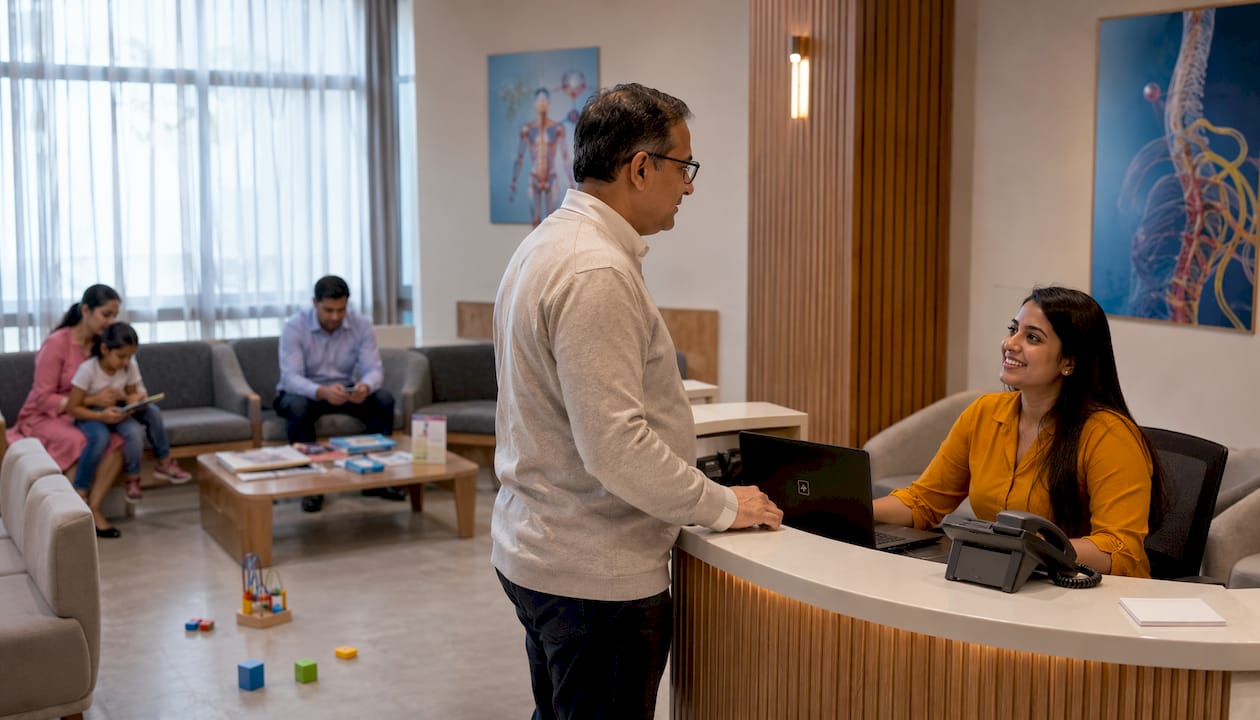
From an administrator's perspective, the large CDC is the right choice when your catchment population generates enough volume to justify the capital and staffing overhead. The efficiency gains from co-locating multiple high-demand modalities on one site are real, but they only materialize when governance keeps pace with physical capacity. Equipment centralization without aligned administrative structures creates bottlenecks rather than savings.
Community diagnostic services at this scale can deliver blood tests, plain film X-rays, ultrasound, echocardiography, upper endoscopy, and mobile MRI from a single location. That breadth reduces the number of referral steps a patient navigates, which directly affects completion rates for diagnostic pathways.
3. Hub-and-spoke Community Diagnostic Centre
The hub-and-spoke model is the most architecturally complex of the three CDC archetypes, and it is the one most relevant to US health systems managing geographically dispersed populations. The central hub is a standard or large CDC. Each spoke is an approved facility in a community, commercial, or non-acute healthcare setting. Every spoke must offer at least one core imaging modality (CT, MRI, X-ray, or ultrasound) plus at least two additional tests from the minimum CDC list.

The clinical logic is sound: bring routine diagnostics closer to where patients live while reserving the hub for complex or high-volume procedures. The operational challenge is data. Interoperability across spokes is not optional. Fragmented records across spoke sites delay care and undermine the continuity that makes the model worth building in the first place. Technical infrastructure and governance must be designed together, not sequentially.
For US policymakers, the hub-and-spoke structure maps well onto existing accountable care organization (ACO) frameworks, where a hospital or large outpatient center anchors a network of affiliated community clinics. The difference is that a true hub-and-spoke CDC requires formal reporting standards and defined activity tracking at every spoke, not just a loose affiliation agreement.
Pro Tip: When designing a hub-and-spoke network, specify data reporting requirements for each spoke site before signing any facility agreements. Retrofitting interoperability standards after launch is significantly more expensive than building them in from the start.
4. Community outreach from secondary care
Community outreach moves the diagnostic service to the patient rather than moving the patient to the service. A hospital-based specialist or a mobile diagnostic unit visits GP surgeries, community health centers, or other local venues on a scheduled basis. This model works well for populations with transportation barriers or for tests that require specialist interpretation but not a full facility.
The limitation is scheduling rigidity. Outreach services depend on the availability of secondary care staff, and any disruption at the hospital level cascades directly into community access. For US health systems with strong specialist shortages in rural or underserved areas, outreach can fill gaps, but it should not be treated as a permanent substitute for a fixed community diagnostic presence.
5. General Practitioners with Special Interests (GPwSI)
The GPwSI model trains primary care physicians to perform specific diagnostic tests or manage particular conditions beyond the scope of standard GP practice. A GPwSI in respiratory medicine might conduct and interpret spirometry in-house. A GPwSI in dermatology might perform dermoscopy. The result is a diagnostic capability embedded directly in the primary care encounter, without a separate referral step.
This model reduces referral volume to secondary care and shortens the patient pathway considerably. The constraint is workforce. Training a GP to a GPwSI standard requires time and ongoing supervision, and the model depends on that individual remaining in the practice. For US administrators, the closest analog is the physician with added qualifications who performs in-office procedures, a model already common in family medicine and internal medicine practices.
6. Specialist Nurse-led and Advanced Practitioner-led services
Specialist nurses and advanced practitioners can own entire diagnostic pathways for specific conditions or tests. A nurse practitioner dedicated to diabetes management might run HbA1c testing, foot assessments, and retinal screening within a single clinic visit. An advanced practitioner in respiratory care might manage spirometry, FeNO testing, and initial interpretation without physician involvement at every step.
Dedicated trained personnel are not just a staffing convenience in this model. They are the quality control mechanism. Underestimating the overhead of maintaining equipment, managing compliance, and ensuring consistent test quality is one of the most common failure points in nurse-led diagnostic services. When that overhead is properly resourced, the model delivers strong continuity of care for defined patient populations.
For US health systems, nurse practitioner-led diagnostic services align well with existing scope-of-practice frameworks in states with full practice authority. They are particularly effective in federally qualified health centers (FQHCs) and rural health clinics where physician availability is limited.
7. Mobile diagnostic services
Mobile units bring specific imaging technologies, such as MRI, mammography, or ultrasound, directly to GP surgeries or community venues. The model is especially effective for screening programs where reaching a defined population matters more than providing a full diagnostic suite. A mobile mammography unit visiting a rural community once a month can meaningfully increase screening uptake without requiring a permanent facility.
The operational tradeoffs are real. Mobile services require vehicle maintenance, scheduling coordination, and staff who can work in non-clinical environments. Quality control is harder to maintain when equipment moves between sites. For US administrators, mobile diagnostics work best as a complement to fixed facilities rather than a replacement, particularly for time-sensitive screening programs where geographic reach is the primary constraint.
8. Shared consortium services
Primary care federations or GP networks pool diagnostic resources across member practices, sharing equipment, staff, and scheduling infrastructure. A consortium of ten practices might jointly fund a point-of-care testing coordinator who rotates across sites, or share a single ultrasound machine with a structured booking system.
The financial logic is straightforward: individual practices that cannot justify the cost of a dedicated diagnostic service can access one collectively. The governance challenge is proportional to the number of partners. Decision-making slows as the consortium grows, and cost-sharing agreements require careful design to avoid free-rider problems. For US health systems, this model maps onto independent practice association (IPA) structures or shared services arrangements within larger medical groups.
9. Telediagnosis services
Telediagnosis separates the point of test administration from the point of specialist interpretation. A GP practice or community clinic collects the sample or image locally. A secondary care specialist reviews and reports remotely. Radiology teleradiology services are the most established example in the US, but the model extends to pathology, cardiology (remote ECG interpretation), and dermatology (teledermatology).
Telehealth-integrated diagnostics have expanded rapidly since 2020, and the infrastructure now exists to support reliable remote interpretation across most diagnostic modalities. The model reduces the need for specialist presence in community settings while maintaining access to specialist-level diagnostic quality. The risk is communication latency: when a result requires urgent follow-up, the distance between the interpreting specialist and the treating clinician must be bridged by clear, fast communication protocols.
| Model | Scale and capacity | Outpatient integration | Diagnostic modalities | Advantages | Limitations |
|---|---|---|---|---|---|
| Standard CDC | Single site, defined minimum test list | High, with outpatient consultations | Radiography, ultrasound, spirometry, ECG | Predictable, replicable, cost-controlled | Limited scope, cannot absorb complex demand |
| Large CDC | Multi-unit, high volume | High, with specialty services | All standard plus endoscopy, ophthalmology, audiology | Broad scope, scale efficiency | High capital cost, governance complexity |
| Hub-and-spoke CDC | Multi-site network | Moderate to high, requires interoperability | Core imaging at spokes, full suite at hub | Geographic reach, flexible capacity | Data fragmentation risk, infrastructure overhead |
| Community outreach | Variable, schedule-dependent | Low to moderate | Specialist-specific tests | Reaches underserved populations | Scheduling fragility, not a permanent solution |
| GPwSI | Single practice, limited volume | Very high, embedded in primary care | Test-specific (spirometry, dermoscopy) | Reduces referrals, fast patient pathway | Workforce-dependent, training overhead |
| Specialist nurse-led | Condition-specific, moderate volume | High, pathway-embedded | Condition-specific panels | Strong continuity, cost-effective | Requires dedicated staffing and compliance oversight |
| Mobile services | Variable, route-dependent | Low | Single modality (MRI, mammography) | Geographic access, screening reach | Quality control challenges, scheduling complexity |
| Shared consortium | Network-wide, shared capacity | Moderate | Shared equipment, rotating staff | Cost-sharing, accessible for small practices | Governance complexity, slower decision-making |
| Telediagnosis | Unlimited geographic reach | Moderate, depends on communication protocols | Radiology, pathology, cardiology, dermatology | Specialist access without travel | Communication latency, follow-up coordination risk |
What should guide your choice of diagnostic service model?
Organizational implications of polyclinic reform
The structural question behind every model choice is whether your diagnostic services sit inside or outside the hospital administrative structure. Edwards and Sheiman make the case clearly:
That principle applies directly to US reform contexts. Polyclinics or large outpatient centers that operate as administratively independent entities tend to develop siloed workflows. When diagnostic services are structurally integrated with hospital specialty care, referral pathways shorten, data flows more reliably, and clinical oversight improves. The polyclinic reform challenge is not primarily a technology problem. It is a governance problem.
Comparative effectiveness across models
Diagnostic service design that prioritizes clinical utility over raw volume consistently produces better patient outcomes. A standalone diagnostic unit optimized for throughput will process more tests per day than a pathway-embedded service, but the pathway-embedded service produces more completed diagnostic episodes. The distinction matters when you are measuring health outcomes rather than activity counts.
The hub-and-spoke model scores well on geographic access and capacity flexibility, but only when interoperability is solved. Standard and large CDCs score well on quality and governance, but they require sufficient population density to justify fixed costs. Nurse-led and GPwSI models score well on continuity and patient experience, but they are workforce-constrained. No single model dominates across all dimensions, which is why most mature health systems use a combination.
Technology infrastructure and data management
Every model above generates diagnostic data that must flow reliably to the treating clinician. The technical requirements differ by model, but the governance principle is the same: data interoperability is not a feature to add later. It is a foundational design requirement.
Key infrastructure considerations by model type:
- Hub-and-spoke networks require a shared electronic health record (EHR) or a defined integration layer that aggregates spoke-level data at the hub without creating duplicate records.
- Telediagnosis services require secure image transmission, standardized reporting formats (HL7 FHIR or DICOM for imaging), and defined turnaround time agreements.
- Mobile services require offline data capture capability and reliable sync protocols for sites with limited connectivity.
- Nurse-led and GPwSI services require point-of-care device integration with the practice EHR, including automatic result upload and audit trail generation.
Centralized diagnostics that combine laboratory, radiology, and data analytics on a single platform reduce the integration burden significantly. When data from multiple modalities flows into one system, administrators gain a complete picture of diagnostic activity without manually reconciling outputs from separate vendors.
Staffing and training requirements
Each model carries distinct workforce demands, and underestimating them is one of the most common reasons diagnostic service expansions underperform.
- Standard and large CDCs require radiographers, sonographers, physiologists, and phlebotomists on a permanent basis, with clear supervision structures and competency frameworks.
- Hub-and-spoke networks require staff who can work across multiple sites and maintain consistent quality without constant on-site supervision.
- Nurse-led services require advanced practitioners with formal competency sign-off for each test they perform, plus a named clinical supervisor for governance purposes.
- Mobile services require staff trained to set up, calibrate, and quality-check equipment in non-clinical environments, a skill set that is distinct from standard clinical training.
- Telediagnosis requires radiologists, pathologists, or other specialists with remote reporting experience and familiarity with the legal and liability frameworks governing remote interpretation in their state.
Funding and reimbursement models add another layer of complexity. In the US, Medicare and Medicaid reimbursement rates for outpatient diagnostic services vary by setting, with hospital outpatient department (HOPD) rates generally higher than ambulatory surgical center (ASC) or freestanding clinic rates. Administrators designing new diagnostic service models need to map their chosen model to the applicable reimbursement category before committing to a facility or staffing structure.
Patient access and equity considerations
The model you choose determines who can realistically use your diagnostic services. A large CDC in an urban center serves the population within reasonable travel distance. A hub-and-spoke network can extend that reach, but only if spoke sites are located where underserved populations actually live, not just where real estate is available. Mobile services can reach populations that fixed facilities cannot, but they require sustained funding and scheduling discipline to deliver consistent access rather than sporadic visits.
Outpatient diagnostic service design that does not explicitly account for transportation, language access, and appointment availability will systematically underserve the populations that need diagnostics most. Equity is not a secondary consideration in model selection. It is a primary design constraint.
How integrated diagnostics are changing what polyclinics can deliver
The case for unified diagnostic platforms
Up to one-third of medical errors in the US are linked to diagnostic mistakes. Integrated diagnostic models address that risk directly by combining laboratory analysis, radiology, and clinical data analytics within a single operational framework. When a clinician can access lab results, imaging reports, and biomarker trends from one platform, the likelihood of a missed finding or a delayed diagnosis drops.
Rapid in-house diagnostics take this further. Test results available in 10–30 minutes change the clinical encounter entirely. A patient presenting with chest pain does not wait two days for a troponin result. A patient with suspected respiratory infection gets a point-of-care panel before leaving the clinic. That speed reduces patient loss to follow-up and supports timely treatment decisions in urgent and primary care settings.
The benefits of integrated diagnostic platforms in polyclinic and outpatient settings include:
- Consolidated data from laboratory, radiology, and physiological testing in a single record
- AI-driven quality control that flags deviations before results are reported
- Faster turnaround times that support same-day clinical decision-making
- Reduced vendor management overhead through single-contract arrangements
- Improved compliance tracking across multiple diagnostic modalities
- Biomarker coverage that supports both routine care and clinical research protocols
How Kohealth Labs supports integrated diagnostic delivery
Kohealth Labs addresses the vendor fragmentation problem that affects most multi-modal diagnostic programs. By combining laboratory services with radiology under a single contract, Kohealth Labs gives clinical research organizations (CROs), government agencies, and wellness programs access to analysis-ready data bundles without the coordination overhead of managing separate providers.
The AI-driven quality control layer is particularly relevant for polyclinic administrators managing high diagnostic volumes. Automated deviation detection catches data quality issues before they reach the reporting stage, which reduces the rework burden on clinical staff and supports faster trial completions. For organizations running clinical trials alongside routine outpatient care, that integration between clinical trial diagnostics and standard laboratory workflows is a direct operational advantage.
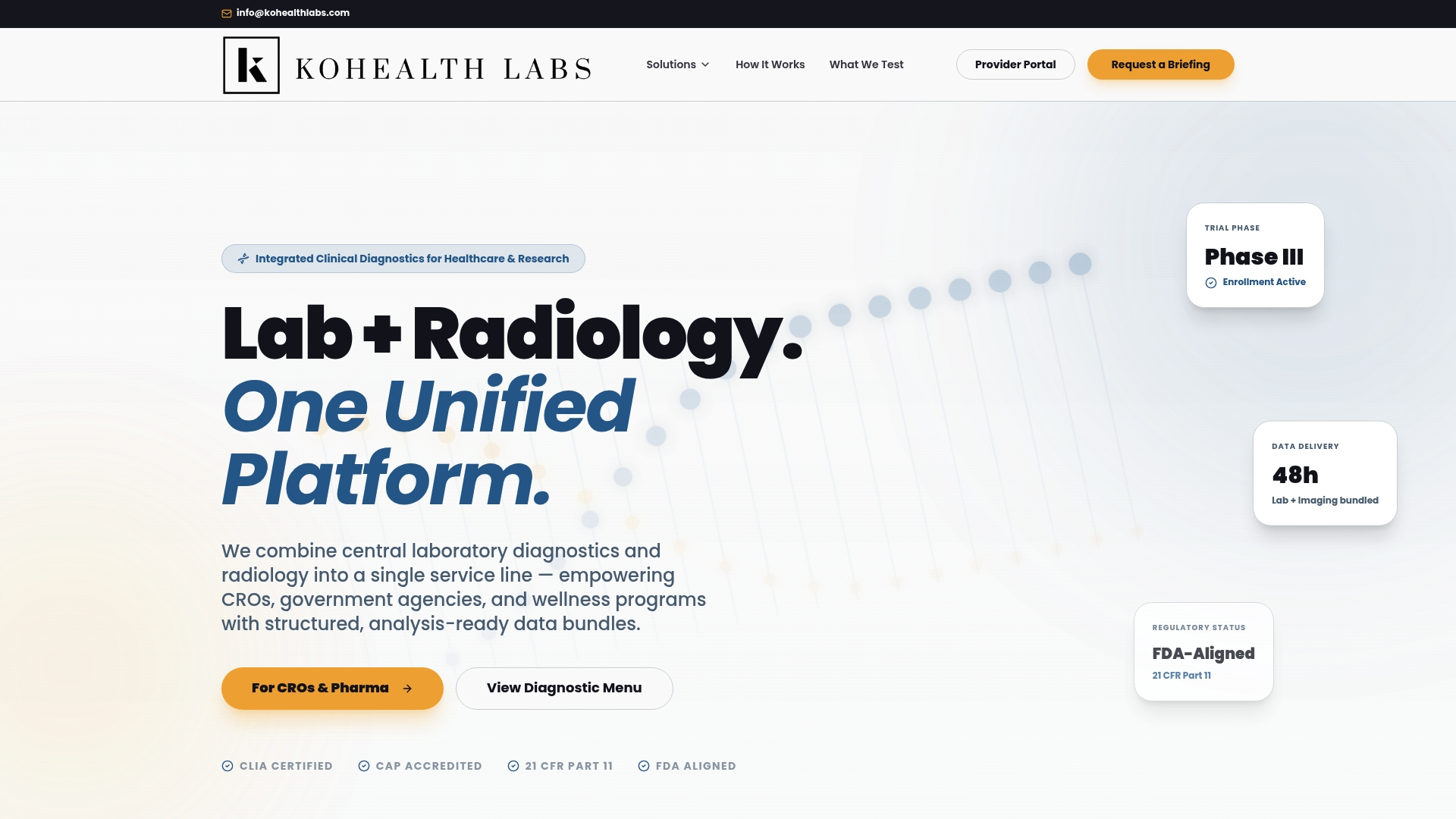
Kohealth Labs covers over 100 biomarkers through its analytics platform, supporting everything from routine metabolic panels to complex specialty testing. For polyclinic administrators evaluating diagnostic consolidation, that breadth means fewer gaps in coverage and fewer situations where a patient needs to be sent elsewhere for a test the facility cannot perform. You can explore the full scope of Kohealth Labs' integrated diagnostic solutions to see how a unified platform fits your specific outpatient or research context.
Workflow acceleration as a design principle
Workflow acceleration is not just a technology benefit. It is a design principle that should shape how you configure any diagnostic service model. When test results arrive in 10–30 minutes rather than 24–48 hours, clinical workflows reorganize around that speed. Clinicians can make treatment decisions during the same encounter. Patients leave with a plan rather than instructions to wait for a call. Administrative staff spend less time chasing results and more time managing patient flow.
Integrated diagnostics improving clinic efficiency is not a theoretical benefit. It shows up in reduced patient leakage, higher completion rates for diagnostic pathways, and better utilization of specialist time. For polyclinic administrators, the question is not whether to integrate diagnostics, but which integration model fits your current infrastructure and patient population.
Key Takeaways
Polyclinic diagnostic service models range from single-site standard CDCs to multi-model integrated platforms, and the right choice depends on population size, geographic reach, and governance capacity.
| Point | Details |
|---|---|
| Three core CDC archetypes | Standard, large, and hub-and-spoke models define the primary structural options for community diagnostic delivery. |
| Seven organizational models | Academic research identifies community outreach, GPwSI, nurse-led, mobile, consortium, and telediagnosis as distinct service types alongside CDCs. |
| Governance drives outcomes | Centralizing equipment without aligning administrative structures creates bottlenecks that negate scale benefits. |
| Speed changes clinical decisions | Rapid diagnostics delivering results in 10–30 minutes support same-day treatment decisions and reduce patient loss to follow-up. |
| Integration reduces diagnostic errors | Up to one-third of US medical errors are linked to diagnostic mistakes, making unified lab and radiology platforms a direct patient safety tool. |