

For clinical trials, healthcare diagnostics means integrated laboratory and radiology services that deliver AI-cleaned, analysis-ready data bundles aligned to SDTM and FHIR under one contract. The single action that reduces trial risk fastest: write an integrated diagnostics requirement into your statement of work and begin partner selection during protocol design, not after first patient in.
Waiting until sites are activated to line up lab and imaging vendors separately almost always means retroactive data cleaning later. Kohealth Labs, for instance, builds analysis-ready bundles across 100+ biomarkers with born-standardized outputs, so mapping happens before delivery instead of after.
- Definition: one contract covering labs plus radiology, delivered as SDTM/FHIR-aligned, AI-cleaned datasets
- Action: add the integration requirement to your SOW during protocol design
- Named capability to look for: 100+ biomarker coverage with API delivery of analysis-ready bundles
Key Takeaways
Integrated lab and radiology diagnostics succeed when data arrives born-standardized under one contract, because retroactive mapping is slower and more error-prone than mapping done at the source.
| Point | Details |
|---|---|
| Define the requirement early | Add an integrated diagnostics clause to the SOW during protocol design, not after site activation. |
| Demand analysis-ready bundles | Require SDTM/FHIR sample outputs, mapping logs, and provenance metadata before signing. |
| Evaluate fusion architecture | Ask vendors whether they use early, mid, or late fusion and request cross-center validation evidence. |
| Negotiate SLAs in writing | Set turnaround time, delivery windows, and error rates as contract terms, not verbal promises. |
| Consider a single-contract model | Kohealth Labs bundles lab, radiology, and AI-driven harmonization across 100+ biomarkers under one contract. |
Why Combine Lab and Radiology Data Into One Diagnostics Service?
Lab results and radiology images measure different things. Labs give you quantitative, time-series signals like biomarker trajectories. Radiology gives you spatial, anatomical detail. Neither tells the full story alone, and a review of PET/MRI fused with liquid biopsy data found that combining molecular and spatial views produces a more complete picture of tumor biology than either modality captures independently, though the authors note that standardized multimodal datasets are still catching up to the promise.
That complementarity has measurable teeth. A review of 43 studies on multimodal prognostic models found that combining clinical, molecular, and imaging data improved cancer prognosis prediction accuracy by roughly 20 to 25 percent compared with single-modality approaches in many reported cases.
Statistic: Cross-modal fusion models that combine imaging and lab time-series data have reported accuracy gains up to 95.3% on benchmark datasets, while cutting model parameters by roughly 44 percent versus baseline approaches. That efficiency matters when a sponsor needs fast, reproducible outputs, not just accurate ones.
The operational case is just as strong as the clinical one.
- One contract means one point of accountability instead of reconciling three vendor timelines
- Fewer handoffs mean fewer transcription and mapping errors before database lock
- SDTM/FHIR-ready delivery shortens the runway to a submission-ready dataset
Pro Tip: Contract for analysis-ready bundles, not raw files. Ask vendors to define exactly what "analysis-ready" means in their delivery, including mapping logs and provenance metadata, before you sign.
What Should You Require From an Integrated Diagnostics Partner?
Procurement teams evaluating vendors need a short list that separates genuine capability from marketing language. Start with these non-negotiables:
- Automated SDTM mapping with documented accuracy, not manual-only processes
- Native FHIR output alongside DICOM and annotated radiomics exports for imaging
- API delivery of analysis-ready bundles, including provenance and validation reports
- End-to-end traceability from specimen collection through final dataset
- HIPAA-aligned security controls and a documented audit trail
During RFP review, push vendors on specifics rather than accepting broad claims.
- Ask for sample SDTM and FHIR outputs from a comparable past study
- Ask for historical turnaround times and sample failure rates, not projections
- Ask how onboarding time scales with trial size and number of sites
- Ask what happens operationally when a specimen or scan fails QC
A few answers should raise concern immediately. Vendors unwilling to share real mapping examples, those relying entirely on manual data wrangling, or those without a clear plan for scaling from a Phase I pilot to a multi-site Phase III study are telling you something important about their limits. Our oncology diagnostics checklist walks through therapeutic-area-specific requirements in more depth.
On service levels, request benchmarks in writing: turnaround time from specimen receipt to reported result, the data delivery window for analysis-ready bundles, and an acceptable error or reprocessing rate. Negotiate penalties or credits tied to missed windows rather than accepting vague "best effort" language.
How Does Multimodal Data Fusion Actually Work?
Vendors talk about "fusion" loosely, so it helps to know what is actually happening under the hood. Three architectural approaches dominate: early fusion combines raw data at the input level, mid fusion combines extracted features from each modality before a shared model processes them, and late fusion runs separate models per modality and combines their decisions at the end. Mid fusion is the most common in trial settings because it balances information sharing against the reality that paired imaging and lab data are still scarce.
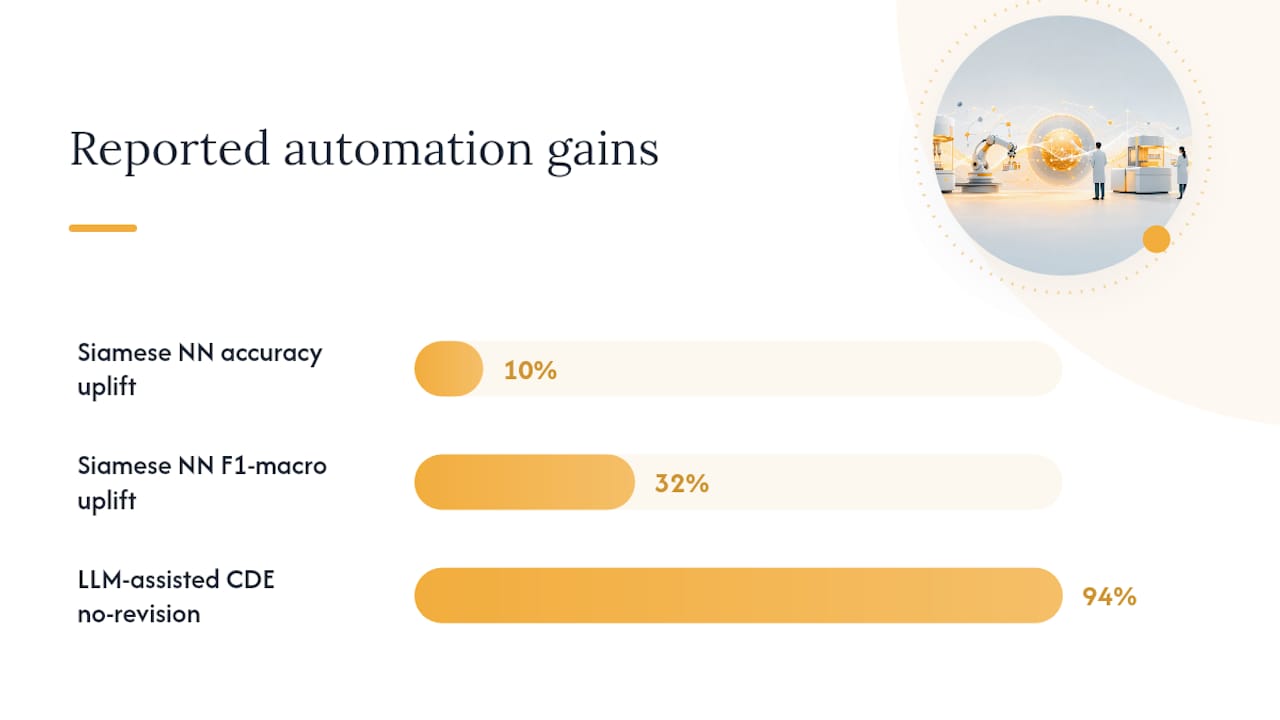
Mapping automation is where AI earns its keep. Siamese neural networks generate embeddings from eCRF metadata that improve automated mapping of EDC fields to SDTM, with one evaluation reporting a 10 percent accuracy uplift and a 32 percent improvement in F1-macro score over prior methods. Large language models paired with retrieval-augmented generation and vector search tools like FAISS take a different approach: they map data dictionaries to FHIR resources using zero-shot or few-shot techniques, cutting manual mapping time dramatically. A related approach using LLM-assisted CDE generation reported that 94% of generated metadata fields required no revision after subject-matter expert review across 31 datasets.
For imaging, radiomics pipelines extract quantitative features from scans, which then get concatenated with lab time-series encodings or fused through a transformer architecture. Explainability tools such as SHAP quantify how much each modality contributes to a given prediction, which matters when a clinical reviewer needs to trust a model's output rather than accept it on faith.
- Early fusion: simplest, but sensitive to missing or misaligned data
- Mid fusion: most practical for trials with partial data overlap
- Late fusion: robust when modalities have very different data quality
- XAI outputs (SHAP or similar) should be requested as standard deliverables
Pro Tip: Ask architects at your prospective vendor for cross-center validation evidence, not just single-site accuracy numbers. A model that only works on the data it was trained on will not survive a multi-country trial.
What Are Typical Timelines and Cost Drivers for Integrated Diagnostics?
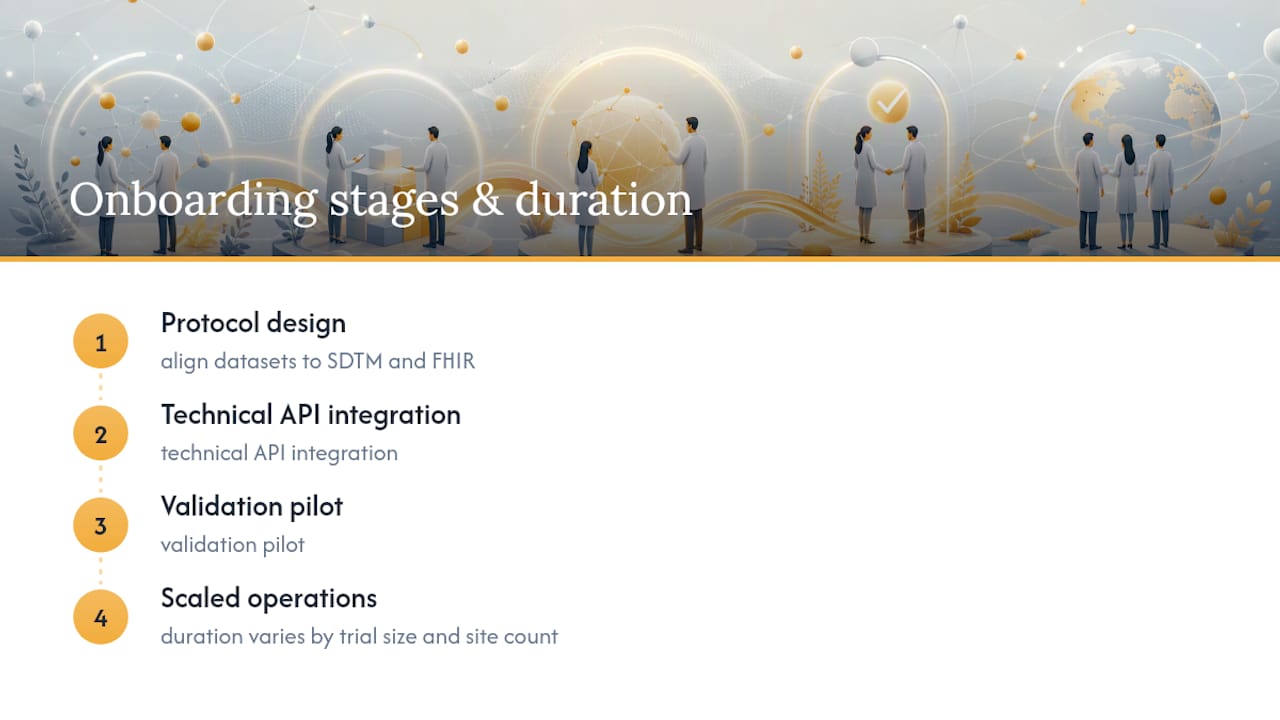
Onboarding an integrated diagnostics partner typically moves through four phases: protocol and SOW design, technical integration of APIs and EMR connections, a validation pilot on a representative dataset, and finally scaled run-time operations across sites. Each phase needs its own sign-off before moving to the next; skipping the pilot phase is the most common reason mapping errors surface late.
Cost drivers cluster around five areas.
- Assay complexity: broad biomarker panels cost more than single-analyte tests
- Imaging modality: PET and MRI reads carry higher complexity than routine CT
- Logistics: phlebotomy coverage and courier specimen pickup cadence
- Data mapping effort: automated pipelines cost less over time than manual curation
- Validation: pilot testing and acceptance criteria review add upfront fees
Bundling lab and radiology under one contract tends to save money once a trial spans multiple sites, because per-vendor coordination costs compound with scale. For single-site Phase I work, the savings are smaller but the reduced administrative burden still counts. Negotiate acceptance testing criteria and SLA penalties before signing, not after the first delivery misses a window. Our guide on timely diagnostic data delivery benchmarks typical turnaround expectations by trial phase.
How Has an Integrated Model Reduced Trial Burden in Practice?
A multi-site oncology trial that previously juggled separate lab, imaging, and data-mapping vendors moved to a single-contract model and reported fewer reconciliation cycles between data delivery and database lock.
- Centralized phlebotomy replaced three regional lab relationships with one scheduling system
- DICOM ingestion and lab results arrived through the same API, already mapped to SDTM
- AI-driven QC flagged specimen and scan deviations before they reached the biostatistics team
The clearest signal of success wasn't a single metric. It was the absence of the usual friction: no more chasing three vendors for a missing field, no late-stage discovery that imaging metadata didn't match the lab timestamps.
Sponsors evaluating a similar shift should look at our unified diagnostics overview for a fuller picture of how the mechanics translate across therapeutic areas.
What Should Trial Leaders Prioritize First?
Prioritize born-standardized data over convenience. Ask any prospective partner for real SDTM and FHIR sample outputs before you sign, not after the pilot fails. Validate a small paired imaging-and-lab dataset early. Triangulate every vendor claim against actual mapping logs and historical pilot results. Confidence built on a vendor's word alone is not confidence.
How Kohealth Labs Supports Integrated Diagnostics Procurement
Kohealth Labs is built around a single premise: sponsors and CROs shouldn't have to manage three vendors to get one dataset. Instead of separate contracts for labs, imaging, and data harmonization, you get one contract, one delivery pipeline, and analysis-ready outputs from day one.
What that looks like in practice: single-contract lab and radiology services, AI-driven data harmonization mapped to SDTM and FHIR, analysis-ready bundles delivered through API or direct EMR integration, phlebotomy and courier specimen pickup, and dedicated onboarding support for regulatory-aligned delivery. Coverage spans over 100 biomarkers alongside imaging and genomics panels, with AI-based QC flagging deviations before they reach your data team.
- Single-contract lab and radiology delivery
- AI-driven SDTM/FHIR harmonization and QC
- Analysis-ready bundles via API or EMR integration
- Phlebotomy, courier logistics, and onboarding support
If you're drafting an RFP or SOW for an upcoming study, request a pilot or view sample SDTM/FHIR outputs at KoHealthLabs to see how the mapping and delivery process works before you commit a full trial to it.
Where to Learn More About Diagnostics Standards and Fusion Methods
For technical due diligence, review the primary sources behind the mapping and fusion claims vendors will cite during procurement.
- Automated SDTM mapping using Siamese networks
- LLM and RAG-based FHIR mapping research
- PET/MRI and liquid biopsy multimodal fusion review
- Cross-modal fusion model performance benchmarks
- AI-assisted data standardization for interoperability
- Healthcare data integration practices for CROs
- KoHealthLabs integrated diagnostics platform
Frequently Asked Questions
What does "healthcare diagnostics" mean in a clinical trial contract? It refers to integrated laboratory testing and radiology imaging delivered together as AI-cleaned, analysis-ready datasets aligned to standards like SDTM and FHIR, typically under a single vendor contract rather than separate lab and imaging agreements.
Why does combining lab and imaging data matter more than using each separately? Labs capture quantitative, time-series biomarker data while radiology captures spatial and anatomical detail. Fusing the two gives a more complete view of disease progression and treatment response than either modality alone, particularly in oncology trials.
How long does onboarding an integrated diagnostics partner usually take? Onboarding typically moves through protocol design, technical API integration, a validation pilot, and scaled operations. Duration varies by trial size and site count, so request a phase-by-phase timeline during procurement rather than a single estimate.
What should be included in an integrated diagnostics RFP? Require sample SDTM and FHIR outputs, documented turnaround times and failure rates, a clear onboarding timeline, evidence of cross-center model validation, and specific SLA terms for data delivery windows and error rates.
Does a single-contract model actually reduce costs? Bundled contracts tend to reduce costs and administrative burden most clearly in multi-site trials, where coordinating separate lab and imaging vendors compounds delays. For smaller single-site studies, the time savings often matter more than the direct cost difference.